<meta name="google-site-verification" content="0S72xkYcSqqt100ZuIzn_Zif1zL8vIvcXUmc5Tjo10o" />


En résumé ? La peur de manquer (FOMO) piège les investisseurs dans des choix émotionnels, mais la certitude du rizq divin offre une paix durable. En plongeant dans la spiritualité musulmane, chaque acte financier devient un acte de foi, aligné avec les principes éthiques. Une étude d’OpenEdition révèle que 78% des décisions irréfléchies en finance découlent de comparaisons sociales stériles, soulignant l’importance de cette approche apaisante.
La peur de manquer (FOMO) vous ronge-t-elle en voyant les réussites financières des autres sur les réseaux sociaux ? Ce stress psychologique, alimenté par la comparaison toxique et la course effrénée au gain rapide, cache une illusion moderne : croire que le bonheur et la sécurité résident dans l’accumulation matérielle. Derrière cette anxiété se cachent des mécanismes émotionnels et spirituels à décortiquer pour retrouver un équilibre halal dans vos investissements. Découvrez comment la certitude du Rizq divin et le Tawakkul transforment la peur en sérénité, et pourquoi les véritables opportunités financières sont celles alignées avec vos valeurs.
Sommaire
Introduction : La peur de manquer (FOMO), l’illusion d’une course sans fin
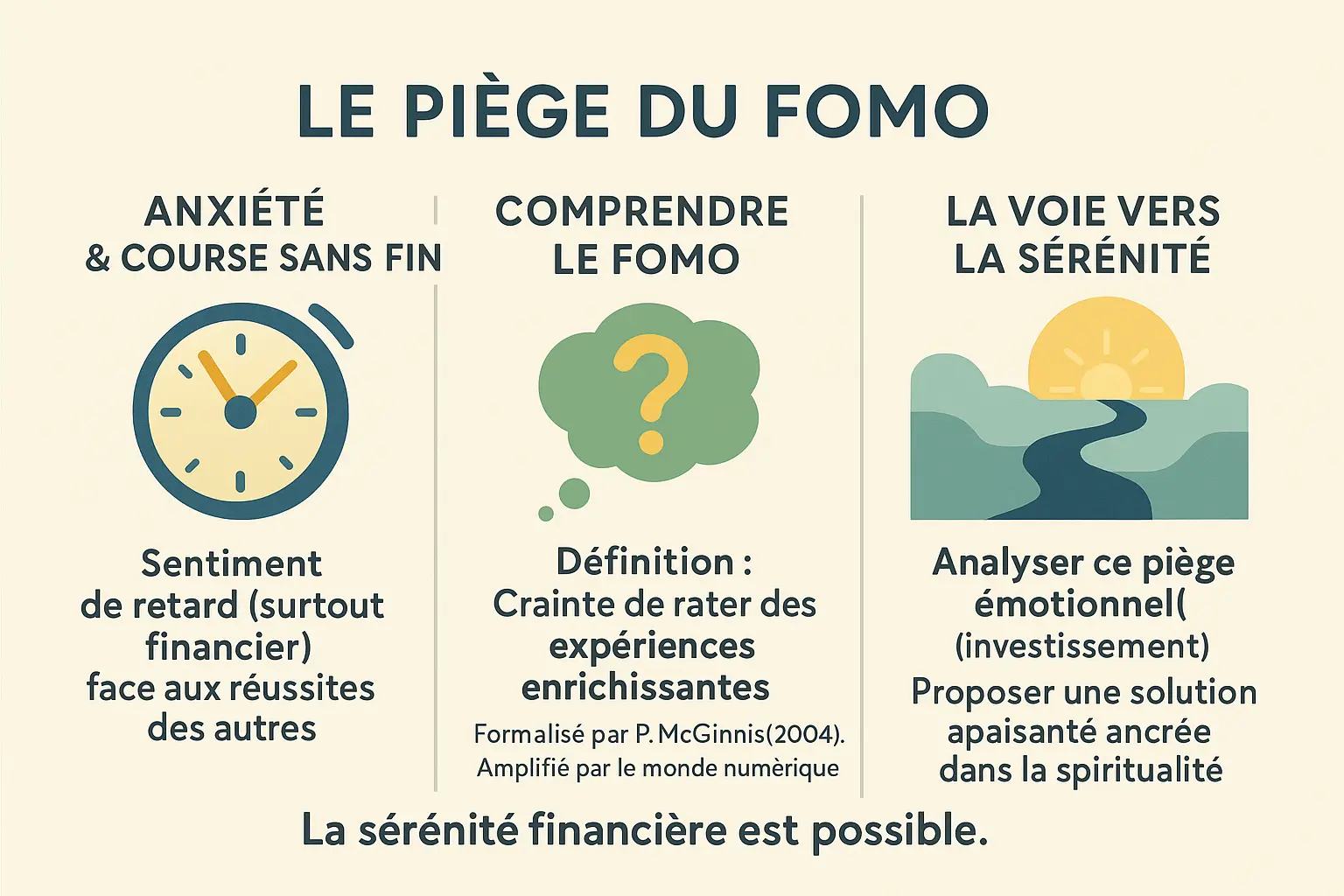
En parcourant votre fil d’actualité, avez-vous déjà ressenti un pincement en voyant des photos de villas, de voitures de luxe ou d’entrepreneurs affichant leurs succès financiers ? Cette anxiété sourde, cette impression de vivre en décalage avec votre propre réalité, c’est ce que les psychologues appellent la peur de manquer (FOMO). Formalisée par Patrick McGinnis en 2004, cette notion désigne « une crainte envahissante que d’autres puissent avoir des expériences enrichissantes desquelles nous serions absents ». Dans notre monde numérique ultra-connecté, ce phénomène déforme notre rapport à l’argent, poussant à des décisions impulsives comme l’achat d’actifs surévalués ou les investissements risqués.
Cet article décortique un piège moderne pour les investisseurs musulmans : comment cette quête effrénée de profit, nourrie par les récits de fortunes fulgurantes, devient un piège émotionnel. Découvrez comment la spiritualité islamique offre une voie d’apaisement en replaçant la certitude du Rizq (subsistance décrétée) et la confiance en Allah (Tawakkul) au cœur de votre stratégie financière, tout en respectant les principes éthiques de la finance islamique.
Le Fomo en investissement : quand l’émotion devient votre pire ennemi
La comparaison toxique et la vision à court terme
Le FOMO naît souvent d’une comparaison malsaine avec son entourage. Voir son voisin acheter un bien immobilier ou son cousin réussir financièrement crée un sentiment d’urgence. Les réseaux sociaux, véritables miroirs déformants, exacerbent ce phénomène en affichant des réussites spectaculaires mais rarement représentatives. Ces situations génèrent une anxiété permanente.
Derrière chaque story Instagram ou post LinkedIn triomphaliste se cache une réalité complexe, souvent invisible. Le jeune entrepreneur qui affiche sa réussite fulgurante a peut-être traversé des galères financières ou bénéficié de privilèges cachés. Imiter ces parcours sans comprendre leur contexte revient à reproduire une recette sans connaître tous les ingrédients.
L’envie qui en découle est un poison. Jalouser un destin qui n’est pas le vôtre oublie que la richesse matérielle est éphémère. Qui pourrait être riche un an puis perdre tout en quelques mois ? Ceux qui courent après des gains exponentiels (x100, x1000) basent leurs choix sur des opportunités fuyantes plutôt que sur une stratégie durable. Cette vision court terme conduit à des décisions risquées.
Les décisions irrationnelles dictées par la peur et l’euphorie
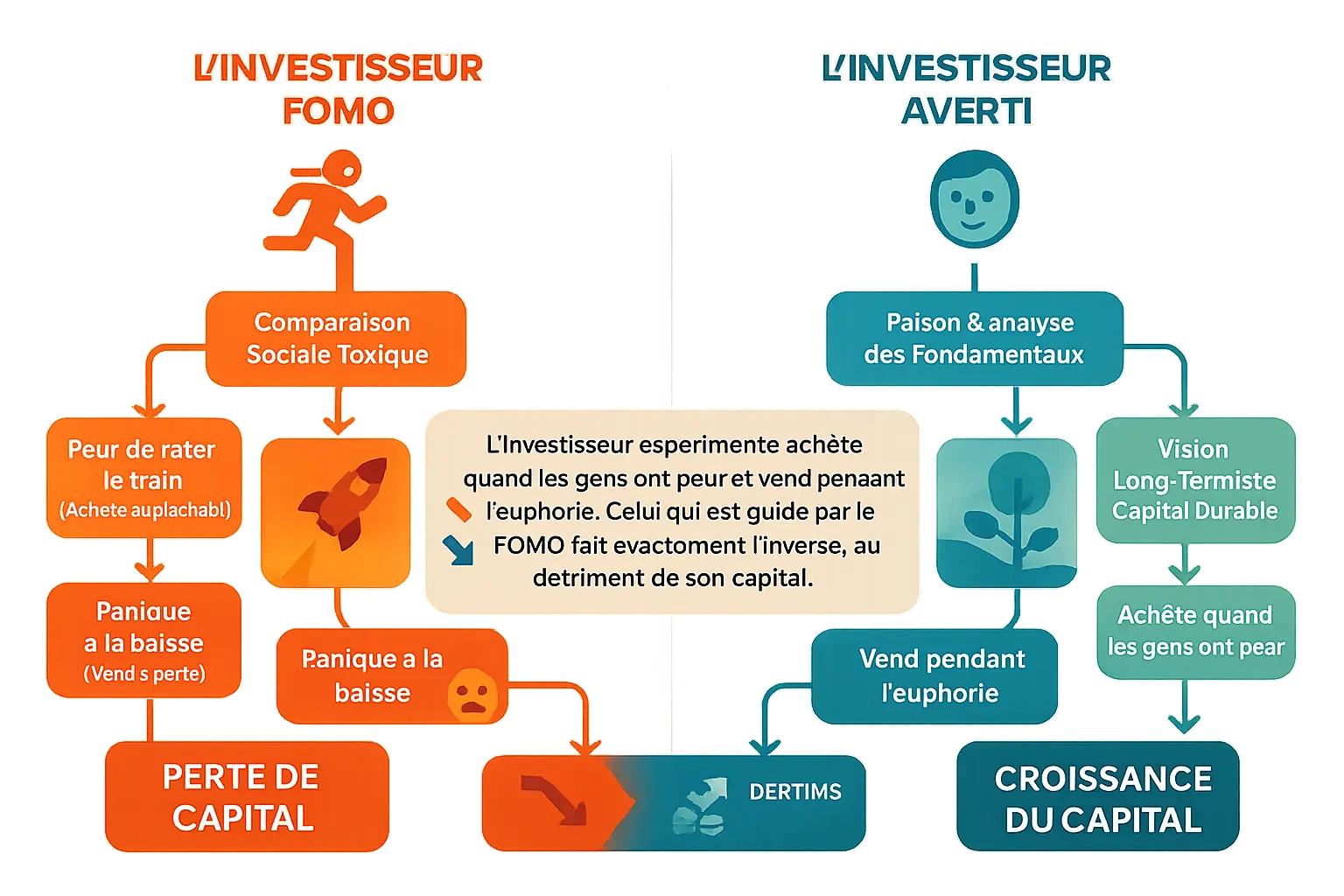
L’investisseur expérimenté achète quand les gens ont peur et vend pendant l’euphorie. Celui qui est guidé par le FOMO fait exactement l’inverse, au détriment de son capital.
Face à la baisse d’un actif, la panique pousse à vendre à perte. Or, un investisseur solide voit cette baisse comme une opportunité d’achat à prix réduit. Le FOMO pousse à l’achat frénétique d’actifs en pleine euphorie, au moment même où leur valeur culmine. Cette course effrénée à la performance reproduit le comportement de la foule, sans analyse objective.
Ce phénomène s’observe clairement sur les marchés de cryptomonnaies. Combien ont acheté du Dogecoin à son pic en 2021, poussés par les memes et les tweets d’Elon Musk ? Peu ont anticipé son effondrement brutal. Cette dynamique de « pump and dump » profite aux initiateurs qui revendent à perte aux derniers arrivés.
Paradoxalement, quand une véritable opportunité se présente, le blocage mental s’installe. Les doutes envahissent l’esprit, alimentés par le « wasswas ». Ce conflit intérieur entre le désir d’agir et la peur de se tromper paralyse. La solution réside dans le retour à la raison, en s’appuyant sur l’analyse rationnelle plutôt que sur l’émotion du moment.
La certitude du rizq : le remède spirituel au stress financier
Comprendre que votre subsistance (rizq) est déjà décrétée
La sérénité financière s’ancre dans le Tawhid, l’unicité d’Allah. Ar-Razzaq, le Pourvoyeur ultime, a inscrit votre rizq – santé, relations, paix intérieure – avant votre naissance. Un hadith (Boukhari) confirme que l’ange note votre subsistance dès le ventre maternel. Cette certitude libère des angoisses terrestres : vous ne manquerez pas ce qui vous est destiné, ni obtiendrez l’interdit.
Travailler 15 heures par jour pour un bien matériel relève du shirk mineur : une dépendance à l’humain plutôt qu’à Allah. La véritable sécurité vient du Tawakkul, cette confiance absolue comparée par le Prophète (PSL) à des oiseaux partant le ventre vide, certains de rentrer le soir le ventre plein.
En immobilier, priorisez le halal : un bien acquis licitement nourrit foi et portefeuille.
Le FOMO matériel face à la sérénité spirituelle
| Approche basée sur le FOMO (Matérialiste) | Approche basée sur le Tawhid (Spirituelle) |
|---|---|
| Source de stress : Peur de manquer, comparaison, sentiment d’être en retard | Source de paix : Certitude que le Rizq est garanti par Allah |
| Moteur de l’action : Envie, cupidité, recherche de gains rapides et démesurés | Moteur de l’action : Confiance (Tawakkul), recherche de l’utilité (Niya) et de la barakah |
| Perception de la richesse : Accumulation de biens matériels comme seule sécurité | Perception de la richesse : Le Rizq est multidimensionnel (santé, foi, famille, biens) |
| Réaction à la volatilité : Panique à la baisse, euphorie à la hausse | Réaction à la volatilité : Patience (Sabr), voir les baisses comme des opportunités |
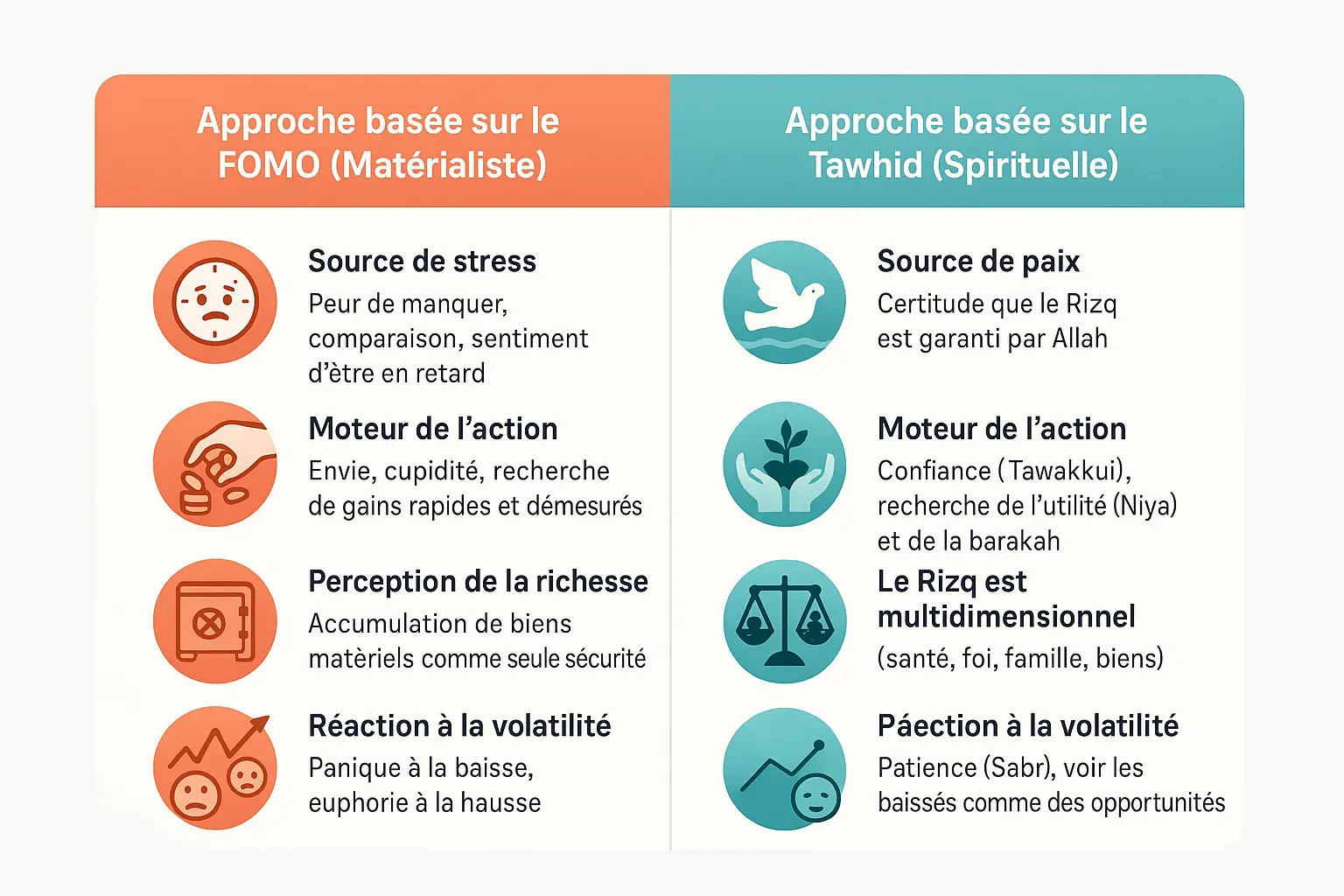
Le FOMO pousse à investir par crainte de manquer. L’approche spirituelle s’appuie sur le Yaqeen : si Allah a écrit ce gain, vous l’aurez. Les baisses deviennent des soldes, non des catastrophes.
Les prospères marient Sabr et action. Ils savent que les épreuves renforcent la foi. Les inégalités de richesse sont des tests : le riche est éprouvé dans sa gratitude, le pauvre dans sa patience.
Pour augmenter votre rizq, priorisez Dua, Istighfar, Sadaqa et liens familiaux. Un hadith assure que la charité attire la richesse comme l’ombre suit celui qui lui tourne le dos.
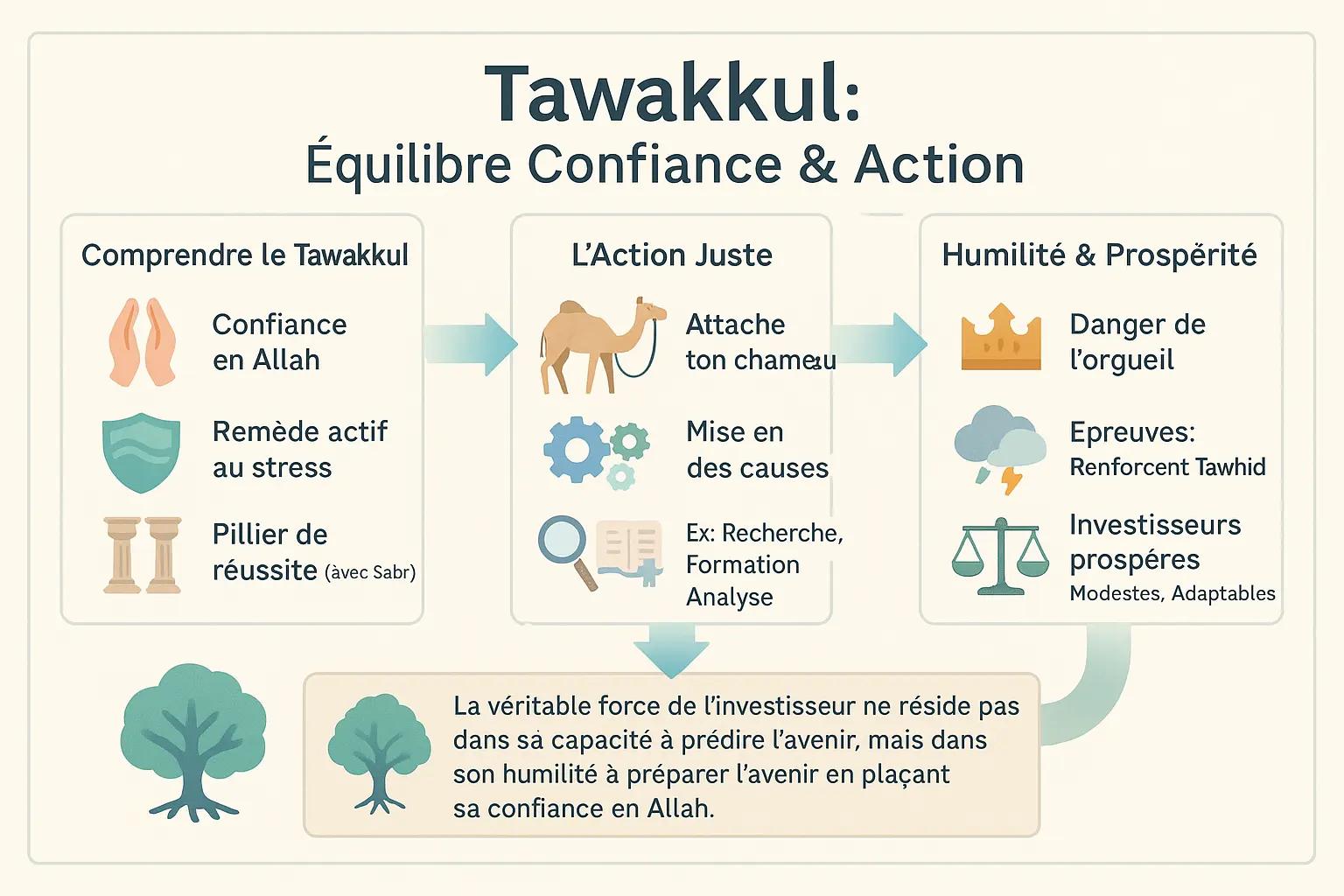
Le tawakkul : l’équilibre parfait entre la confiance en allah et l’action juste
Attache ton chameau et place ton espère en Allah
Le tawakkul, cette confiance totale en Allah, n’est pas une invitation à l’inaction. C’est un équilibre subtil entre l’effort et la foi, comme l’a illustré le Prophète (PSL) dans le célèbre hadith du chameau : « Attache ton chameau et fais confiance à Allah ». Cette métaphore s’applique directement à l’investisseur moderne.
En finance islamique, ce principe prend tout son sens. Avant de placer sa confiance en Allah, l’investisseur musulman doit d’abord attacher « son chameau » – autrement dit, faire ses devoirs. Pour un investissement halal, cela signifie étudier les fondamentaux d’un projet, comprendre son modèle économique et évaluer sa conformité à la charia.
Prenez l’exemple de investir dans l’or de manière halal. Cet actif historique demande une analyse rigoureuse avant d’y placer sa confiance, tout en sachant qu’Allah est le véritable Pourvoyeur (Ar-Razaq). L’investisseur éclairé fait ses calculs, étudie le marché, puis place sa confiance en Allah.
Le tawakkul véritable est un état d’esprit qui suit l’action. Il permet de traverser les turbulences du marché avec sérénité, sachant qu’Allah seul ouvre les portes de subsistance. Cette paix intérieure prévient les décisions émotionnelles.
L’humilité, la clé des investisseurs prospères
La véritable force de l’investisseur ne réside pas dans sa capacité à prédire l’avenir, mais dans son humilité à préparer l’avenir en plaçant sa confiance en Allah.
La réussite rapide sans épreuves peut être un piège. Elle nourrit l’orgueil, cet ennemi de la foi, en faisant croire que la réussite vient de soi-même plutôt que d’Allah. Les épreuves financières, en revanche, rappellent à l’investisseur sa vulnérabilité et sa dépendance à Allah.
Les investisseurs les plus résilients sont ceux qui restent modestes, capables de remettre en question leurs certitudes et de s’adapter aux changements du marché tout en gardant le cap spirituel. Ils voient chaque opportunité et chaque perte comme un rappel de leur dépendance totale envers le Vrai Pourvoyeur.
Les clés concrètes pour attirer la barakah et acquérir un rizq béni
Se tourner vers l’au-delà pour recevoir les bénédictions d’ici-bas
Les méthodes matérielles rapides comme le riba sont des leurres. Le musulman doit privilégier des moyens spirituels. L’intention pure (niya) est essentielle : servir autrui ouvre le rizq. La richesse suit naturellement, comme l’ombre suit celui qui lui tourne le dos, libérant de la course au profit immédiat du FOMO. En se recentrant sur la volonté divine, l’investisseur islamique construit un portefeuille éthique, échappant aux pièges de la spéculation excessive.
Quatre actions pour multiplier son rizq
- Istighfar (demande de pardon) : Efface les péchés bloquant le rizq. Le Prophète (paix sur lui) pratiquait l’istighfar quotidiennement. Selon un hadith, cela attire des solutions (Musnad Ahmad 2234), comme un entrepreneur repentant un conflit commercial et voyant un contrat inespéré se concrétiser. Ce geste purifie le cœur et ouvre des opportunités cachées.
- Shukr (reconnaissance) : Remercier Allah pour ses biens. Le Coran assure que la gratitude attire davantage de faveurs (14:7). Elle cultive le contentement et la barakah dans les gains, comme un épargnant reconnaissant pour ses modestes rendements, évitant ainsi les risques excessifs tout en préservant sa stabilité financière.
- Sadaqa (aumône) : Donner ne diminue pas le rizq, il le multiplie. La charité discrète attire des bénédictions, comme un commerçant offrant discrètement de la nourriture à un nécessiteux et voyant son activité prospérer. Ce geste purifie la richesse et attire des bénédictions visibles dans les affaires.
- Silat al-Arham (liens familiaux) : Renforcer les relations familiales attire la bénédiction, comme souligné dans cet article sur le FOMO. Un soutien spirituel et concret, comme aider un proche dans le besoin, évite les décisions isolées dictées par l’anxiété financière. Ces liens renforcent la stabilité émotionnelle et matérielle.
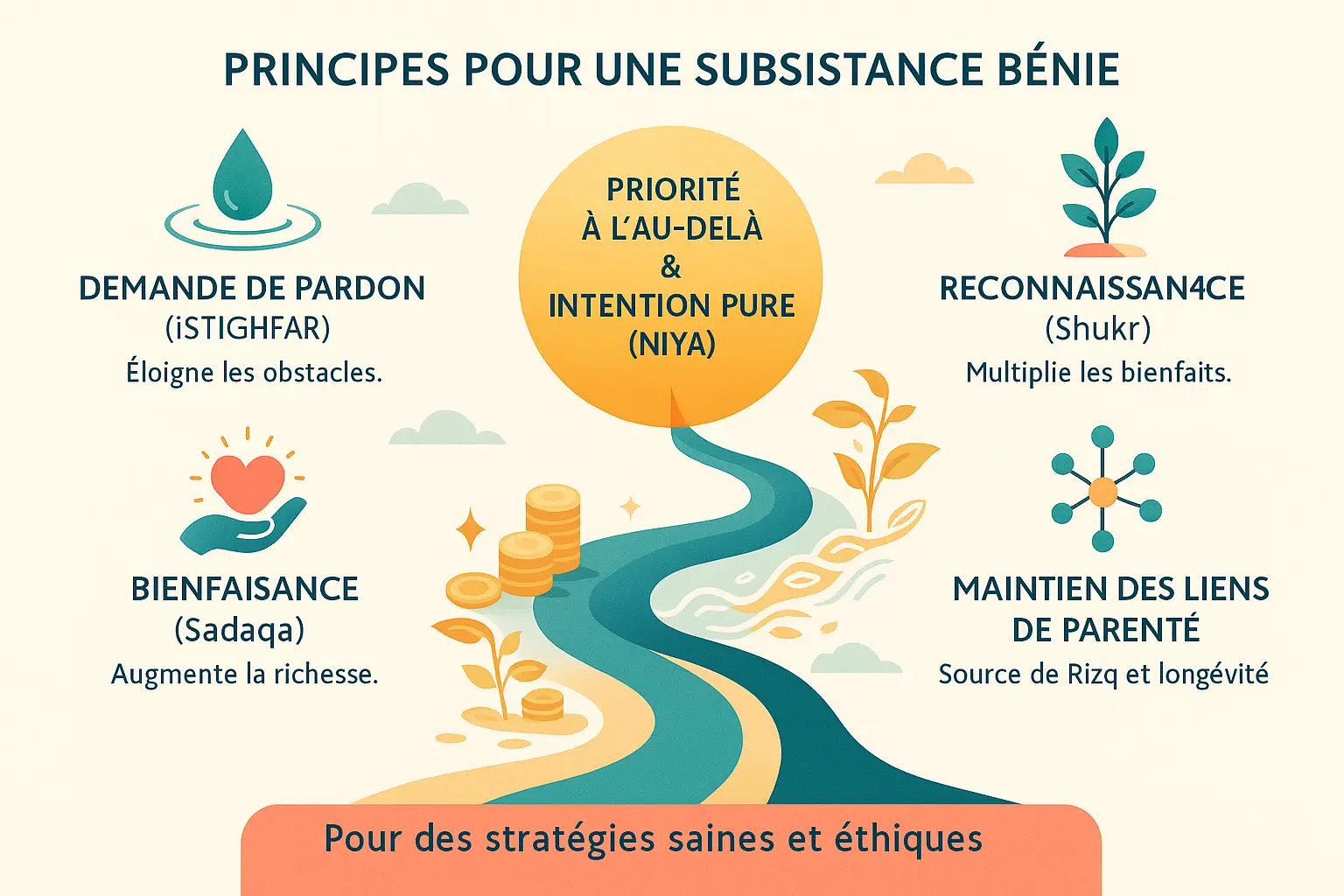
En intégrant ces pratiques, l’investisseur musulman échappe aux pièges du matérialisme. C’est ici la véritable stratégie islamique, unissant foi et action. En combinant Tawakkul et efforts licites, il construit un avenir financier durable, en harmonie avec les valeurs de transparence et de justice de la finance islamique.
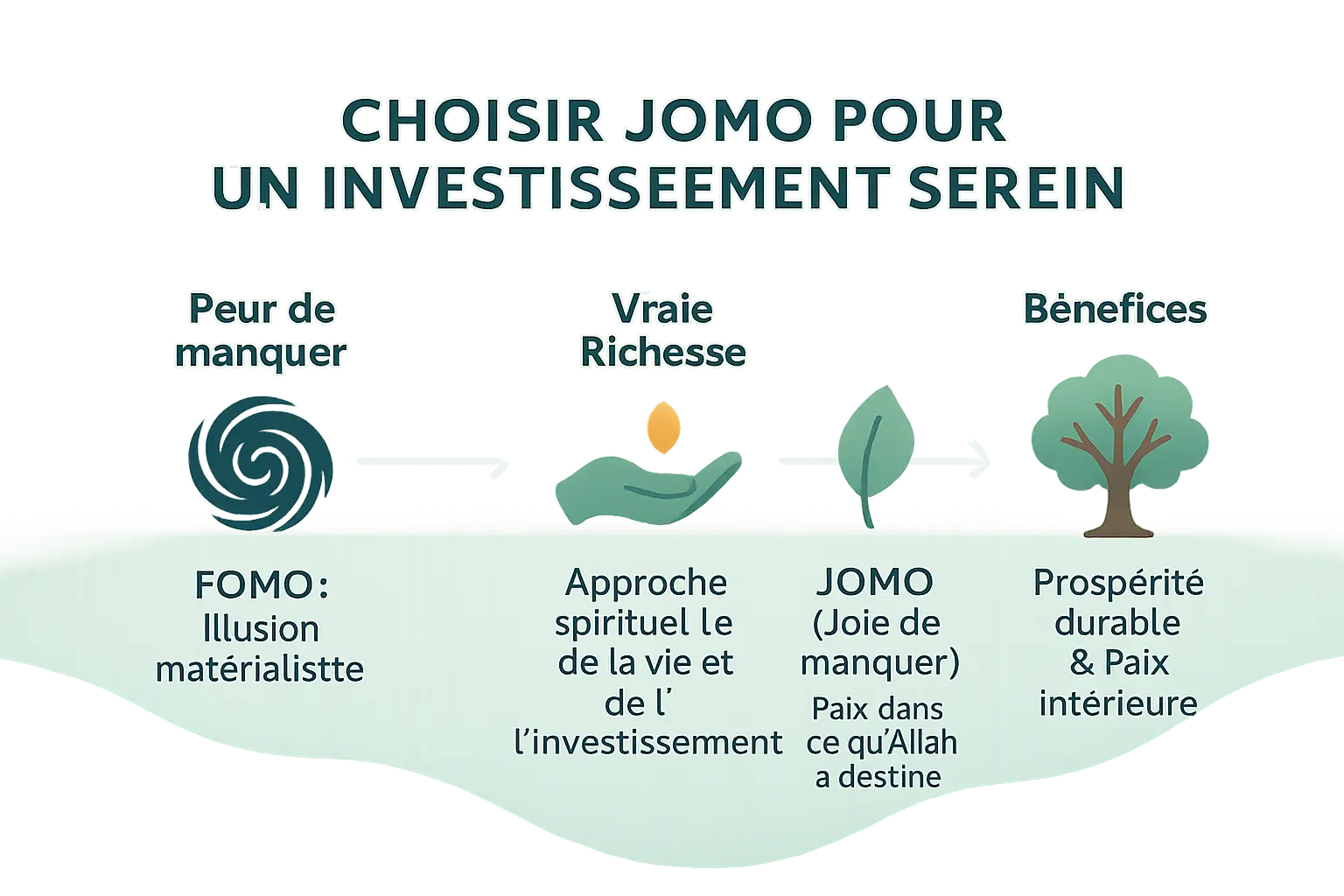
Conclusion : Choisir La Joie De Manquer (JOMO) Pour Un Investissement Serein
Le FOMO n’est qu’une illusion moderne. Cette peur de rater des opportunités masque l’essence du Rizq : subsistance décrétée par Allah. Croire que notre salut dépend d’une course effrénée vers le profit traduit une mécompréhension du Tawakkul.
Le JOMO incarne la liberté. C’est le calme de refuser les placements risqués pour se concentrer sur l’halal. Chaque dirham gagné ou perdu s’inscrit dans un plan divin. Cette certitude libère des décisions impulsives.
Namlora incarne cette voie. La plateforme transforme l’angoisse en action guidée par la foi. Ici, prospérité rime avec harmonie entre finances et enseignements islamiques. Comme dit dans le texte : « Celui qui se tourne vers l’au-delà, Allah le pourvoit naturellement. »
La peur de manquer (FOMO) est une illusion matérielle. En adoptant le JOMO – la joie de se concentrer sur son chemin, guidé par le Rizq divin – l’investisseur découvre une sérénité. Namlora invite à une prospérité alignée avec vos valeurs, où la confiance en Allah et l’éthique islamique transforment stress en sagesse.
FAQ
Quelle est la signification du FOMO (peur de manquer) ?
Le FOMO, acronyme de « Fear Of Missing Out », désigne une peur psychologique de rater des opportunités perçues comme essentielles, que ce soit dans la vie sociale, professionnelle ou financière. En investissement, cela pousse à des décisions hâtives, comme acheter un actif en pleine euphorie, par crainte de « louper le coche ». Cette anxiété trouve ses racines dans la comparaison avec autrui (réseaux sociaux, réussite des proches) et une vision court-termiste. En Islam, ce stress est lié à un manque de Tawakkul, cette confiance en Allah (Ar-Razaq) qui rappelle que la subsistance (Rizq) est déjà décrétée.
Le FOMO provoque-t-il de l’anxiété ?
Absolument. Le FOMO génère une anxiété chronique en alimentant la peur de regretter le passé et de manquer le futur. En investissement, cela se traduit par une course effrénée vers des gains rapides (x100, x1000), au détriment d’une stratégie durable. Cette course est toxique : elle pousse à vendre à perte en période de baisse (panique) ou à acheter à des sommets (euphorie). En Islam, cette peur matérialiste trahit un oubli de la certitude spirituelle : la sécurité véritable ne vient pas d’un bien immobilier ou d’un CDI, mais de la confiance en Allah, le véritable Pourvoyeur.
Qu’est-ce que le syndrome FOBO ?
Le FOBO (Fear Of Better Options) est un cousin du FOMO. Il correspond à l’angoisse de manquer une meilleure opportunité en en choisissant une autre. Par exemple, un investisseur hésite à racheter un actif en baisse, imaginant toujours un « meilleur prix à venir« . Ce piège paralyse l’action, alimentant le wasswas (doute). La solution ? Revenir à la raison et aux fondamentaux : si l’actif est solide, agir malgré l’incertitude, tout en gardant à l’esprit que le Rizq (subsistance) est déjà écrit par Allah, et non sous notre seul contrôle.
Comment vaincre la peur de manquer ?
Vaincre le FOMO passe par une révolution intérieure. D’abord, comprendre que le Rizq (subsistance) est décrété par Allah avant notre naissance : travailler 5 ou 15 heures par jour n’accélère pas ce qui est écrit. Ensuite, cultiver le Tawakkul (confiance en Allah) en agissant avec rigueur (recherche d’un investissement solide) tout en lâchant prise sur les résultats. Enfin, se recentrer sur l’essentiel : la reconnaissance (Shukr), la charité (Sadaqa), et le pardon (Istighfar) ouvrent des portes de subsistance que la course matérielle ferme.
Comment guérir du FOMO ?
Guérir du FOMO exige de rompre avec la comparaison toxique. Commencez par limiter les réseaux sociaux, ces miroirs déformants de la réussite. Ensuite, pratiquez le Tawakkul : comme le dit le Prophète (PSL), « attache ton chameau et place ta confiance en Allah » – agir avec sagesse tout en remettant le résultat à Allah. Enfin, cultivez l’utilité (Niya) en investissant non par envie, mais pour apporter une valeur aux autres. Ainsi, la richesse suit naturellement, comme l’ombre suit celui qui lui tourne le dos.
Comment se nomme la phobie de manquer ?
Bien que le terme médical exact soit « atychiphobie » (peur de l’échec), dans le contexte moderne, la peur de manquer est universellement appelée FOMO (Fear Of Missing Out). En finance islamique, ce phénomène est un piège émotionnel. Il incarne une insécurité spirituelle : douter que le Rizq (subsistance) soit déjà écrit par Allah. La solution ? Se rappeler que la vraie sécurité n’est pas dans le portefeuille, mais dans la certitude divine (Yaqeen).
Quelle est la psychologie de la peur de manquer ?
La peur de manquer naît d’un mélange de matérialisme et de biais cognitifs. Psychologiquement, elle repose sur deux piliers : la comparaison sociale (envier le cousin qui achète un appartement) et la vision court-termiste (chercher des gains démesurés sans patience). En Islam, ces tendances trahissent un oubli du Tawhid : l’argent n’est pas la sécurité, Allah l’est. Le FOMO est donc un rappel spirituel pour recentrer son intention (Niya) sur l’au-delà, pas sur les biens éphémères.
Qu’est-ce que le syndrome FOMO ?
Le syndrome FOMO est une dépendance émotionnelle à l’anticipation du regret. En investissement, il pousse à acheter un actif après sa hausse (par peur de rater le train) ou à vendre à la baisse (par panique). C’est l’inverse de la sagesse islamique : l’investisseur expérimenté achète quand les autres ont peur et vend quand ils sont euphoriques. Le FOMO est un « Shirk mineur » en confiant sa paix intérieure à des actifs instables plutôt qu’en Allah, le seul garant du Rizq.
Comment éviter la FOMO dans l’investissement ?
Pour éviter le FOMO, trois clés : 1) La certitude spirituelle – Comme le rappelle le Tawhid, le Rizq est garanti par Allah, pas par un portefeuille. 2) La discipline pratique – Rechercher des investissements halal (or, immobilier éthique) avec des causes solides (étude des fondamentaux). 3) L’humilité – Se remettre en question, comme les investisseurs prospères qui s’adaptent sans orgueil. Enfin, pratiquez le JOMO (Joy Of Missing Out) : la joie de se concentrer sur son propre chemin, en laissant le comparatif oiseux à son voisin.