<meta name="google-site-verification" content="0S72xkYcSqqt100ZuIzn_Zif1zL8vIvcXUmc5Tjo10o" />

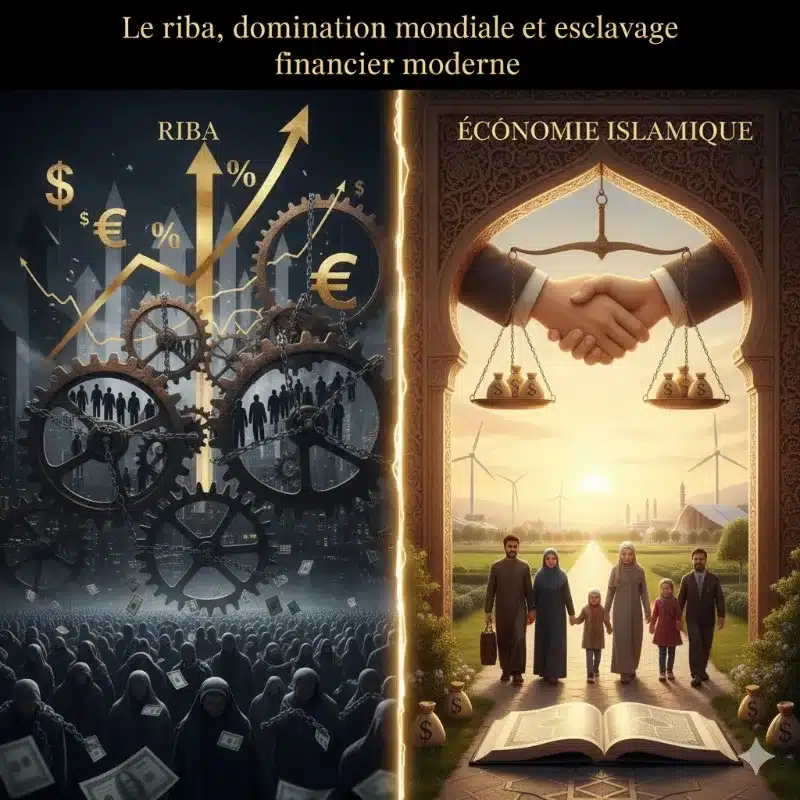
Is riba a tool of domination or a simple interest that traps individuals and nations in a cycle of dependence? Behind its banal appearance, this system monetizes debt to concentrate power, impoverish savers and transform projects into burdens, such as student loans or mortgages that enslave generations. Discover how this mechanism, denounced in the Shari'a, destroys social justice by creating a parasitic economy, and how an Islamic model, based on risk-sharing (mudaraba, musharaka) and income purification, offers a path to financial freedom and collective dignity.
Contents
Riba: more than just interest, it's a destructive mechanism
The definition and spiritual gravity of riba
The word riba means "surplus" or "excess". In Islam, it refers to any guaranteed gain without effort, real exchange or risk-sharing. Allah warns: "O you who believe! If not, war from Allah" (Sura 2, v.278-279), underlining its impact on social justice.
The two faces of riba: how to recognize it?
| Type of Riba | Definition | A concrete example |
|---|---|---|
| Riba al-Nasiah (the riba of delay) | Time savings with no real compensation. | Lend €1,000, pay back €1,100 a year later: €100 Riba al-Nasiah. |
| Riba al-Fadl (surplus riba) | Unequal exchange of identical goods from hand to hand. | Exchange 1 kg of superior dates for 2 kg of inferior dates immediately. |
Riba is divided into two forms that alter economic equity: Riba al-Nasiah (interest on a loan) and Riba al-Fadl (unequal exchange of similar goods).
The bankruptcy of the value of money
In Islam, money is a means of exchange, not a commodity. Lawful trade creates value (products, services). Riba, on the other hand, generates artificial gain without effort, creating a parasitic economy in which the lender enriches himself without acting.
Debt bondage: the individual trap of riba
Debt as modern slavery
Riba turns borrowers into modern-day slaves. Take a young Muslim who dreams of becoming a homeowner. To buy a property, he takes out a bank loan with interest. From that moment on, his freedom is compromised. Understanding the stakes involved in a conventional mortgage reveals a devious trap: for 20 to 30 years, he'll be working not for his own personal fulfillment, but to service his debt. If his professional project fails, the bank will seize his property, leaving him in a more precarious situation than before.
Inflation: the silent tax that impoverishes the masses
Since the abandonment of the gold standard in 1971, governments have been printing money as they please. It's like diluting coffee with water: the substance is diluted. This dilution of monetary value, known as inflation, is in fact a silent tax that hits the most vulnerable hardest.
- The losers: savers and employees, whose purchasing power and savings are melting away.
- The winners: holders of real assets (real estate, gold, equities) who see their value rise mechanically.
- The main beneficiaries: the banks, which take advantage of the money creation system and leverage to lend far more than they own.
Inflation encourages rapid spending ("my money will be worth less tomorrow"), speculative investment and, ultimately, the acceptance of riba as the norm.
riba as a tool of systemic domination: how riba weakens the community
Manipulation through consumption and fear of loss
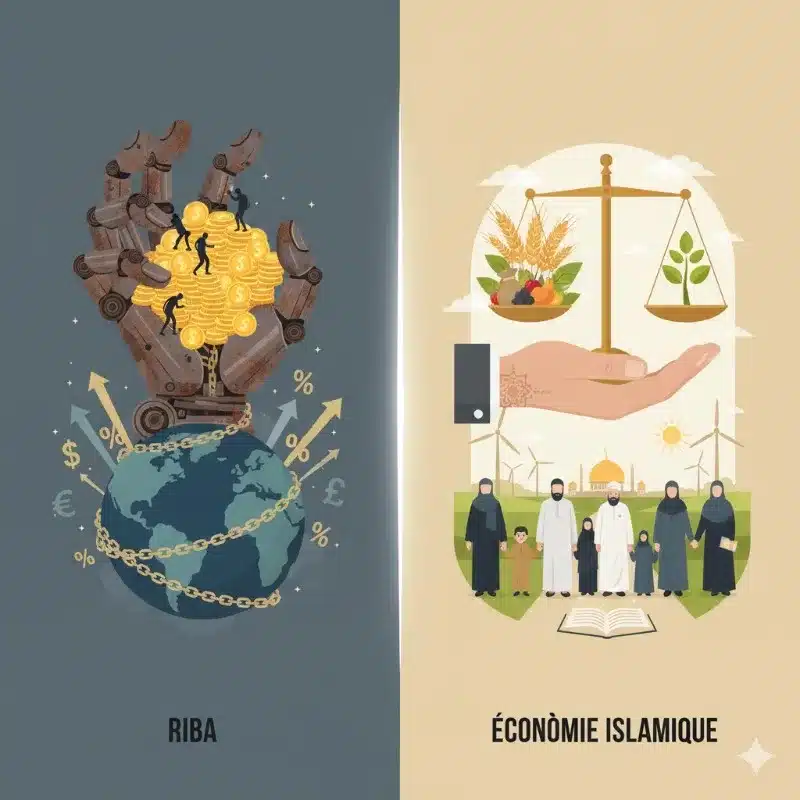
Inflation turns every individual into an anxious actor. By diluting the value of money, it drives people to spend quickly, to speculate in risky assets, or to accept riba as the "lesser evil". This mechanism creates a vicious cycle: the more debt one accumulates, the more one is forced to work to repay it, losing all financial freedom.
Collective humiliation and economic dependence
Muslim communities, which are largely excluded from alternative financing channels, remain vulnerable. Scholars point to a paradox: total exclusion from the modern financial system, while desirable in theory, could exacerbate their isolation. It is here that Islamic banks are attempting to offer a middle way, but they remain dependent on conventional infrastructures, illustrating the urgent need to build autonomous alternatives.
Systemic contamination: a challenge for Islamic finance
Even halal initiatives are affected. An Islamic fintech, for example, often has to deposit its cash in a conventional bank for liquidity reasons. As a result, some of its funds indirectly generate riba, tainting the entire ecosystem. This contamination underscores the urgent need to innovate in fully compliant models, such as the tokenization of tangible assets or smart contracts under the supervision of Shariah experts.
Taking back control: alternatives for a just and ethical future
The principles of an ethical economy: sharing risk and circulating wealth
The Islamic economy is based on justice and solidarity. Its two pillars: risk sharing and wealth redistribution.
- Risk sharing: In Mudaraba, the investor provides the capital and the manager the expertise. Profits are shared, losses hit the capital. In Musharaka, everyone invests and manages, with proportional profits and losses. These models guarantee fairness and commitment.
- Circulation of wealth: Zakat redistributes surpluses, Waqf finances education and health via foundations. These tools prevent the concentration of wealth and strengthen community ties.
Navigating the current system: purification and general interest
Les principes de Tazkiyah (purification des gains douteux) et Maslaha (compromis nécessaires) guident les musulmans. La Tazkiyah exige de donner les revenus liés au riba en charité. L’AAOIFI autorise l’investissement dans des entreprises avec <30% de dettes à intérêt et <5% de revenus illicites, comme transition dans un système imparfait.
Practical strategies to free yourself from riba
A gradual transition is essential:
- Training: Learn the fundamentals of Islamic trade and Shariah criteria.
- Action plan: Prioritize repayment of interest-bearing debts and structure a budget free of non-compliant products.
- Ethical investments: direct your savings towards Shariah equities, unleveraged real estate or precious metals.
- Halal ecosystem: Favoring participative banks and Islamic fintechs to strengthen independence.
Fighting riba: a commitment to justice and dignity
Riba embodies a silent mechanism of domination: it enslaves through debt, impoverishes societies through inflation and weakens nations. By dissociating money from economic realities, it creates an unjust imbalance in which lenders enrich themselves without risk, while borrowers become mired in a cycle of dependence. This logic distorts the primary function of wealth: to serve humanity, not exploit it.
Namlora offers a concrete alternative. Through risk-sharing (musharaka, mudaraba) and halal investments, we put Islamic ethics back at the heart of finance. Each transaction strengthens family autonomy and community cohesion, breaking with the parasitic model of riba.
Refusing riba means choosing freedom. It means building a fair economy, where spirituality and balance revive forgotten values. Together, let's shape a future aligned with human dignity and social justice.
Riba is not a simple financial practice, but a system of domination and modern-day slavery. It destroys economic equilibrium, enslaves individuals and weakens nations. Yet there is an alternative: to work for a just society, where dignity and solidarity guide every choice, building a balanced and ethical future.
FAQ
What is riba according to Islam?
Riba refers to any guaranteed gain without effort or risk-taking, often likened to bank interest. Islam formally forbids it, as it upsets the economic and moral balance. The Koran likens it to social injustice, where the rich profit from the needs of the poor.
What's the difference between riba al-Nasiah and riba al-Fadl?
Riba al-Nasiah: interest on a loan, linked to time.
👉 Example: lend €1,000 and get back €1,100 after a year.
Riba al-Fadl: unequal exchange between similar goods.
👉 Example: exchange 1 kg of superior dates for 2 kg of inferior dates.
Both forms are prohibited as they create an unfair imbalance between the parties.
Why is riba considered modern-day slavery?
Because it shackles the individual and society through debt.
Mortgages, student loans and consumer credit keep people in a cycle where they work to repay interest, without ever achieving financial freedom. Inflation amplifies this phenomenon by making money weaker and weaker.
What are the effects of riba on the global economy?
Riba fuels the concentration of wealth, speculation and instability.
Banks create money out of debt, causing financial bubbles and successive crises. Meanwhile, wages stagnate and the cost of living rises, accentuating inequalities.
What are the Islamic alternatives to riba?
The Islamic economy is based on the sharing of risks and profits.
The main models are:
Mudaraba: one provides the capital, the other the management.
Musharaka: both invest and share gains and losses.
These contracts promote a real economy, without speculation or exploitation.
How to purify income tainted by riba?
Tazkiyah (purification) consists of giving in charity the portion of income linked to non-conforming earnings.
This is a stage of repentance and spiritual rebalancing, recommended by contemporary scholars, particularly in situations where the economic environment does not allow for total avoidance of riba.
Does riba still exist in modern Islamic finance?
Yes, sometimes indirectly: some Islamic banks or fintechs deposit funds in conventional institutions for liquidity reasons. This creates a partial contamination of the system, hence the importance of innovations such as tokenization of real assets and Sharia-compliant smart contracts.