<meta name="google-site-verification" content="0S72xkYcSqqt100ZuIzn_Zif1zL8vIvcXUmc5Tjo10o" />

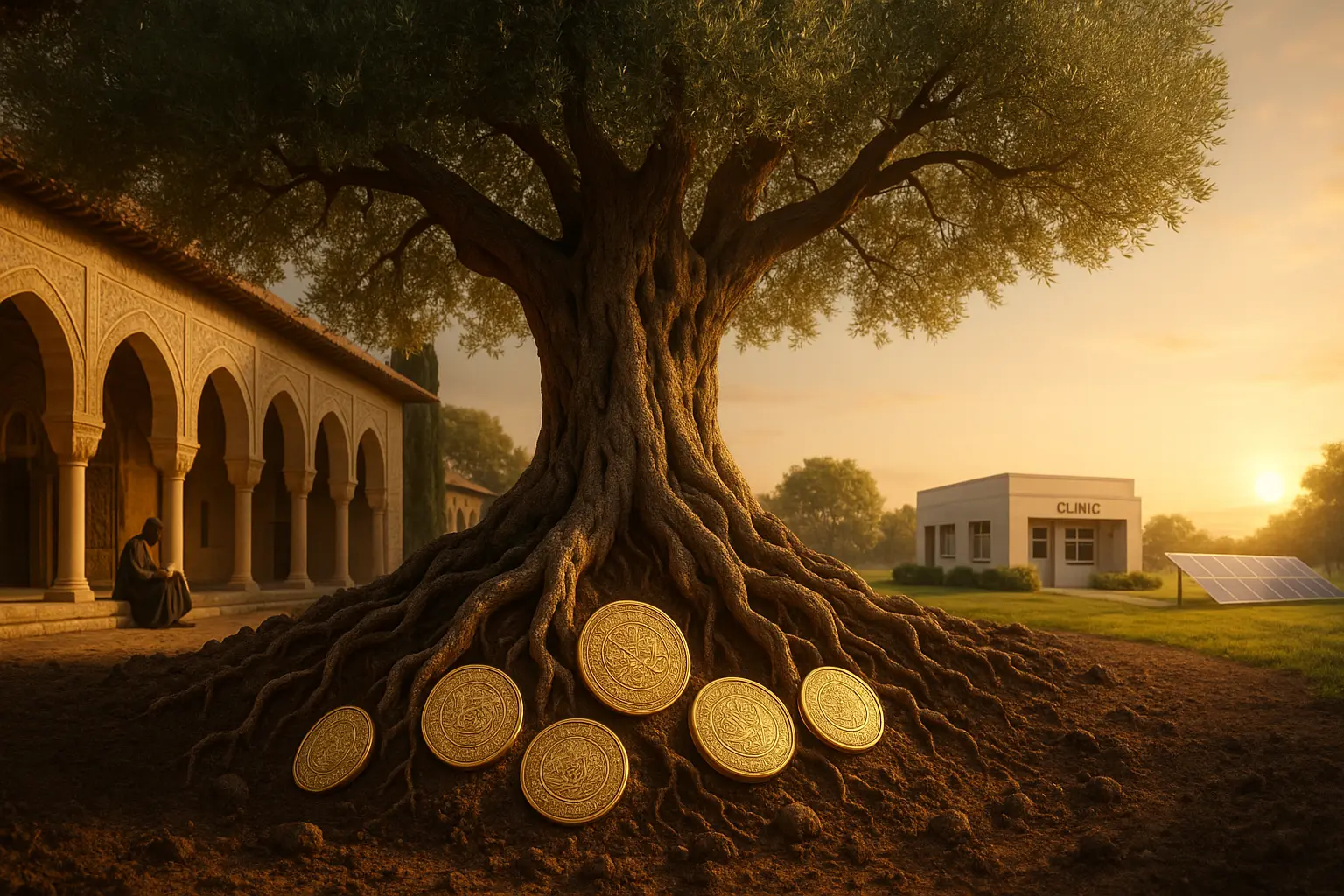
L’essentiel à retenir : Le waqf incarne un modèle d’investissement éthique et durable, issu de l’économie islamique. En immobilisant un bien halal pour générer des revenus perpétuels au bénéfice communautaire, il transforme la richesse en levier social et spirituel. Précurseur des fonds d’impact, il allie pérennité matérielle et récompense spirituelle, comme les universités médiévales ou les puits d’Othman Ibn Affan.
Las de voir l’économie moderne gangrenée par la spéculation et la dette ? Le waqf économie éthique incarne une alternative millénaire, où le capital sert l’humain et la pérennité plutôt que la rentabilité à court terme. Ancré dans la finance réelle et les valeurs islamiques, ce modèle transforme un bien en source inépuisable de bénéfices sociaux – écoles éternelles comme Al-Azhar, hôpitaux gratuits, logements accessibles – comme un arbre généreux dont les fruits profitent à tous, aujourd’hui et demain. Au-delà du matériel, il cultive la Sadaqa Jariya, cette aumône qui continue de porter récompense éternelle, tout en préservant l’essentiel : la confiance, la justice et la durabilité.
Sommaire
Le waqf, une fondation de cœur et d’esprit pour une économie éthique
Définition et principes : un bien dédié à la bienfaisance pour l’éternité
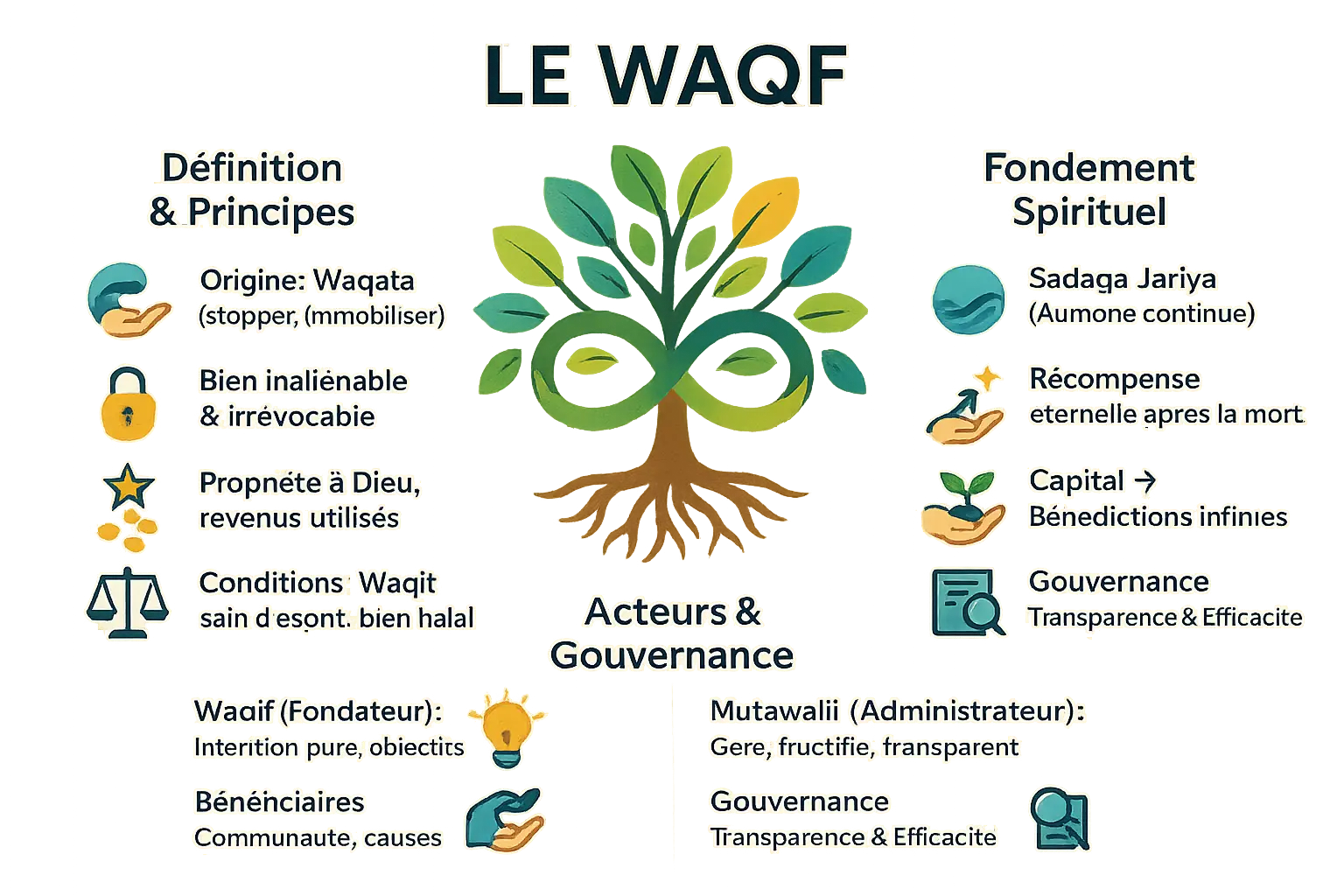
Le mot Waqf (وقف) provient de la racine arabe waqafa, signifiant « immobiliser ». Selon la norme AAOIFI n°33, c’est un contrat irrévocable immobilisant un actif halal pour en consacrer les bénéfices à des causes sociales ou religieuses. Le capital reste inaliénable, symboliquement transféré à Dieu, tandis ses fruits servent les bénéficiaires désignés. Pour être valide, le Waqif (fondateur) doit être majeur, sain d’esprit, et propriétaire du bien, qui doit être tangible et licite.
La sadaqa jariya, le fondement spirituel de l’investissement éternel
Le Waqf transforme le capital en source de bénédictions infinies, tant pour la communauté que pour le donateur. C’est une transaction où le bien-être social nourrit le salut individuel.
Il incarne la Sadaqa Jariya (aumône continue), dont la récompense persiste après la mort. Un hadith rapporté par Muslim (1631) souligne que seules trois actions rapportent après le décès : la Sadaqa Jariya, la science bénéfique et les enfants pieux. Contrairement aux donations ponctuelles, le Waqf crée un héritage spirituel éternel par des actifs productifs. Cette double récompense – terrestre par l’impact social et céleste par la rétribution divine – en fait un investissement spirituel unique.
Les acteurs et la gouvernance : un pacte de confiance
La gouvernance du Waqf repose sur une structure claire et responsable. Chaque acteur se lie par un engagement sacré de transparence et d’efficacité. Voici les rôles clés :
- Le Waqif (le fondateur) : L’initiateur, qui engage son bien avec une intention pure de servir la communauté
- Le Mutawalli (l’administrateur) : Le gardien légitime, chargé de préserver l’actif et d’en optimiser l’impact selon les volontés du fondateur
- Les bénéficiaires : La communauté ou les causes définies, qui reçoivent les fruits du Waqf selon les objectifs établis
Ce système s’appuie sur des mécanismes modernes de transparence et de reddition de comptes, garantissant la pérennité de l’œuvre et la confiance des parties prenantes. Les normes AAOIFI renforcent cette gouvernance par des cadres comptables et éthiques rigoureux.
Un modèle de développement au fil de l’histoire
Les racines prophétiques : les premiers waqfs de l’islam
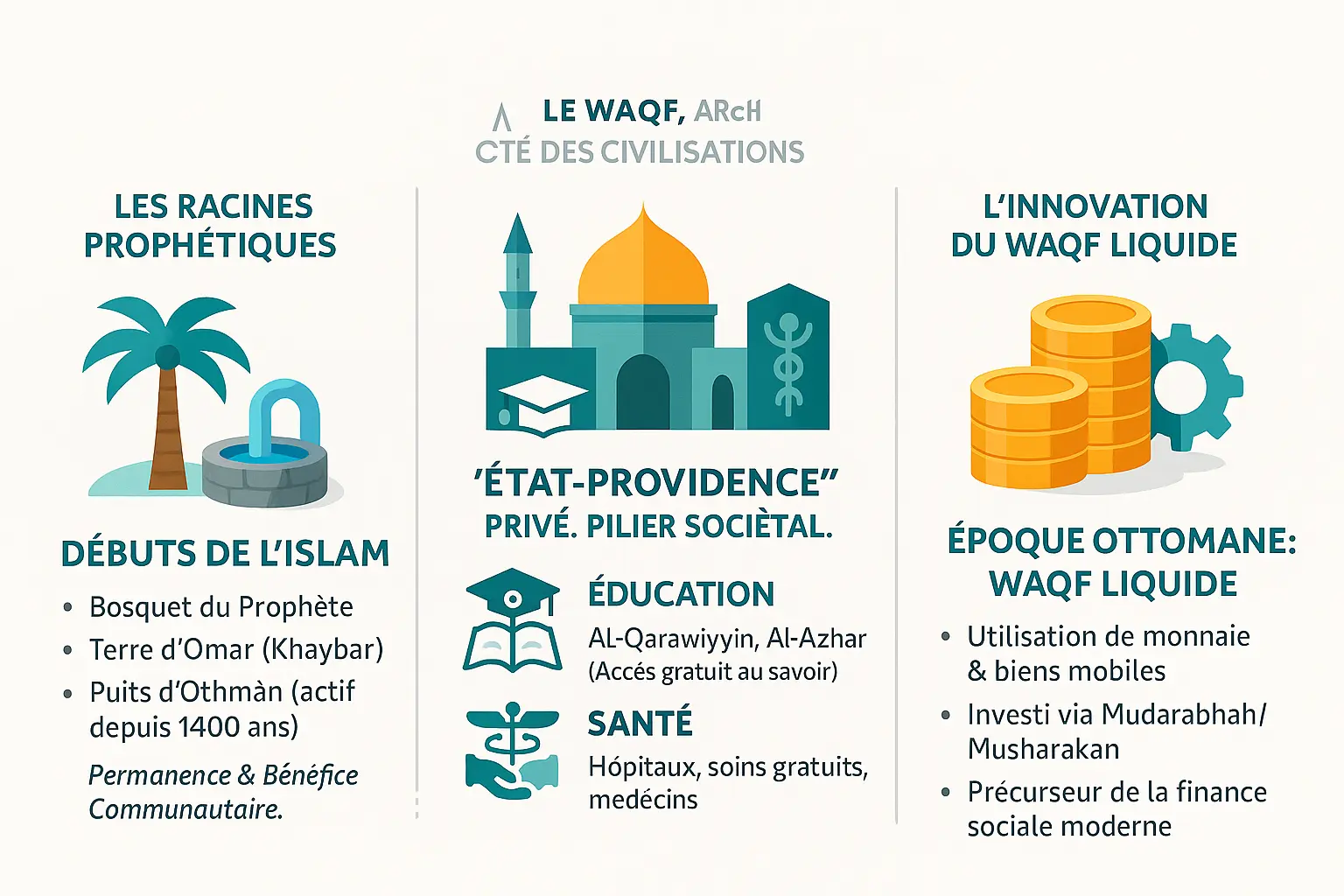
Il est ancré dès l’ère prophétique grâce à Othman ibn Affan (RA), qui a acquis le puits de Rumâh à Médine pour le rendre accessible à tous. Ce Waqf, actif aujourd’hui encore, génère des revenus redistribués via l’agriculture, soutenant les orphelins et les démunis.
Omar ibn al-Khattab (RA) a établi un autre pilier en consacrant une terre fertile à Khaybar comme Waqf éternel. Ce modèle, inaliénable, nourrit les pauvres et les voyageurs, inspirant les compagnons à généraliser cette pratique, comme le souligne Jabir ibn Abdullah.
Le waqf, architecte des civilisations musulmanes
Cette institution a façonné les sociétés islamiques comme un « État-providence » privé, avec un impact majeur dans trois domaines :
- Éducation : L’Université Al-Qarawiyyin (Maroc, 859 après J.-C.) et Al-Azhar (Égypte) ont été financées par des Waqfs, ouvrant l’accès au savoir à tous.
- Santé : Les Bimaristan (hôpitaux) des califats omeyyade et abbasside, comme celui d’Al-Muqtadir à Bagdad, offraient des soins gratuits, payés par des revenus de Waqf.
- Infrastructures : Le complexe de Haseki Sultan à Istanbul, financé par Waqf, réunissait mosquée, soupe populaire et bains publics, révélant un urbanisme communautaire. À Zanzibar, les Waqfs ont sculpté les paysages urbains.
L’innovation du waqf liquide
L’époque ottomane a vu naître le Waqf liquide, captalisant des fonds via la Mudarabah. À Bursa, ces fonds ont dynamisé l’économie en finançant des moulins et commerces. Bien que marginalisés par l’État moderne, leur héritage inspire encore l’économie islamique, comme en témoigne la Vakıflar Bankası en Turquie.
Le waqf, une alternative éthique au système financier actuel
Un modèle affranchi de la dette et de la spéculation
Le système financier mondial repose sur le riba, un mode de financement basé sur l’intérêt. En islam, cette pratique est prohibée car elle génère de la richesse sans création de valeur réelle, comme le souligne la BCEAO qui le qualifie d’« enrichissement sans cause ».
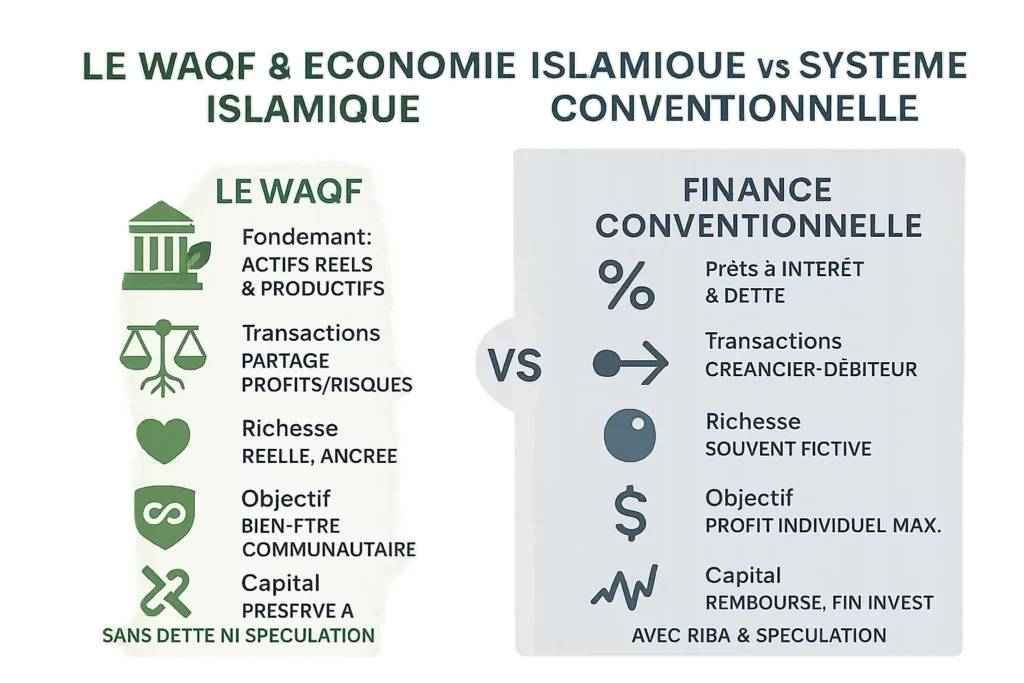
Contrairement à ce modèle, le waqf incarne les principes de la finance islamique : partage des profits et des pertes (Moudaraba, Mousharaka) et adossement à des actifs tangibles (immobilier, entreprises éthiques). Ce système élimine le risque de dépendance à la dette tout en ancrant la richesse dans l’économie réelle. Par exemple, celui de l’université Al-Azhar au Caire, créé au Xe siècle, a permis de financer l’éducation gratuite de générations d’étudiants grâce à des revenus fonciers stables. Pour en savoir plus sur les limites de la spéculation, découvrez les principes qui encadrent la spéculation en islam.
Le waqf, pilier d’une économie tangible et résiliente
Il tire sa force de la productivité de ses actifs réels : un immeuble, une terre agricole ou une entreprise durable. Contrairement aux systèmes fondés sur la dette, ce modèle préserve le capital et génère des revenus récurrents pour la communauté. C’est un « investissement à impact social » avant l’heure, comme le décrit une étude de OpenEdition.
En se basant sur des biens productifs, le waqf échappe aux bulles spéculatives et offre une stabilité rare dans un monde marqué par les crises répétées. Par exemple, le Waqf familial (Dhurri) permet à une lignée de préserver un patrimoine tout en redistribuant les profits au profit de la communauté, comme le montre l’exemple de fermes agricoles gérées collectivement en Afrique de l’Ouest. Ce modèle illustre comment une économie ancrée dans le concret peut résister aux aléas financiers modernes.
Comparaison des modèles : waqf vs finance conventionnelle
| Critère | Le Waqf et l’économie islamique | Le système financier conventionnel |
|---|---|---|
| Fondement | Actifs tangibles et productifs | Prêts à intérêt et dette |
| Nature des transactions | Partage des profits et des risques | Relation créancier-débiteur |
| Richesse générée | Réelle et adossée à la productivité | Souvent fictive et basée sur la dette |
| Objectif final | Bien-être social et communautaire | Maximisation du profit individuel |
| Pérennité du capital | Capital préservé à perpétuité | Capital remboursé, fin de l’investissement |
Revitaliser le waqf : des solutions concrètes pour le 21e siècle
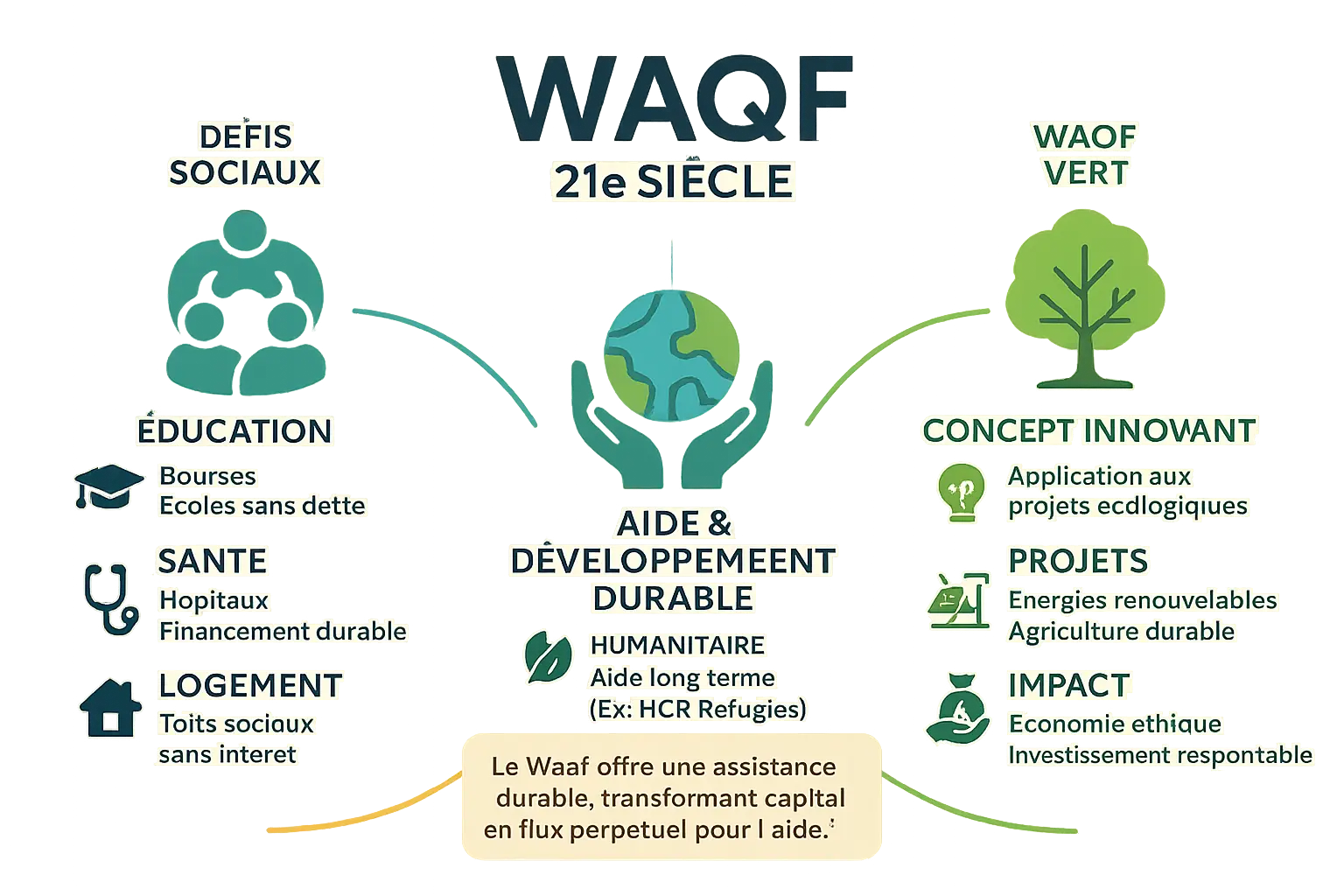
Répondre aux défis sociaux : éducation, santé et logement
Le Waqf moderne répond aux besoins actuels en éducation, santé et logement. En éducation, des institutions comme l’université Al-Azhar en Égypte ou l’IIUM en Malaisie bénéficient depuis des siècles de revenus pérennes pour financer l’enseignement. À Istanbul, le Complexe Süleymaniye, construit au XVIe siècle, continue de financer des écoles et des logements étudiants grâce à ses revenus fonciers.
En santé, des hôpitaux comme le Rumah Sehat Terpadu en Indonésie assurent des soins gratuits via des revenus de Waqf, combinant modernité et pérennité. Pour le logement, des biens immobiliers transformés en Waqf offrent des solutions abordables, évitant la dépendance aux prêts à intérêt. Le Fonds National du Royaume-Uni illustre cette innovation en gérant des logements sociaux tout en maintenant les bâtiments à long terme. Découvrir des projets immobiliers éthiques.
Un levier pour l’aide humanitaire et le développement durable
Il transforme un capital initial en un flux de revenus perpétuel pour l’aide humanitaire.
Le Fonds islamique mondial pour les réfugiés (GIFR), lancé en 2022 par le HCR et la Banque islamique de développement, illustre cette puissance. Avec un objectif de 500 millions de dollars, il investit selon la charia pour financer des programmes dans 31 pays : éducation (bourses pour 872 000 personnes en 2024), santé (eau potable et hygiène), et logement (23 600 abris réparés au Tchad). Selon un rapport de l’ONU, les outils islamiques restent sous-utilisés malgré leur potentiel pour atteindre les ODD. Déjà, le GIFR a soutenu 8,9 millions de bénéficiaires depuis 2017, prouvant que ce modèle combine urgence et durabilité.
L’émergence du « waqf vert » : investir pour la planète
Le Waqf Vert oriente des actifs vers des causes écologiques : reboisement, énergies renouvelables, agriculture durable. En Syrie, des terres arides deviennent des fermes d’oliviers productives, combinant sécurité alimentaire et préservation des sols. Le cadre du Waqf Vert, documenté par des experts, propose des projets comme des centrales solaires ou des réseaux d’irrigation économes en eau. Ces initiatives soutiennent les ODD liés au climat et à la vie terrestre, alignant le respect de la création divine avec les défis modernes. La préservation de l’environnement devient ici un acte de foi, où chaque arbre planté ou panneau solaire installé génère une récompense spirituelle éternelle.
De la volonté à l’action : comment participer son économie
Créer son propre waqf : les étapes clés
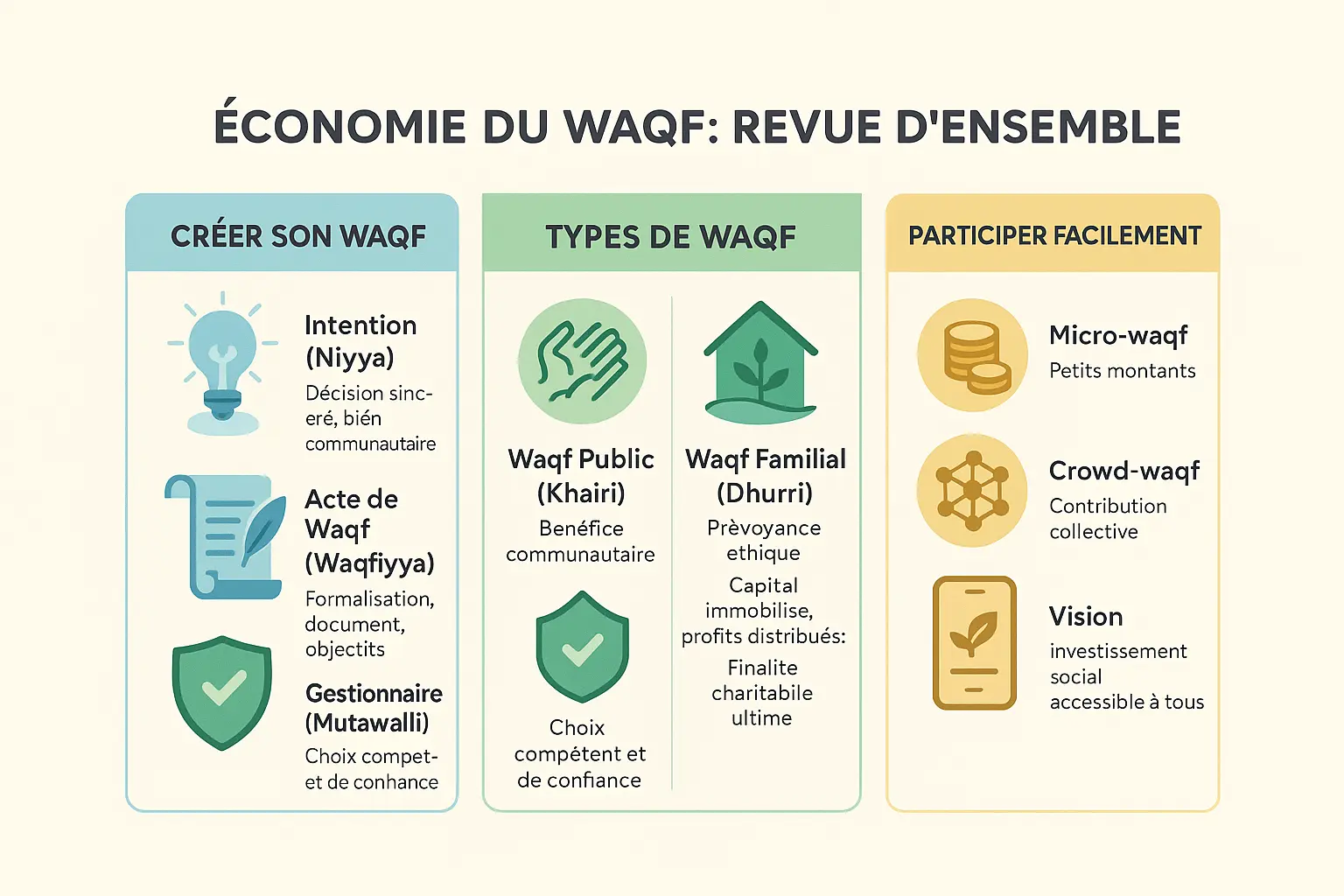
Transformer un bien en levier d’impact spirituel et social commence par une intention sincère. Voici les étapes simplifiées pour concrétiser votre projet de waqf :
- L’intention (Niyya) : Fixez un objectif clair en harmonie avec vos valeurs. Voulez-vous soutenir l’éducation, la santé, ou renforcer la solidarité familiale ? Cette intention guide chaque décision ultérieure.
- L’acte de Waqf (Waqfiyya) : Formalisez votre engagement dans un document détaillant le bien choisi, ses bénéficiaires, et les modalités de gestion. Ce contrat spirituel et juridique garantit la pérennité de votre don.
- La désignation du gestionnaire (Mutawalli) : Choisissez une personne ou une institution de confiance pour préserver et optimiser le bien. Ce gestionnaire agit comme un garant de vos intentions, avec une rigueur comptable et un souci éthique.
Le waqf familial (dhurri), un outil de prévoyance éthique
Le waqf familial (dhurri) conjugue protection des patrimoines et solidarité intergénérationnelle. Contrairement au waqf public (khairi) dédié aux causes universelles, le dhurri privilégie d’abord les descendants du fondateur.
Prenons l’exemple d’un élevage de moutons : le capital (les animaux) reste inaliénable, mais les profits (vente de laine, d’agneaux) peuvent soutenir les besoins familiaux. Toutefois, cette structure exige une finalité caritative ultime. Si la lignée s’éteint, les actifs peuvent être redirigés vers des causes publiques, assurant ainsi un impact social durable.
Participer à des fonds de waqf modernes et accessibles
La révolution numérique a démocratisé le waqf. Désormais, même de modestes contributions peuvent alimenter des projets collectifs grâce au crowdfunding islamique. Ce modèle, éprouvé dans des initiatives agricoles, permet à des petits agriculteurs d’accéder à des financements sans dette.
Pour les novices, les institutions financières islamiques modernes offrent un accompagnement clé en main. Elles assurent la conformité à la Chari’a, la transparence des comptes, et l’optimisation des rendements. Que ce soit pour financer un puits en Afrique ou un programme éducatif en Asie, ces plateformes transforment chaque don, même modeste, en graine de changement.
Le waqf incarne une vision où la foi nourrit l’action. Il rappelle que l’économie peut être un levier d’unité, pas de division. En préservant le capital et en redistribuant ses fruits, ce modèle prévoit une société plus juste, où la baraka remplace la spéculation, et où chaque acte financier devient une forme de culte.
Le Waqf incarne une solution intemporelle pour une économie juste, durable et solidaire. En alliant spiritualité et bien-être social, il **transforme le capital en bénéfice collectif, remplaçant la dette par la Baraka**. Accessible à tous, il incarne un investissement éthique où chaque acte résonne pour l’éternité, entre terre et ciel.
FAQ
Quel est le concept de waqf ?
Le Waqf est une institution profonde de l’islam, un peu comme planter un arbre dont les fruits nourriront les générations futures. Il s’agit d’immobiliser un bien (un terrain, un immeuble, ou même de l’argent) pour en consacrer les bénéfices à une cause charitable. Le bien devient inaliénable et irrévocable – on ne peut ni le vendre, ni le transmettre par héritage. C’est un don définitif, mais pas désintéressé : votre intention sincère crée un flux de bienfaits continus, pour la communauté et pour vous, au-delà de votre vie terrestre.
C’est quoi le waqf en islam ?
Pour le musulman, le Waqf est bien plus qu’un outil juridique : c’est un engagement spirituel. Imaginez un capital figé comme un pilier solide, dont les revenus s’écoulent comme une rivière nourrissant les besoins d’une école, d’un hôpital, d’un puits. Cette pratique trouve sa racine dans un hadith prophétique : l’aumône continue (Sadaqa Jariya) fait partie des trois actes qui persistent après notre mort. En dédiant un bien à Dieu, vous construisez un héritage éternel, où chaque euro généré devient une prière silencieuse pour votre salut.
Qu’est-ce que le waqf vert ?
Le Waqf Vert est une innovation qui s’inspire de l’esprit écologique de notre époque. Comme un jardin dont les racines nourrissent la terre, il s’agit d’investir dans des projets durables – énergies renouvelables, agriculture responsable, reforestation. Ce n’est pas juste économiser l’eau d’un puits, mais préserver la source elle-même. Un Waqf moderne qui allie foi et écologie, pour cultiver un monde où les générations futures trouveront un toit, de la nourriture, et un environnement préservé.
Qu’est-ce que le waqf dans le Coran ?
Le mot « Waqf » n’apparaît pas en lettres arabes dans le Coran, mais son esprit imprègne l’ensemble du message divin. Rappelez-vous le verset : « Et ils vous demandent ce qu’ils doivent donner. Dis : Donnez l’excédent » (2:219). Le Waqf est cet excédent transformé en don perpétuel. C’est l’application concrète de cette injonction, en immobilisant un bien pour en faire un fleuve de bienfaits, là où la Sadaqa ordinaire est une goutte d’eau qui s’évapore.
Quelles sont les règles du waqf ?
Les règles du Waqf sont simples comme un contrat de confiance : il faut être majeur, sain d’esprit, et propriétaire du bien offert – sans dettes qui pèseraient sur ce don. Le bien doit être licite (halal), tangible, et son utilisation clairement définie (pour une école, un hôpital…). Une fois le contrat établi, le bien appartient symboliquement à Dieu. Le Mutawalli, gestionnaire désigné, le cultive avec honnêteté comme un jardinier soigne un verger, en redistribuant les fruits sans en posséder les racines.
Quelle est la différence entre le waqf et la sadaqah ?
La Sadaqa est une aumône ponctuelle, un don qui s’achève avec l’acte. Le Waqf, lui, est un don qui continue de donner – comme planter un arbre dont les fruits nourriront les pauvres pendant des siècles. Si la Sadaqa est une bougie qui éclaire un soir, le Waqf est un phare dont la lumière guide les générations. La différence tient au lien éternel : dans le Waqf, le capital reste intact, et seuls les revenus servent à la cause, créant une récompense spirituelle ininterrompue.
Qu’est-ce que le waqf en finance islamique ?
En finance islamique, le Waqf est l’anti-dette par excellence. Contrairement aux systèmes traditionnels basés sur l’intérêt (riba), il repose sur des actifs réels – un immeuble, une ferme – dont les profits circulent dans l’économie sans spéculer. C’est une manière d’investir sans oublier qu’un capital bien utilisé nourrit la société. Imaginez un fonds qui génère des revenus éthiques, comme un verger dont les récoltes alimentent des écoles : c’est le Waqf, prémisse de la finance sociale moderne.
Quelle est la définition de Qawam ?
Je crois que vous faites référence à « Waqf » plutôt qu’à « Qawam ». Le terme « Qawam » en islam désigne plutôt celui qui entretient ou soutient – par exemple, le rôle d’un mari envers sa famille. Mais en matière de Waqf, c’est le Mutawalli qui « qawam » l’actif immobilisé, le préserve et en fait fructifier les bénéfices pour la communauté.
Comment se débarrasser du waswas en Islam ?
Le waswas est ce murmure du malin qui trouble votre foi ou vos bonnes actions. Pour s’en libérer, l’Islam préconise une hygiène spirituelle : recherchez refuge auprès d’Allah, récitez le Coran avec régularité, et pratiquez la prière de repentance. Comme une brise qui disperse les nuages, la constance dans le bien éloigne ces tentations. Si le trouble persiste, consultez un savant ou un conseiller spirituel, car parfois, le malaise vient d’une porte qu’il faut refermer ensemble.