<meta name="google-site-verification" content="0S72xkYcSqqt100ZuIzn_Zif1zL8vIvcXUmc5Tjo10o" />


L’essentiel à retenir : La zakat n’est pas une simple aumône, mais un levier économique qui combat la thésaurisation en imposant un taux annuel de 2,5 % sur les avoirs dormants. En incitant à investir ou redistribuer, elle stimule la croissance et réduit les inégalités. Un mécanisme divin pour une finance juste, où la richesse circule au bénéfice de tous plutôt que de stagner.
Fatigué de voir des fortunes dormir inutilement alors que des millions manquent du nécessaire ? La zakat, souvent réduite à un simple devoir rituel, est en réalité un mécanisme divin contre la thésaurisation, redistribuant la richesse stagnante et réveillant l’économie. En imposant 2,5 % sur les avoirs inactifs, elle punit la stagnation et stimule l’investissement éthique, transformant l’argent figé en outil de justice sociale. Contrairement au capitalisme qui concentre les richesses, la zakat crée un flux circulaire bénéfique, réduisant les inégalités et insufflant sérénité collective. Découvrez comment ce pilier islamique allie croissance durable et valeurs de partage, réalignant la finance sur l’humain.
Sommaire
La zakat : bien plus qu’une aumône, un pilier économique
Dépasser la vision traditionnelle de la zakat
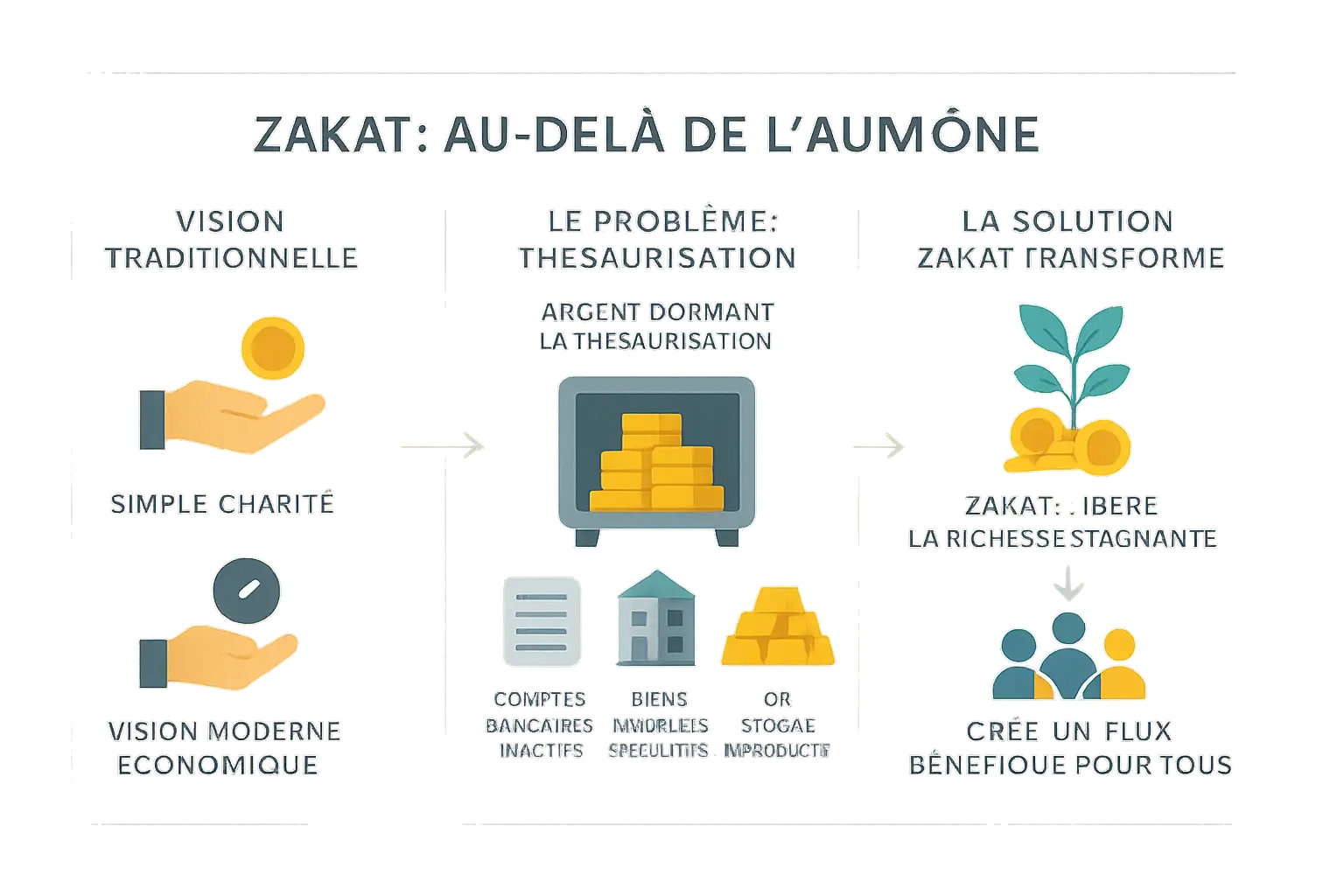
Quand on évoque la Zakat, nombreuses sont celles et ceux qui y voient une simple obligation religieuse. Pourtant, cette pratique est bien plus qu’un acte de charité : c’est un mécanisme économique pensé pour fluidifier les richesses et éviter leur concentration. En exigeant un prélèvement annuel de 2,5 % sur les avoirs inactifs, la Zakat incite à sortir de la logique de l’argent qui dort, pour le mettre en mouvement au bénéfice de tous.
Le problème de l’argent dormant
La thésaurisation – accumulation passive de richesses – est un poison pour l’économie. Un compte bancaire saturé, des biens immobiliers vacants, ou des métaux précieux enfermés dans un coffre : ces pratiques privent la société de ressources vitales. Alors que le capitalisme moderne valorise l’accumulation, la zakat thésaurisation s’attaque à cette stagnation en imposant une perte douce mais régulière sur les avoirs non productifs. Résultat ? L’argent circule, stimulant emploi, consommation et solidarité.
Annonce du plan
Cet article explore comment la Zakat révolutionne notre rapport à l’argent. Nous verrons comment elle désincite la thésaurisation, redistribue les richesses de manière juste, et s’oppose à un système qui valorise la concentration financière. En résumé, la Zakat n’est pas seulement un devoir spirituel : c’est un levier pour une économie plus inclusive, où la richesse nourrit la société plutôt que d’alimenter des comptes anonymes.
La thésaurisation : une injustice sociale et un frein économique
Qu’est-ce que la thésaurisation en finance islamique ?
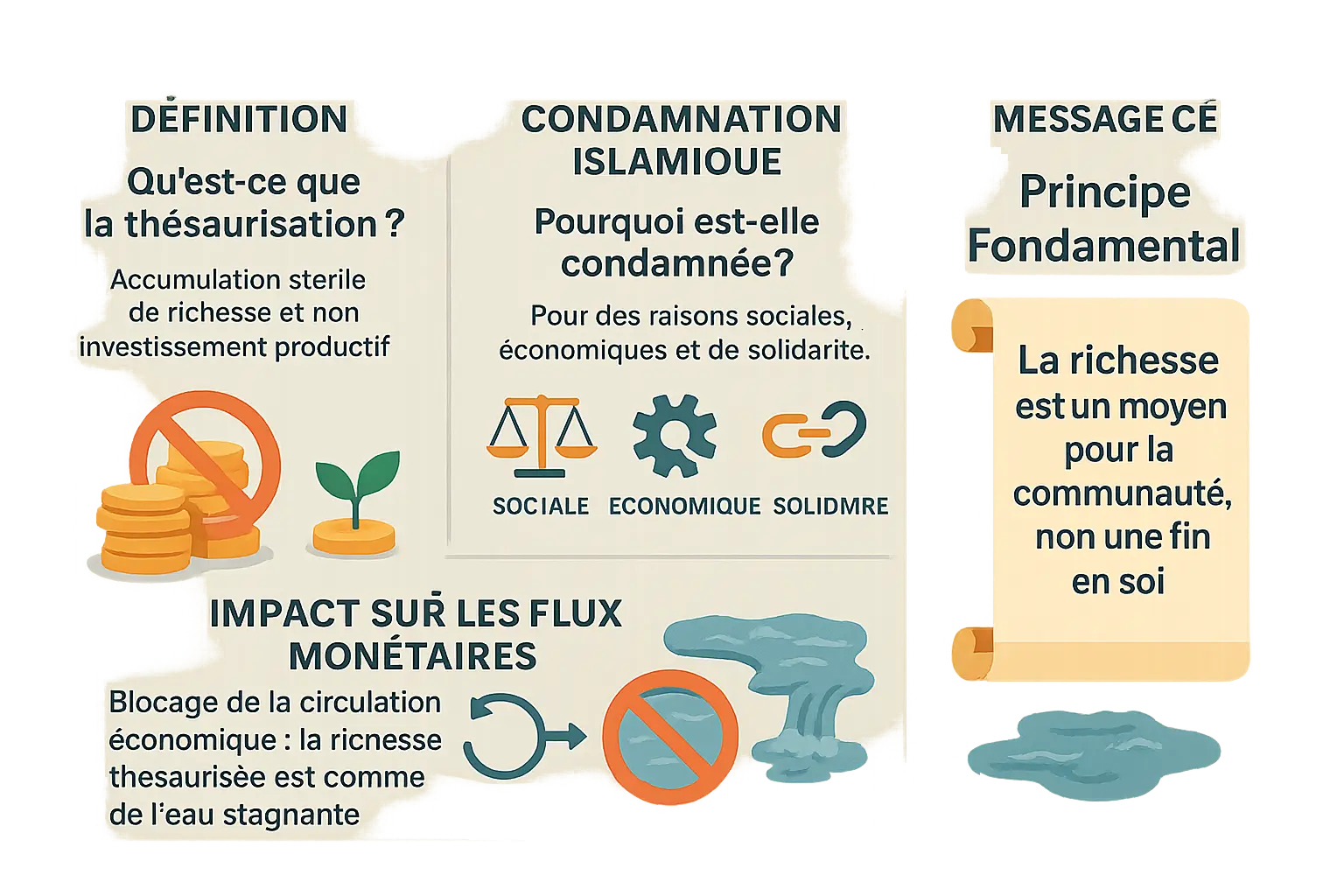
En finance islamique, l’épargne utile est encouragée, mais la thésaurisation, ou « al-kanz », est l’accumulation excessive de richesses — argent, or, liquidités — au-delà des besoins réels, sans les investir ou s’acquitter de la Zakat. Ce stockage stérile va à l’encontre de l’éthique islamique, paralysant l’économie et empêchant les ressources de servir la communauté. Concrètement, thésauriser, c’est laisser des avoirs dormir dans un coffre ou un compte sans les utiliser pour des projets productifs, des échanges commerciaux ou des actes de solidarité.
Pourquoi l’islam condamne-t-il cette pratique ?
La thésaurisation concentre la richesse entre quelques mains, privant l’économie de liquidités vitales. Elle freine la justice économique et l’épanouissement collectif. Derrière cette condamnation, une vision profonde : la richesse doit circuler pour servir la communauté, jamais s’accumuler. En thésaurisant, un individu non seulement contrevient à un devoir spirituel, mais agit contre l’intérêt général. Cela crée un déséquilibre qui affaiblit les liens sociaux et éloigne la société du modèle islamique de partage et de responsabilité mutuelle.
La richesse n’est pas une fin en soi, mais un moyen au service de la communauté. La laisser dormir, c’est priver la société de son potentiel de croissance et de justice.
L’impact négatif sur les flux monétaires
L’argent immobilisé étouffe l’économie. Lorsque des montants importants sont thésaurisés, les flux monétaires ralentissent, accentuant les inégalités. La Zakat incite à la mise en mouvement des richesses : l’argent doit créer, échanger, redistribuer. Comme une rivière qui irrigue les terres, la richesse circule et nourrit l’écosystème économique. Lorsqu’elle s’arrête, elle assèche les opportunités pour ceux qui en ont besoin.
Cette dynamique est confirmée par l’impact négatif sur l’économie. Lorsqu’il circule, il nourrit l’emploi et la prospérité partagée. Lorsqu’il dort, il étouffe le développement collectif. Sans mouvement, les richesses deviennent inutiles, les inégalités s’enracinent, et la croissance s’épuise.
La zakat : un mécanisme divin pour la circulation des richesses
Le principe : une taxe spirituelle sur la stagnation
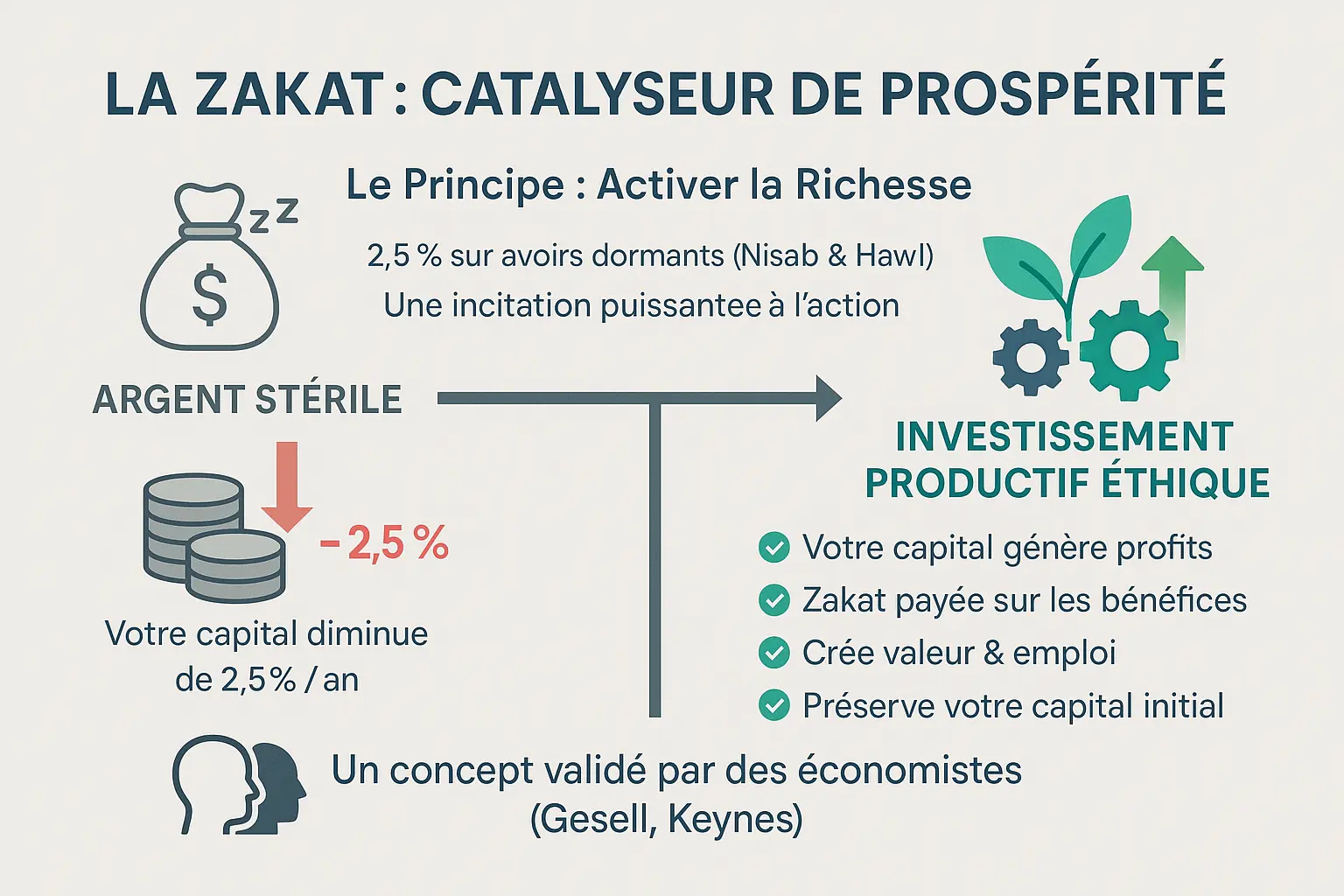
Derrière sa dimension spirituelle, la zakat agit comme un levier économique unique. En exigeant un prélèvement annuel de 2,5 % sur les avoirs dépassant un seuil minimal (le Nisab) et détenus pendant un an lunaire (le Hawl), elle incarne une règle claire : l’argent qui ne circule pas se réduit mécaniquement. Ce n’est pas une punition, mais un rappel bienveillant : la richesse est un outil de justice sociale, non un trophée individuel. Elle cultive l’habitude de l’action, comme un jardinier qui taille les branches mortes pour la santé de l’arbre.
De la stagnation à l’investissement productif
Face à cette règle, deux chemins s’éclairent :
- L’inaction : Votre argent perd 2,5 % chaque année, un frein naturel à l’immobilisme.
- L’action éthique : En investissant dans des projets halal—comme un atelier de couture ou une micro-ferme agroécologique—vous payez la zakat sur les profits, non sur le capital. Cela protège votre fonds tout en générant emploi et autonomie locale.
Ce mécanisme nourrit un écosystème solidaire. Une personne qui finance un artisan halal ne redistribue pas seulement 2,5 % : elle active un cycle de valeur, de dignité et de confiance. C’est l’ADN même de Namlora, qui fait rayonner ces principes.
Un concept validé par des économistes
La logique de la zakat résonne avec des visions économiques universelles. Silvio Gesell, précurseur du XXᵉ siècle, imaginait une « monnaie fondante » pour décourager la thésaurisation. John Maynard Keynes, père de l’économie moderne, qualifiait cette idée d’ »irréprochable ». Lire l’idée derrière est saine : une économie fluide où l’argent sert, pas enchaîne.
En résumé, la zakat incarne un équilibre rare. Elle prévient la concentration des richesses en les remettant en mouvement, tout en ancrant la foi dans l’économie réelle. C’est une invitation à construire un monde où prospérité et équité se renforcent, comme les racines et les branches d’un même arbre.
Comment la zakat s’applique-t-elle concrètement aux biens thésaurisés ?
Le cas de l’or et de l’argent dormant
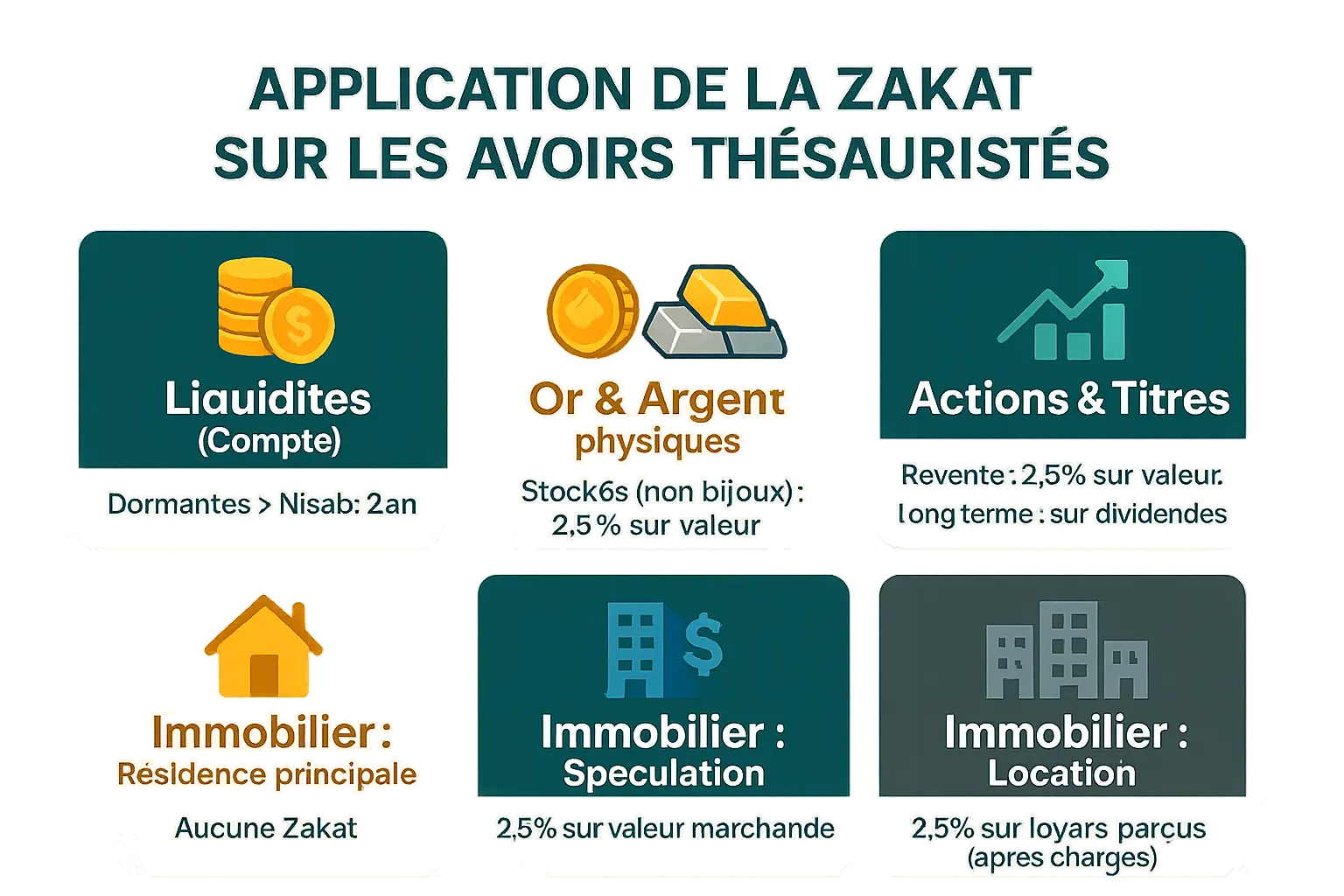
Conserver des liquidités ou des métaux précieux sans les utiliser expose à la Zakat. Dès que vos avoirs dépassent le seuil du Nisab (85g d’or ou 595g d’argent), vous devez verser 2,5 % de leur valeur chaque année. Cette règle incite à sortir ces biens de leur inertie économique.
Un coffre-fort rempli d’or inactif devient un levier économique via la Zakat. Soit vous le réinvestissez dans des projets productifs, soit vous redistribuez sa valeur. Cette obligation annuelle transforme l’épargne stérile en capital circulant. Pour ceux qui souhaitent faire fructifier leur or de manière éthique, il existe des méthodes d’investissement conformes aux principes islamiques.
Qu’en est-il de l’immobilier non productif ?
La résidence principale est épargnée, mais les biens acquis pour la spéculation ou laissés vides entrent dans le calcul. Un appartement déclaré comme actif spéculatif subit une Zakat de 2,5 % sur sa valeur marchande.
Les logements vacants sans raison légitime deviennent zakatables pour encourager leur mise en location. Cela lutte contre l’accumulation immobilière stérile et relance le marché. Un propriétaire laissant un bien inoccupé paie non seulement une Zakat sur sa valeur potentielle, mais prive aussi les ménages de ressources vitales. Cette logique s’intègre dans une vision plus vaste d’un financement immobilier éthique, éloigné des pratiques spéculatives.
Tableau récapitulatif : zakat sur les avoirs
| Type d’Avoir | Situation de l’Avoir | Principe d’Application de la Zakat |
|---|---|---|
| Liquidités (Compte bancaire) | Argent dormant au-delà du Nisab | 2,5 % sur le montant total après un an. |
| Or et Argent physiques | Stockés comme réserve de valeur (hors bijoux portés) | 2,5 % sur la valeur marchande actuelle. |
| Actions et Titres | Investis dans des entreprises halal | 2,5 % sur la valeur des actions si destinées à la revente, ou sur les dividendes si conservées à long terme (selon les écoles). |
| Immobilier | Résidence principale | Pas de Zakat. |
| Immobilier | Acheté pour la spéculation (revente) | 2,5 % sur la valeur marchande du bien. |
| Immobilier | Mis en location | 2,5 % sur les loyers perçus (après déduction des charges). |
La Zakat transcende l’obligation financière. Elle pousse à réinvestir dans l’économie réelle en taxant les actifs inactifs. Ce mécanisme garantit une rotation vertueuse de la richesse, favorise l’accès au logement et stimule l’entrepreneuriat. En maintenant cette dynamique, la Zakat agit comme un remède contre les déséquilibres économiques et sociaux liés à l’accumulation passive de capital.
Zakat vs capitalisme : deux visions opposées de la richesse
Distribution contre concentration
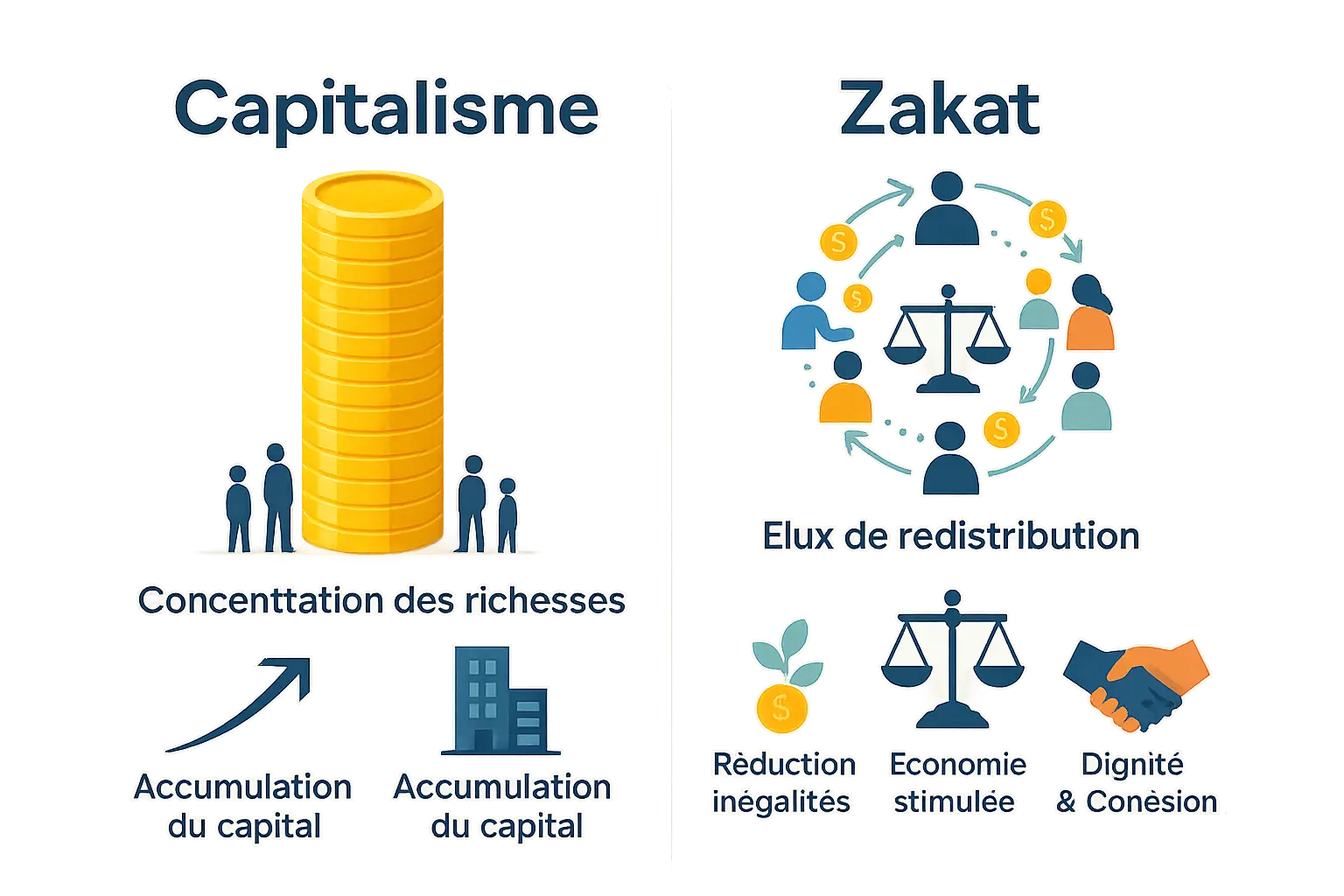
Le capitalisme moderne favorise la concentration des richesses entre quelques mains, créant un déséquilibre structurel. La Zakat, en revanche, impose un flux constant de redistribution, garantissant un équilibre social et économique plus sain.
Là où le capitalisme moderne favorise la concentration du capital, la Zakat impose un flux constant de redistribution, garantissant un équilibre social et économique plus sain.
En exigeant un prélèvement annuel de 2,5 % sur les avoirs dormants, la Zakat incite à investir dans l’économie réelle plutôt qu’à thésauriser. Ce seuil n’est pas arbitraire : il évite de décourager l’épargne tout en incitant à l’action. Par exemple, un épargnant musulman préfère placer son argent dans un fonds solidaire plutôt que de le laisser stagner, générant à la fois un rendement éthique et un impact social. À long terme, ce mécanisme cultive un équilibre entre épargne et partage.
Les bienfaits d’une économie fondée sur la solidarité
La Zakat ne se limite pas à un acte religieux : c’est un pilier économique qui réinvente les rapports sociaux. Son impact se mesure par :
- Réduction des inégalités : En transférant des ressources des plus aisés vers les plus vulnérables, la Zakat renforce la cohésion. En savoir plus sur sa capacité à réduire les inégalités socio-économiques. Ce mécanisme rééquilibre les écarts hérités et prévient la paupérisation chronique.
- Stimulation de l’économie réelle : Les fonds redistribués dynamisent la consommation et l’entrepreneuriat. Un receveur de Zakat dépense immédiatement pour ses besoins essentiels, activant les marchés locaux. En Afrique de l’Ouest, des initiatives comme le programme « Zakat for Entrepreneurs » au Sénégal transforment ces fonds en micro-crédits productifs.
- Protection spirituelle et dignité : Pour le donateur, la Zakat libère l’âme de la tentation de l’accumulation. Pour le bénéficiaire, c’est un droit qui restaure la dignité sans humiliation. Cette double dimension matérielle et morale renforce la confiance au sein des communautés.
En agissant sur ces leviers, la Zakat construit un écosystème où la richesse circule, nourrit l’activité et prévient les crises. Elle incarne une vision où prospérité et justice s’harmonisent, ancrant la stabilité par l’équité. Contrairement aux cycles spéculatifs du capitalisme, elle établit un modèle d’équilibre entre éthique, économie et solidarité.
Vers un écosystème financier plus juste et plus humain
La zakat, une loi économique et spirituelle
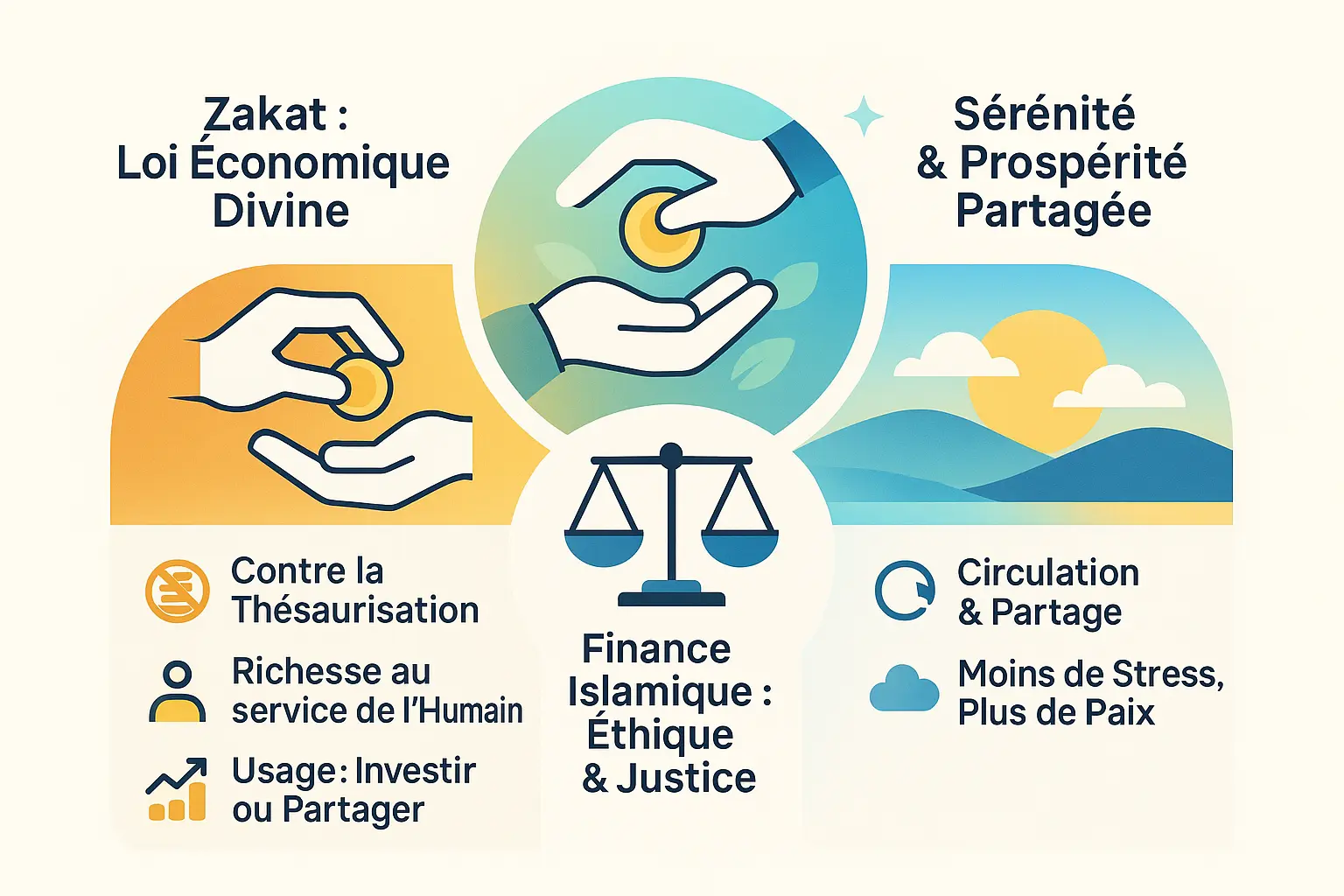
La Zakat est à la fois un devoir religieux et un mécanisme économique intelligent : en imposant 2,5 % sur les richesses inactives, elle empêche la thésaurisation. Contrairement au capitalisme moderne valorisant l’accumulation, elle exige que l’argent circule pour servir la communauté.
Ce système protège la société en incitant à investir dans le réel ou à redistribuer aux plus démunis. Un capital stagnant subit une érosion progressive, tandis qu’un capital investi génère bénéfices et solidarité.
Bâtir un nouveau modèle d’investissement
Namlora incarne cette vision avec un écosystème d’investissement éthique où rentabilité et conformité islamique guident chaque décision, valorisant transparence, partage des profits et exclusion des activités illicites.
Notre plateforme connecte entrepreneurs et investisseurs engagés. Namlora guide vers des opportunités responsables où la croissance profite à tous sans trahir ses valeurs.
Un choix pour un avenir serein
Choisir la Zakat, c’est opter pour une sérénité collective : ce système crée une économie vivante où chacun trouve sa place, libérant les riches de l’attachement excessif et redonnant dignité aux plus vulnérables.
Transformez votre argent en levier de transformation sociale. Découvrez nos solutions d’investissement halal pour aligner vos finances à vos convictions et contribuer à un monde plus juste, un dirham à la fois.
La zakat n’est pas une obligation rituelle, mais une loi économique divine qui combat la thésaurisation en redistribuant la richesse. Elle stimule l’économie et la cohésion sociale. La finance islamique incarne un modèle juste et éthique. Namlora propose des solutions d’investissement halal. Ensemble, transformons la richesse en progrès partagé.
FAQ
Quelle est la différence entre la thésaurisation et l’épargne ?
La thésaurisation consiste à accumuler des richesses (or, argent, immobilier) sans les utiliser ni les investir, les laissant stagner alors qu’ils pourraient servir à la société. L’épargne, en revanche, est une réserve prévue pour des besoins futurs (comme un projet ou une précaution), souvent temporaire et alignée sur des objectifs productifs. L’islam encourage l’épargne utile, mais condamne la thésaurisation stérile, car elle prive l’économie de liquidités vitales et creuse les inégalités sociales.
Quel est le montant du zakat achoura pour 2025 ?
Le terme « zakat achoura » semble être une confusion avec la Zakat Al-Maal (zakat sur les biens). En 2025, le seuil (Nisab) est fixé à environ 530 € (base argent, 595 g) ou 7 595 € (base or, 85 g). Si vos avoirs dépassent ce seuil depuis un an (Hawl), la Zakat s’élève à 2,5 % de la valeur marchande de vos biens éligibles (liquide, or, investissements spéculatifs, etc.).
Qu’est-ce que la thésaurisation ?
La thésaurisation désigne l’accumulation de richesses au-delà des besoins personnels, sans les investir, les utiliser ou s’acquitter de la Zakat. C’est un acte d’avarice stérile, condamné par le Coran (Sourate At-Tawba, v.34), qui prive l’économie de flux et concentre les richesses. À l’inverse, l’islam valorise l’investissement éthique et le partage, comme le souligne la Zakat, qui incite à « faire fructifier » les biens.
Que faire si j’ai de l’or mais pas d’argent pour payer la zakat ?
Si vous possédez de l’or atteignant le seuil du Nisab (85 g, environ 7 595 € en 2025) sans liquidités, vous devez convertir une partie de cet or en argent pour régler la Zakat (2,5 % de sa valeur). Par exemple, pour 100 g d’or, vendez environ 2,5 g pour le redistribuer. Cette obligation rappelle que la richesse doit circuler, même si cela implique de se séparer d’un bien matériel.
Quels sont les avantages de la thésaurisation ?
Selon la finance islamique, la thésaurisation n’apporte aucun avantage. Elle est même perçue comme une injustice sociale, car elle fige les richesses et alimente la spéculation. L’islam préfère une économie dynamique où chaque actif génère de la valeur ou nourrit la solidarité. La Zakat, en taxant l’inaction, encourage cette vision circulaire et juste, contrairement au capitalisme qui valorise l’accumulation.
Quels sont les inconvénients de la thésaurisation ?
La thésaurisation a deux impacts majeurs :
• Économique : Elle étouffe les flux monétaires, freinant la consommation, l’investissement et la création d’emplois.
• Social : Elle concentre les richesses, laissant une majorité sans moyens d’existence. Spirituellement, elle nourrit l’attachement matériel. La Zakat combat ces effets en transformant l’argent inactif en levier de justice ou de croissance.
Quel est le montant du zakat pour la zakat Al Maal 2025 ?
Pour 2025, le seuil (Nisab) est basé sur l’or ou l’argent :
• Or : 85 g (environ 7 595 €).
• Argent : 595 g (environ 530 €).
Si vos avoirs (liquide, or, investissements spéculatifs) dépassent ce seuil depuis un an (Hawl), appliquez un taux de 2,5 % sur leur valeur totale après déduction des dettes éligibles.
Est-ce qu’on peut donner la zakat à la famille ?
La Zakat ne peut pas être donnée à ses ascendants directs (parents, grands-parents), descendants (enfants, petits-enfants) ou conjoint(e). Cependant, une grande tante, un cousin ou une personne éloignée liée à votre famille peut en bénéficier, à condition qu’elle n’ait pas de ressources suffisantes. L’objectif est de renforcer les liens sociaux sans négliger les obligations familiales normales.
Quel est le montant de la zakat par personne en France ?
En France, le montant varie selon le Nisab et la valeur du capital de chaque individu. Si vos biens (liquide, or, investissements) valent plus de 7 595 € (or) ou 530 € (argent) et dépassent ce seuil depuis un an, vous payez 2,5 % de leur valeur. Ce calcul inclut aussi les dettes déductibles, comme les frais immobiliers ou impôts à venir.