<meta name="google-site-verification" content="0S72xkYcSqqt100ZuIzn_Zif1zL8vIvcXUmc5Tjo10o" />
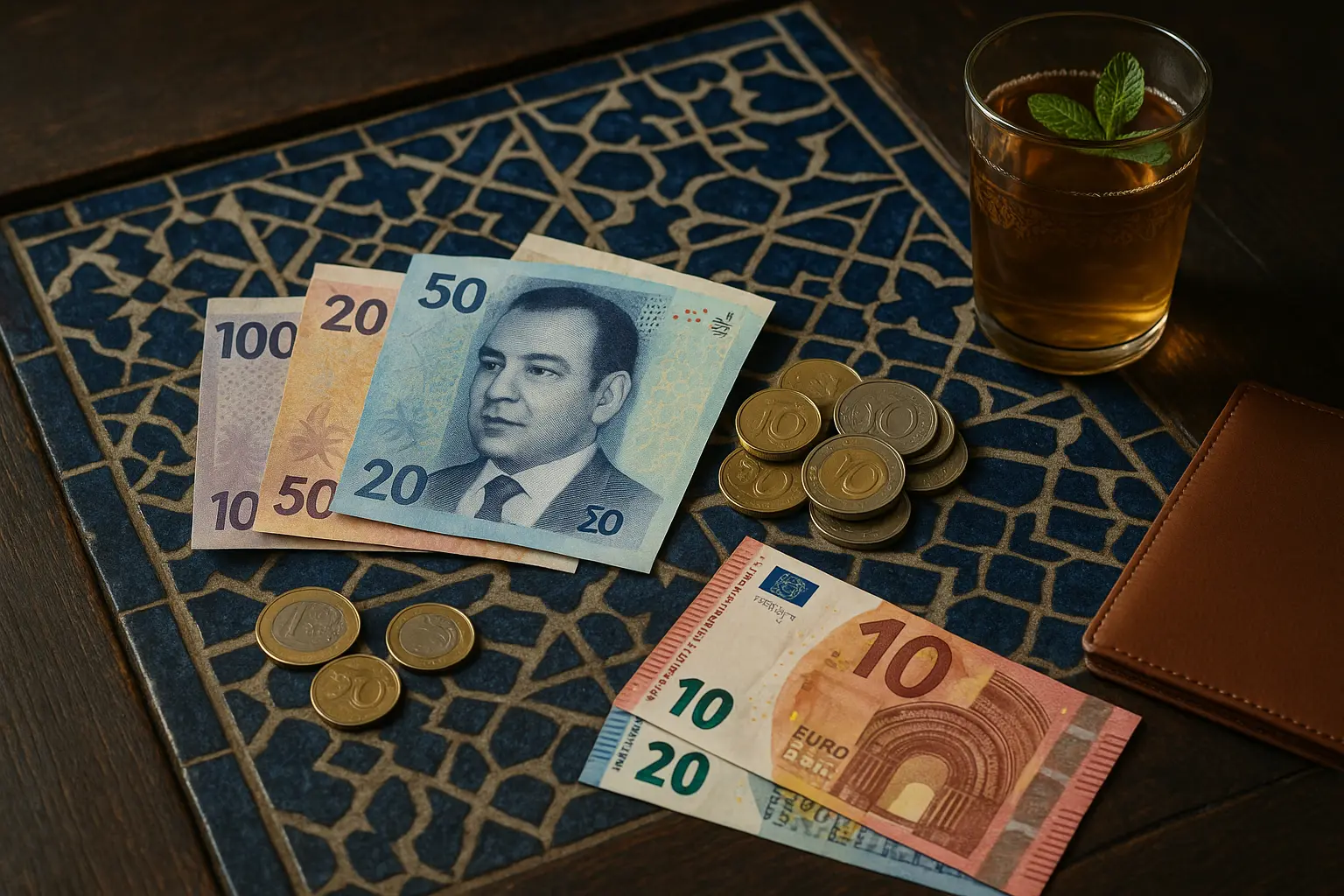
L’essentiel à retenir : Le dirham marocain (MAD/DH) est la seule monnaie acceptée au Maroc, avec un taux de change avantageux (1€ ≈ 10,5 DH). Privilégiez les bureaux de change officiels ou les DAB pour éviter les mauvaises surprises. Conservez vos reçus pour reverser vos dirhams restants. Une petite coupure comme 10 DH suffit pour un thé traditionnel, symbole de l’accueil marocain.
Fatiguée de jongler entre euros et dirhams lors de vos visites au Maroc ? La monnaie maroc reste un mystère malgré vos origines ? Ce guide décrypte le dirham marocain (MAD), son statut officiel et les pièges à éviter. Découvrez les bons réflexes pour changer de l’argent, reconnaître les billets (comme le 200 DH ou le 100 DH orné de paysages désertiques), et naviguer sans stress. Avec 1 EUR ≈ 10,49 MAD et une inflation stable à 1%, vous éviterez les mauvaises surprises. Vos grands-parents apprécieront votre aisance en marchandant un tapis au souk, tout comme les billets commémoratifs de 25 DH !
Table of Contents
Le dirham marocain : la monnaie officielle à connaître pour votre voyage
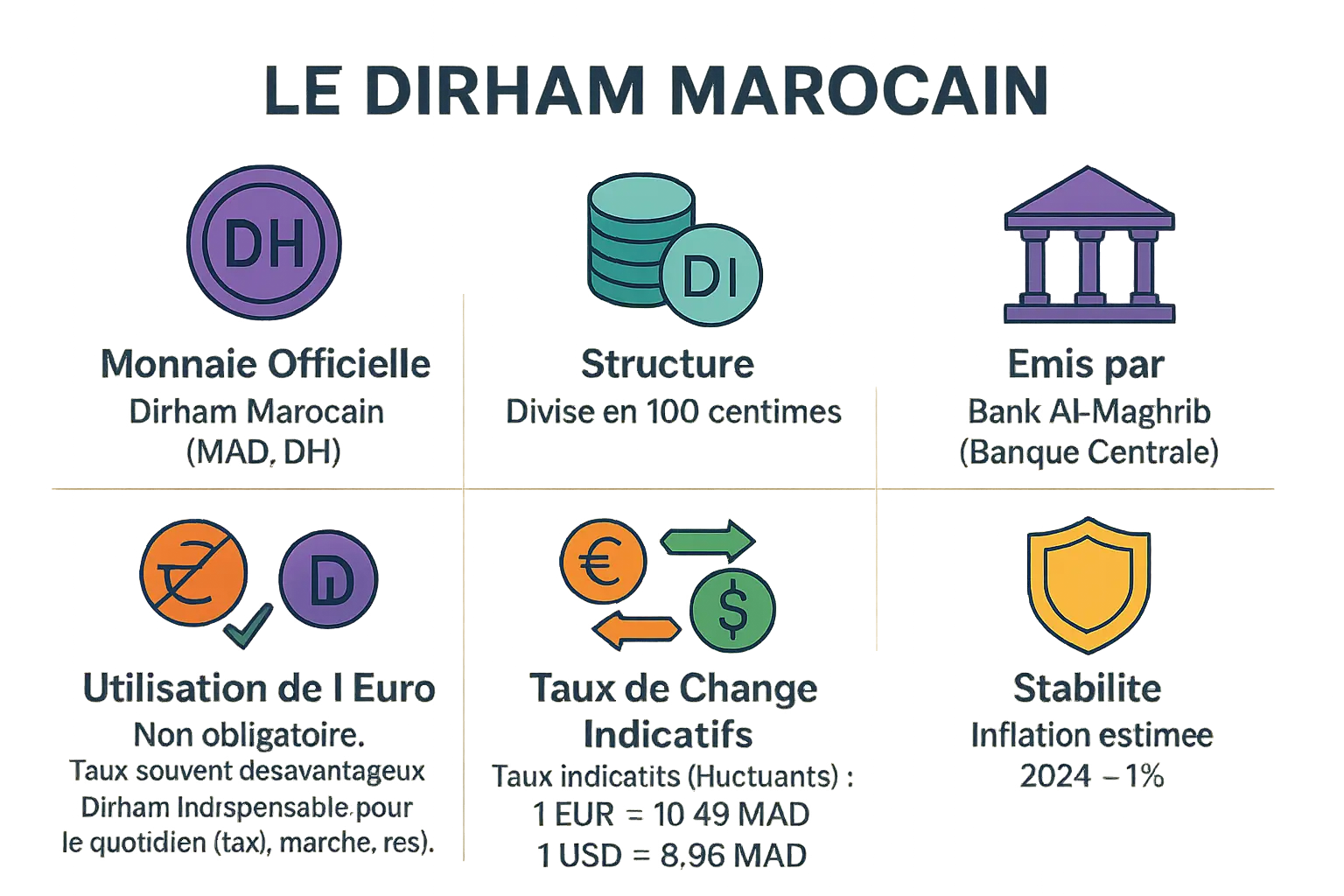
Comme Samira, vous rêvez d’un voyage au Maroc pour retrouver vos racines familiales ? Le dirham marocain (MAD/DH) est la seule monnaie acceptée partout dans le pays. C’est un élément clé pour profiter pleinement de votre immersion culturelle, et même les billets racontent l’histoire du Maroc à travers leurs motifs.
La monnaie se divise en 100 centimes, comme les centimes d’euro. Gérée par la Bank Al-Maghrib, elle circule en pièces (0,50 à 10 DH) et billets (20 à 200 DH). Depuis 2023, de nouvelles pièces en circulation renforcent sa modernité. Les billets récents arborent des paysages emblématiques : mosquée Hassan II, port de Tanger, ou encore cascades d’Ouzoud.
L’euro est parfois accepté dans les grands hôtels ou zones touristiques, mais avec des taux désavantageux. Pour les marchés, taxis ou cafés locaux, seul le dirham fonctionne. Une erreur à éviter ? Arriver sans dirhams : changez vos euros dès l’arrivée à l’aéroport ou dans une banque locale.
1 euro vaut environ 10,49 dirhams. En 2024, l’inflation reste très faible (1%), assurant une stabilité rassurante. Prévoyez entre 4 000 et 8 000 MAD pour une semaine. Un café coûte 3 à 5 DH, un taxi 20 DH, un repas dans un bon restaurant 150 à 300 DH. Le baksheesh (pourboire) se pratique modérément : 5 à 10 DH pour un bagagiste.
Pour changer de l’argent, préférez les banques (Attijariwafa, Banque Populaire) ou bureaux de change officiels. Évitez les échanges en rue pour éviter les arnaques. Les distributeurs locaux acceptent Visa/Mastercard, mais informez votre banque avant le départ pour éviter les blocages. Les paiements mobiles restent rares en zones rurales.

Pourquoi changer de l’argent dès l’arrivée au Maroc ?
Le dirham (MAD) est une monnaie semi-flexible non librement convertible. Impossible de s’en procurer facilement hors du pays. Une fois sur place, mieux vaut oublier les billets étrangers : pourboires, taxis, souks se règlent en dirhams. Même si certains commerces touristiques acceptent l’euro, le taux est souvent désavantageux.
Où changer ses euros en dirhams ?
- Bureaux de change officiels : Meilleure solution pour obtenir de l’argent rapidement. Trouvables dans les aéroports, gares et zones touristiques, avec des taux transparents. Évitez ceux des endroits stratégiques comme Jemaa el-Fna où les marges sont parfois gonflées.
- Banques marocaines : Taux plus avantageux, mais horaires restreints (en moyenne 8h30-14h30) et potentielles files d’attente. À privilégier si vous avez du temps.
- Distributeurs automatiques (DAB) : Solution rapide et accessible 24h/24. Les DAB des grandes banques offrent des taux compétitifs. Attention aux frais de votre propre banque et à la DCC (à refuser systématiquement).
- Hôtels : Pratique en urgence, mais taux souvent mauvais. À utiliser uniquement si nécessaire.
Pourquoi éviter le change illégal ?
« Pour votre sécurité, privilégiez les bureaux agréés ou les DAB. Conservez vos reçus pour reconvertir les dirhams restants avant le départ. »
Changer son argent dans la rue est interdit au Maroc. Résultat : risques d’arnaque, de faux billets, et même d’ennuis juridiques. Impossible de prouver légitimité en cas de contrôle.
Payer par carte au Maroc : jusqu’où c’est possible ?
Les grandes surfaces et hôtels acceptent la carte, mais le cash règne dans les souks et petites échoppes. Prévoyez toujours des petites coupures. Une carte sans frais à l’étranger (Revolut, Wise) facilite les retraits.
Conseils pour gérer son argent
Conservez vos reçus de change pour reconvertir les dirhams restants. N’exportez jamais plus de 2 000 MAD (limite légale). Pour une semaine, prévoyez entre 1 600 et 5 000 MAD selon votre budget. Vérifiez toujours les billets de 20 et 200 MAD qui se ressemblent.
Reconnaître les billets et les pièces de la monnaie marocaine
Pour Samira, savoir distinguer les billets et pièces marocains, c’est avancer sereinement dans les souks ou aider ses grands-parents à compter la monnaie. Un détail qui renforce sa connexion avec le Maroc.
Le dirham (DH) se divise en 100 centimes. En circulation, des billets de 20, 50, 100 et 200 DH, ainsi que des pièces de 0,50, 1, 2, 5, 10 DH et 10/20 centimes. Les nouvelles pièces de 2023, avec des motifs géométriques et inscriptions en arabe, incluent des détails tactiles pour les malvoyants.
Les billets de la série 2013, portant le portrait du roi Mohammed VI, illustrent l’histoire du pays. Le 200 DH montre le port de Tanger, symbole de l’ouverture internationale. Le 100 DH célèbre les traditions nomades avec une tente sahraouie et des chameaux. Le 50 DH évoque la nature via les cascades d’Ouzoud. Le 20 DH représente la mosquée Hassan II, symbole religieux et architectural.
| Type | Valeur | Description |
|---|---|---|
| Billet | 200 DH | Port de Tanger, navire cargo, phare du Cap Spartel |
| Billet | 100 DH | Tente sahraouie, parc éolien, chameaux dans le désert |
| Billet | 50 DH | Cascades d’Ouzoud, arganier |
| Billet | 20 DH | Mosquée Hassan II, pont Hassan II, train |
| Pièce | 10 DH | Nouvelle série 2023, motifs tactiles pour malvoyants |
| Pièce | 5 DH | Nouvelle série 2023, alliage résistant |
| Pièce | 2 DH | Dessin floral et inscription en arabe classique |
| Pièce | 1 DH | Nouvelle série 2023, couleur argentée |
| Pièce | 0,50 DH | Nouvelle série 2023, bord doré |
| Pièce | 0,20/0,10 DH | Moins utilisées aujourd’hui en raison de l’inflation |
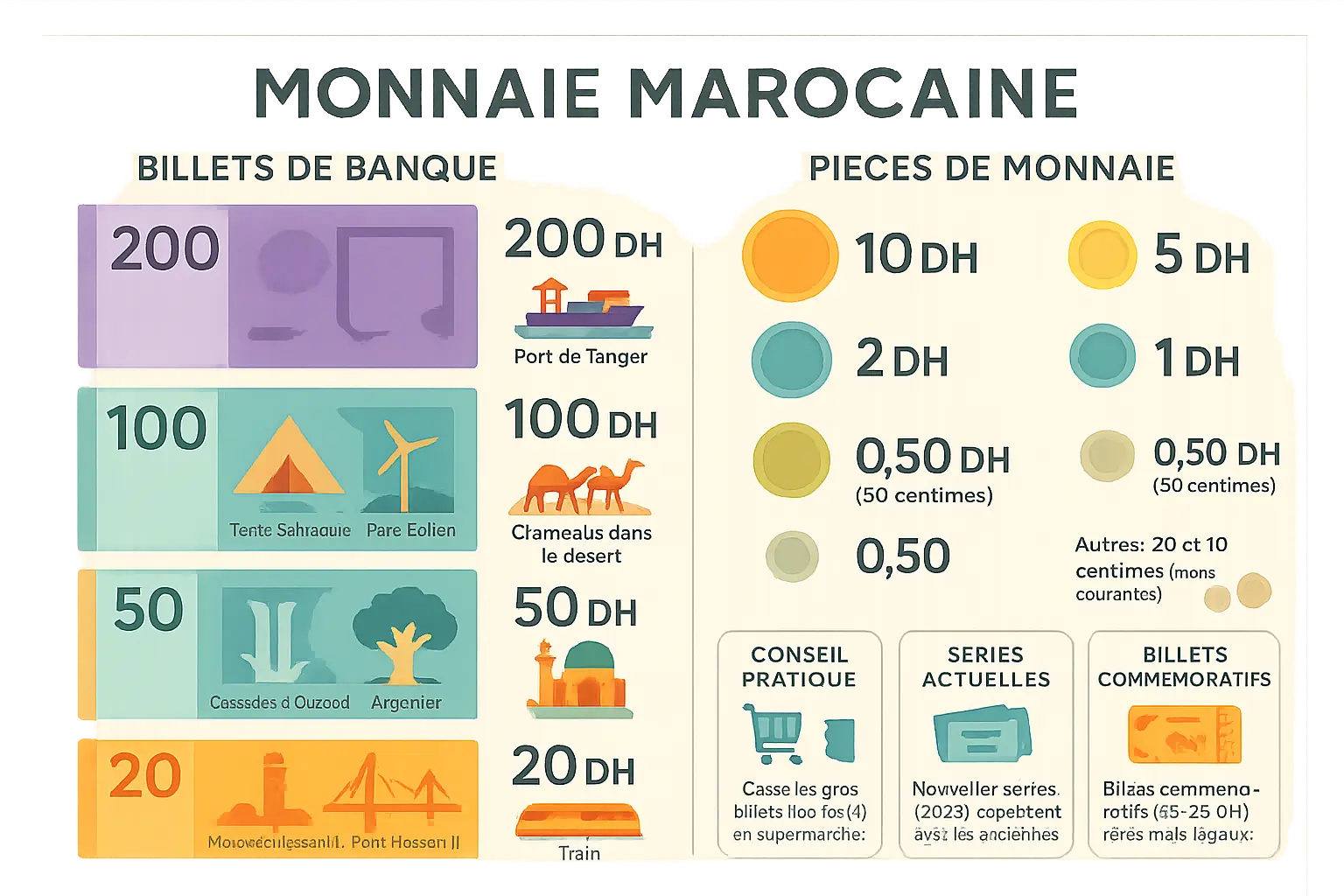
Attention aux billets commémoratifs comme celui de 25 DH (rare mais valide), imprimé sur un matériau hybride. En voyage, échangez les gros billets dès l’arrivée, notamment dans les supermarchés ou les aéroports où les taux sont compétitifs. Les petits commerçants ou taxis ont souvent du mal à rendre la monnaie au-delà de 100 DH. Cela évite les situations délicates, surtout quand on veut s’immerger dans le quotidien marocain comme Samira, déterminée à impressionner ses grands-parents en payant le vendeur de thé sans hésiter.
Le pouvoir d’achat du dirham : concrètement, que peut-on acheter ?
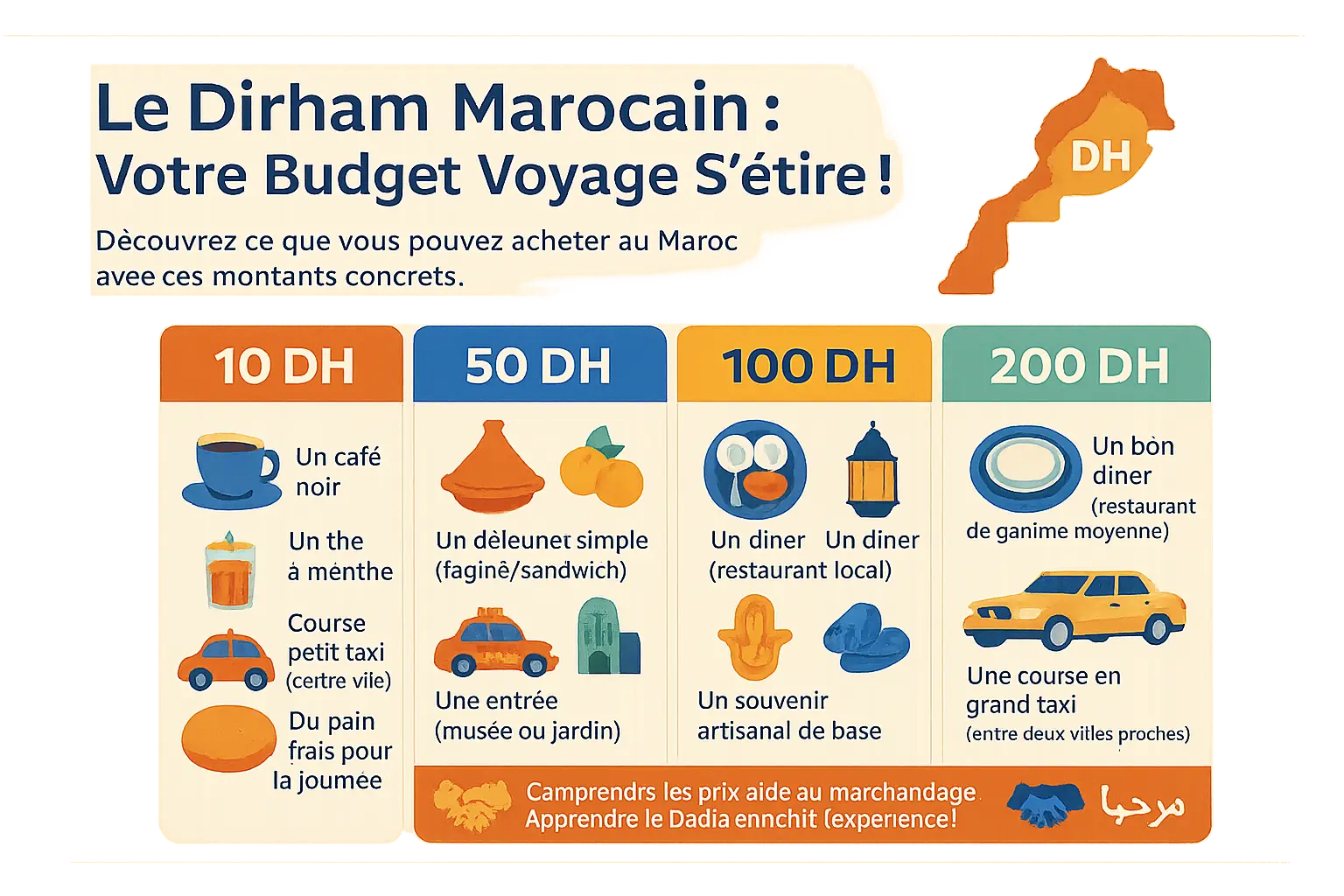
Comprendre le dirham, c’est saisir l’essence même du budget voyage au Maroc. 1 DH = 0,09 €, mais cette conversion mathématique ne raconte pas toute l’histoire. Le vrai pouvoir d’achat se mesure à ce que vous pouvez acquérir avec votre argent. Et là, les surprises sont nombreuses !
Votre budget voyage s’étirera bien plus loin au Maroc. Un repas complet dans un petit restaurant local peut coûter le prix d’un simple café à Paris, une réalité qui rend l’exploration du pays encore plus accessible.
Voici un aperçu concret de ce que vous pouvez obtenir avec différentes sommes de dirhams :
- Avec 10 DH : Un café noir, un thé à la menthe dans un café populaire, une course de petit taxi en centre-ville, du pain frais pour la journée.
- Avec 50 DH : Un déjeuner simple (tagine, sandwich) dans un petit restaurant, plusieurs kilos d’oranges au souk, une entrée dans certains musées ou jardins.
- Avec 100 DH : Un repas pour deux dans un snack, un dîner dans un restaurant local, un souvenir artisanal de base (après négociation).
- Avec 200 DH : Un bon dîner dans un restaurant de gamme moyenne, une course en grand taxi entre deux villes proches.
Comprendre ces ordres de grandeur change la donne, surtout lorsqu’on arpente les souks. Apprendre les bases du darija marocain peut transformer votre expérience de shopping et vous aider à obtenir des prix justes. Quelques mots comme « bshaal » (pour combien ?), « ghali » (cher) ou « choukrane » (merci) ouvrent bien des portes.
Le dirham, divisé en 100 centimes, circule sous forme de billets de 20, 50, 100 et 200 DH, et de pièces allant de 0,50 à 10 DH. Connaître ces détails évite les malentendus lors de vos transactions quotidiennes.
Attention toutefois : l’euro n’est pas reçu partout. Bien qu’accepté dans certains lieux touristiques, le dirham reste la monnaie officielle à utiliser. Un détail crucial à garder en tête pour éviter les mauvaises surprises.
Un peu d’histoire et d’économie : les secrets du dirham
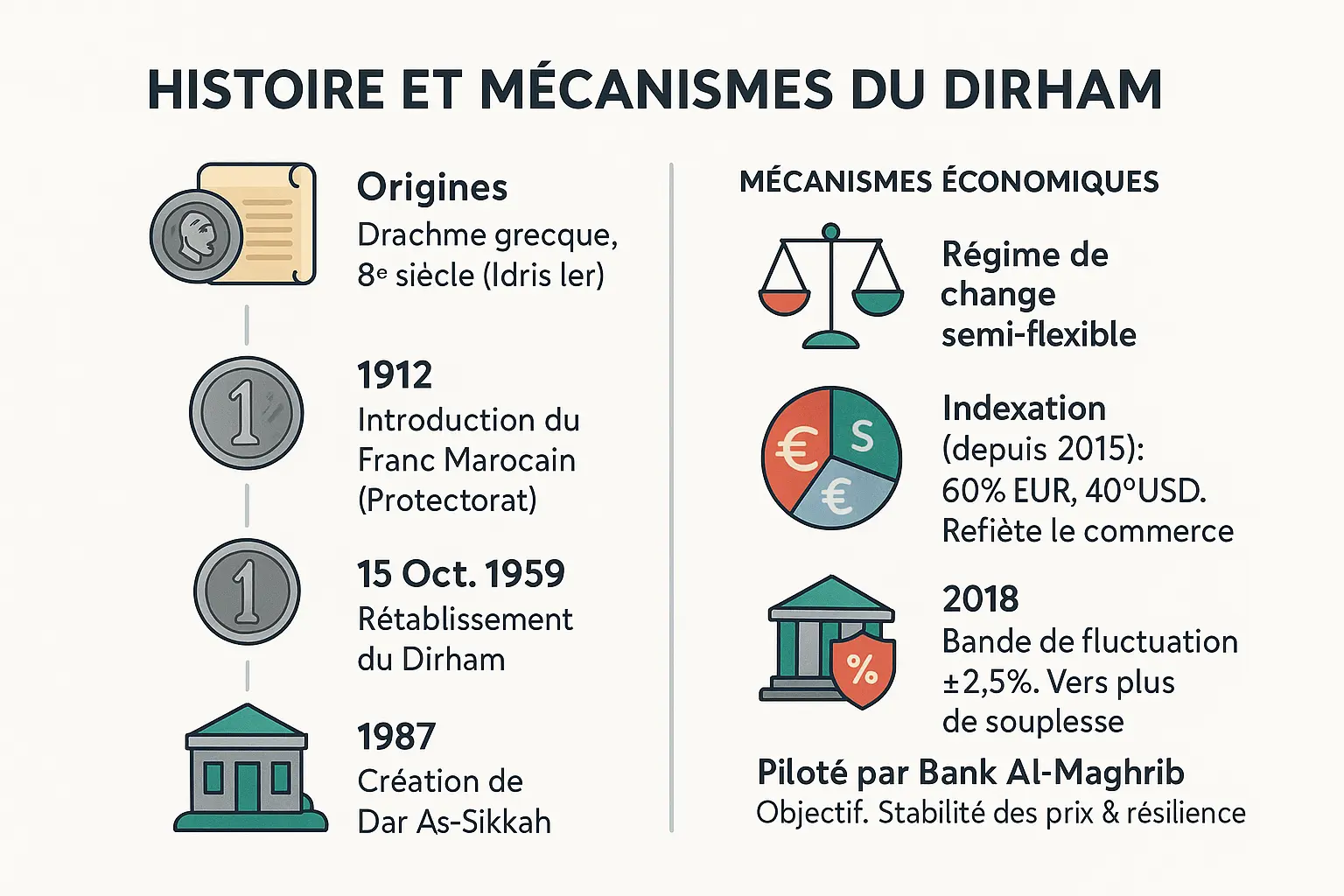
Le dirham marocain cache une histoire millénaire. Son nom vient de la drachme grecque, et les premiers dirhams d’argent furent frappés au VIIIe siècle par Idris Ier. Ces pièces, gravées de versets coraniques, marquaient l’indépendance économique du royaume. Saviez-vous que cette monnaie a traversé des siècles avant de devenir le symbole de la souveraineté retrouvée en 1959 ?
Sous le protectorat français (1912-1956), le franc marocain dominait. Mais après l’indépendance, le dirham revient au pouvoir le 15 octobre 1959. La création de Dar As-Sikkah en 1987 permet une fabrication locale des billets et pièces. Aujourd’hui, ce sont des visages du roi Mohammed VI et des paysages comme les cascades d’Ouzoud qui ornent les billets, mélangeant modernité et tradition.
Le dirham est semi-flexible depuis 2015, ancré à 60% sur l’euro et 40% sur le dollar. Ce choix reflète les échanges commerciaux du Maroc. En 2018, la bande de fluctuation s’élargit à ±2,5%, préparant un futur régime flottant. Pourquoi cette évolution ? Bank Al-Maghrib cherche à renforcer la résilience économique, tout en évitant les chocs externes. Comprendre la finace islamique ici
Les réformes récentes visent une transition progressive. Selon des études économiques, cette politique vise la stabilité des prix tout en préparant le Maroc aux marchés mondiaux. Pour Samira, cela signifie que lors de ses visites familiales, le dirham restera la seule monnaie acceptée dans les souks, même si certains lieux touristiques tolèrent l’euro, comme les hôtels de luxe à Marrakech.
Questions avancées : crypto-monnaies et règles d’import/export de devises
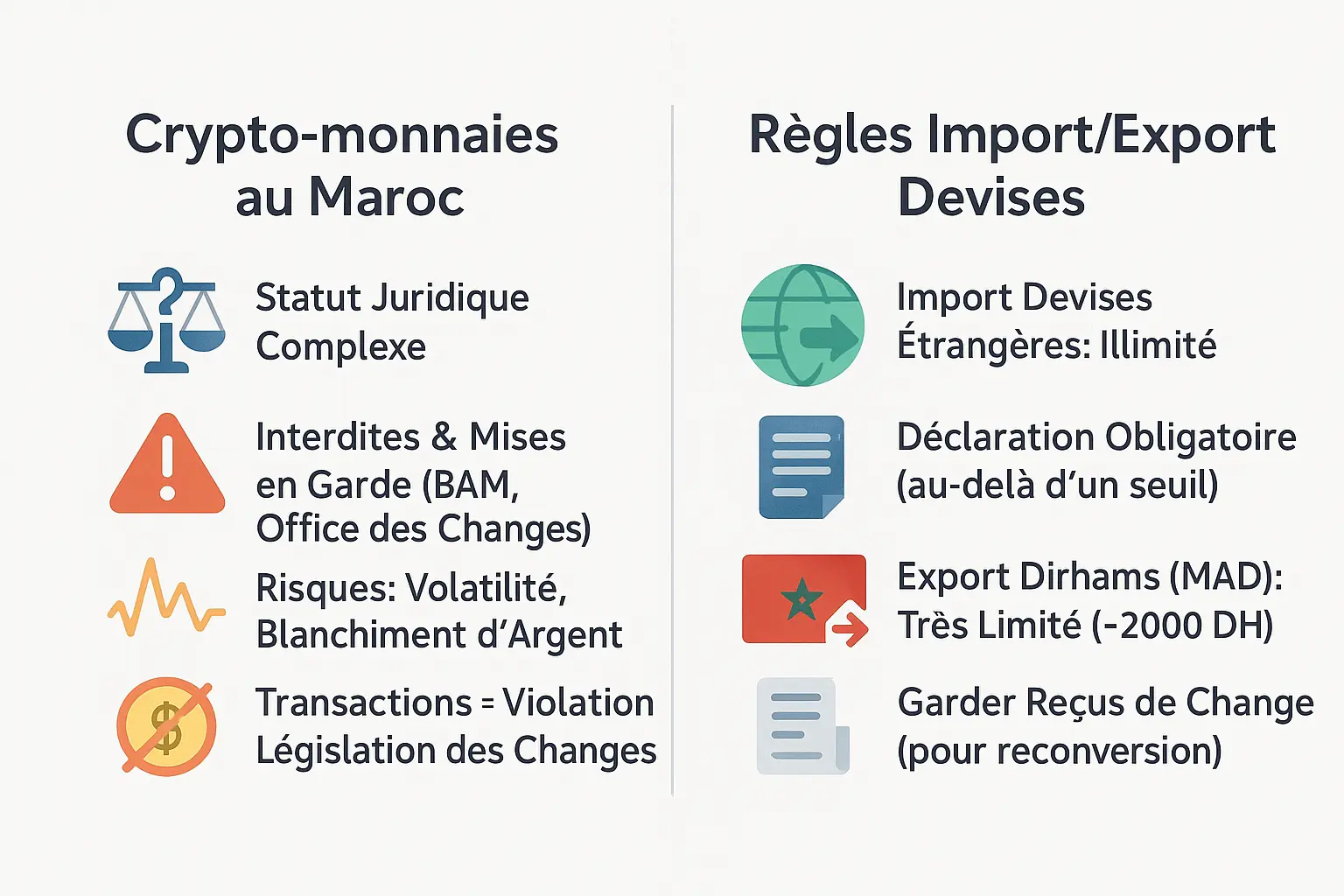
Est-ce que vous saviez que les cryptomonnaies comme le Bitcoin posaient des problèmes légaux spécifiques au Maroc ? Malgré leur popularité mondiale, ces monnaies virtuelles restent dans un flou juridique dans le royaume chérifien. Bank Al-Maghrib et l’Office des Changes ont clairement mis en garde contre leurs risques, citant notamment leur volatilité extrême et leur utilisation potentielle pour le blanchiment d’argent.
Concrètement, si la simple possession de cryptomonnaies n’est pas interdite, leur usage comme moyen de paiement l’est formellement. Les professionnels qui s’adonnent à des activités liées à ces monnaies virtuelles encourent des peines allant jusqu’à 3 ans d’emprisonnement et des amendes de 5 millions de dirhams. La Cour de Cassation a même jugé en 2021 qu’un transfert Bitcoin non déclaré constituait une violation de la loi. Comme l’explique ce dossier juridique, ces transactions violent potentiellement la législation sur les changes.
Concernant l’importation de devises étrangères, aucune limite n’est fixée mais une déclaration est obligatoire à partir de 100 000 DH. Les résidents marocains bénéficient toutefois de dotations annuelles pour voyager : 100 000 DH pour les déplacements professionnels, 40 000 DH pour les loisirs, et 15 000 DH pour les pèlerinages. En revanche, l’exportation du dirham marocain est strictement limitée à 2 000 DH. Conservez toujours vos reçus de change : ils vous permettront de convertir vos dirhams excédentaires en euros ou dollars avant de quitter le pays.
Votre mémo sur la monnaie marocaine : l’essentiel à retenir
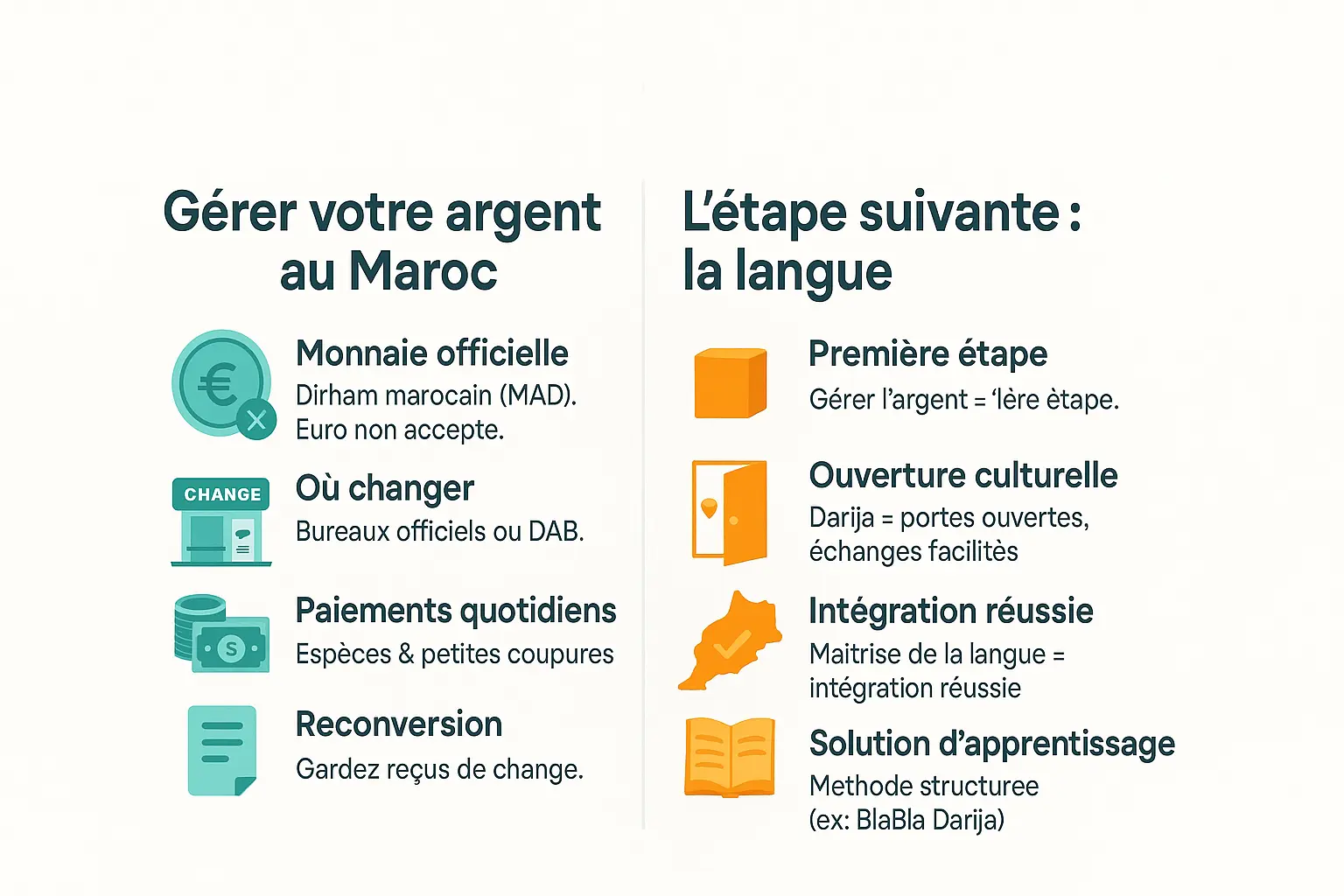
- La monnaie officielle est le dirham marocain (MAD). L’euro n’est pas une monnaie de paiement.
- Changez votre argent dans des bureaux de change officiels ou retirez aux distributeurs pour des taux fiables.
- Gardez toujours des espèces et des petites coupures pour les dépenses quotidiennes.
- Conservez vos reçus de change pour reconvertir vos dirhams restants à l’aéroport.
Comprendre le dirham est une première étape, mais maîtriser quelques mots de darija ouvre vraiment les portes. Saviez-vous que demander un « café mazouté » ou négocier au souk devient possible avec une base solide ? Même les petites transactions prennent tout leur sens quand vous échangez avec un taxi ou un artisan.
Si comme Samira, vous voulez passer du statut de spectateur à interlocuteur actif, une méthode structurée est indispensable. BlaBla Darija propose des cours hebdomadaires, des vidéos accessibles à vie et une communauté bienveillante pour progresser sereinement.
Découvrir comment la maîtrise du darija est un atout pour une intégration réussie au Maroc peut transformer vos interactions. Des plateformes comme BlaBla Darija offrent un parcours clair pour apprendre à votre rythme, sans promesse exagérée, juste une progression durable.
Votre voyage au Maroc commence par le dirham : changez-le dans des lieux sûrs, gardez des petites coupures et vos reçus. Pour une immersion totale, maîtrisez aussi le darija ! Sur BlaBla Darija, apprenez les bases avec des vidéos et une communauté pour vivre pleinement votre héritage.
FAQ
Est-ce que l’euro est accepté au Maroc ?
Comme Samira, vous vous demandez peut-être si vous pouvez utiliser l’euro lors de votre voyage. La réponse est claire : le dirham marocain (DH) est la seule monnaie officielle et doit être utilisée pour la majorité des transactions. Cependant, certains grands hôtels ou commerces touristiques acceptent parfois l’euro, mais le taux de change appliqué y est souvent désavantageux. Pour les petits achats quotidiens – comme acheter des fruits secs au souk avec votre grand-mère –, mieux vaut avoir des dirhams en poche.
1 € correspond à combien de dirham ?
Au 24 août 2025, 1 euro équivaut à environ 10,49 dirhams (MAD). Ce taux fluctue légèrement en fonction du marché, alors gardez à l’esprit qu’il peut varier selon le lieu et la date du change. Pour un repère rapide, imaginez que chaque euro vous permet d’acheter une dizaine de mandarines au marché local !
50 € c’est combien en dirham ?
En multipliant 50 € par le taux de 10,49 MAD, vous obtenez environ 524,50 DH. Cela représente un budget confortable pour plusieurs repas familiaux ou quelques souvenirs artisanaux. Privilégiez les retraits en une seule fois via un DAB pour éviter les frais répétés, surtout si vous comptez offrir un cadeau à vos grands-parents.
Est-il préférable d’utiliser des euros ou des dirhams au Maroc ?
Optez pour les dirhams ! Bien que l’euro soit parfois accepté dans les établissements haut de gamme, il reste marginal. Les taxis, petits restaurants ou étals du marché exigent systématiquement des dirhams. Pour éviter les mauvaises surprises – comme un vendeur refusant votre billet –, échangez vos euros dès votre arrivée. Cela vous évitera aussi de rentrer en France avec des dirhams non échangeables.
Est-il possible de payer en carte bleue au Maroc ?
Oui, mais avec modération ! Les cartes bancaires (Visa ou Mastercard) fonctionnent dans les grands hôtels, chaines de supermarchés ou restaurants modernes. Cependant, les taxis, marchands ambulants et cafés traditionnels ne disposent souvent que d’un terminal pour les espèces. Emportez toujours des dirhams pour les imprévus, surtout si vous prévoyez de flâner dans les médinas avec votre famille.
Où changer ses euros en dirham ?
Vos meilleures options sont les bureaux de change officiels (présents dans les aéroports et centres-villes) ou les DAB locaux. Les banques sont sûres mais moins pratiques en raison des horaires stricts. Évitez les hôtels pour le change, leurs taux sont généralement moins avantageux. N’oubliez pas de conserver vos reçus : ils vous permettront de reconvertir vos dirhams restants avant le retour.
Le dirham marocain est-il plus fort que l’euro ?
Non, le dirham est moins fort que l’euro, mais sa valeur est relativement stable grâce à son ancrage partiel sur la monnaie européenne. En 2025, 1 € valant 10,49 MAD, l’euro garde une position dominante. Toutefois, l’économie marocaine, avec son inflation maîtrisée à 1% en 2024, assure une certaine stabilité. Cela signifie que votre budget voyage s’étire sans craindre les variations brutales.
Quels sont les frais de change pour un euro en dirham marocain ?
Les bureaux de change agréés n’appliquent généralement pas de commission, mais le taux peut intégrer une marge. Les frais cachés apparaissent surtout avec les retraits via DAB : comptez environ 2 % de commission prélevée par la banque locale, plus une somme fixe (3,50 à 6 €), sans oublier les frais de votre propre banque. Vérifiez les conditions de votre carte avant le départ pour éviter les mauvaises surprises.