<meta name="google-site-verification" content="0S72xkYcSqqt100ZuIzn_Zif1zL8vIvcXUmc5Tjo10o" />

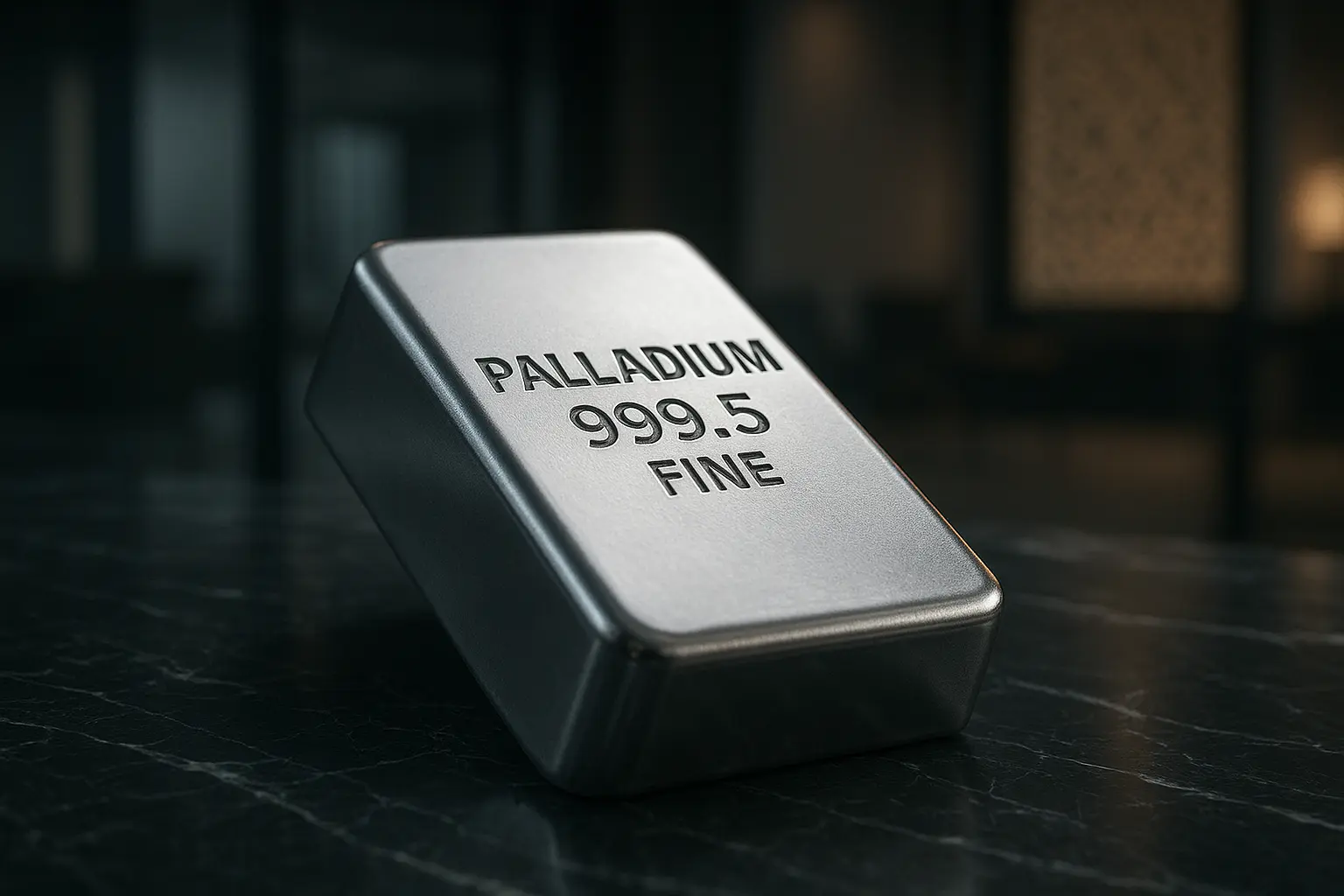
Le palladium halal, une opportunité méconnue pour investir en cohérence avec vos valeurs ? Face à la volatilité des marchés et aux défis de la finance traditionnelle, le palladium se démarque : métal précieux à la fois tangible et stratégique, utilisé dans l’automobile (pots catalytiques), l’électronique et les équipements médicaux, il allie croissance et conformité. Avec une performance de +20-25 % en 2025, ce métal rare, certifié Shariah-compliant via des produits physiques, des ETC adossés ou des structures Murabaha, offre une diversification responsable. Découvrez comment il protège votre capital, évite les pièges comme les contrats dérivés, et incarne une finance durable, ancrée dans les valeurs islamiques.
Sommaire
Le palladium, un métal précieux méconnu mais stratégique
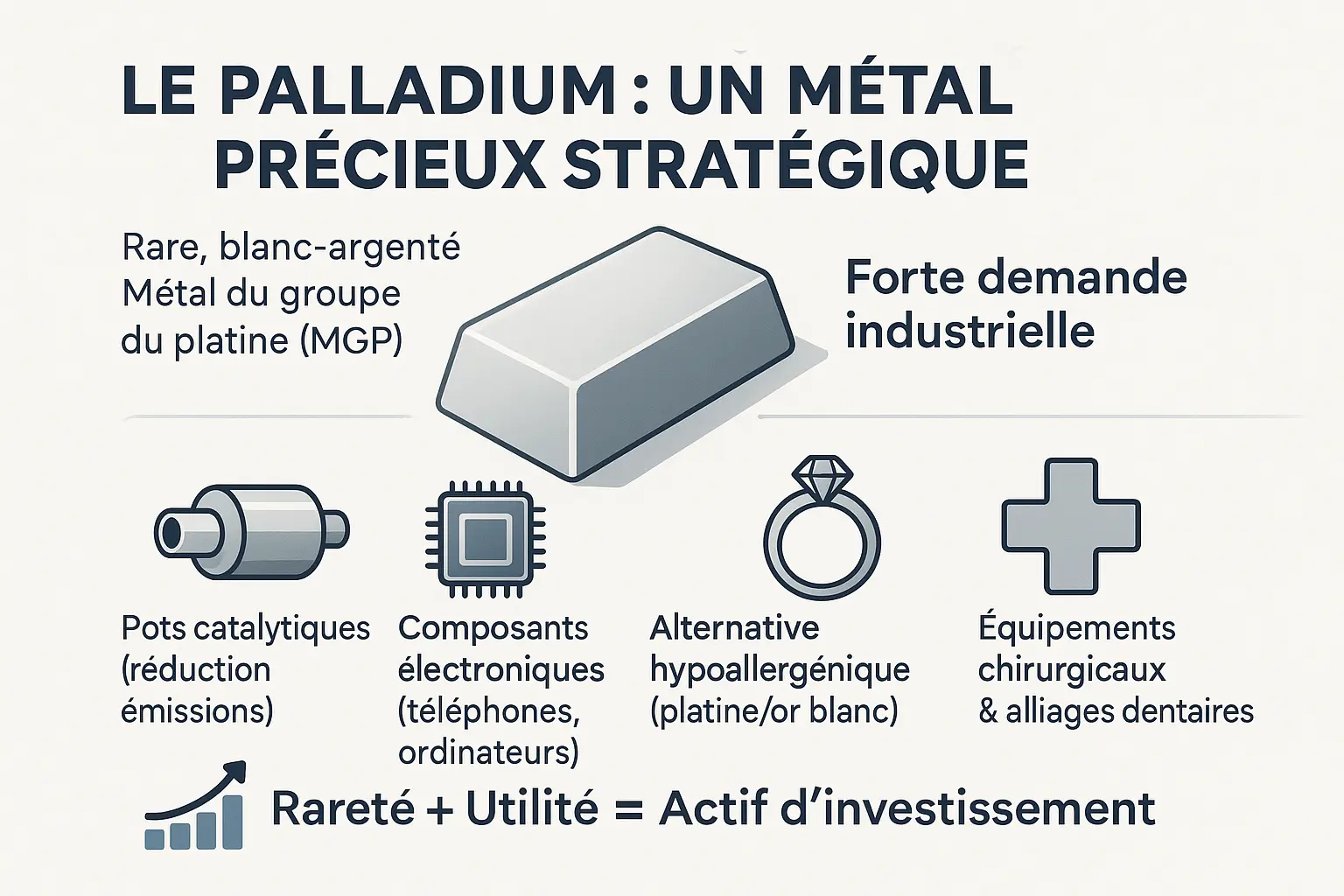
Savez-vous que ce métal blanc argenté, souvent mis à l’écart au profit de l’or ou du platine, concentre une demande industrielle 3 fois supérieure à celle de la bijouterie ?
Le palladium est un métal précieux rare, découvert en 1803, qui brille par ses applications industrielles. Contrairement à l’or, il ne sert pas qu’aux placements ou aux bijoux. Sa force réside dans son utilisation dans des secteurs critiques.
- Automobile : Il filtre 90 % des gaz toxiques dans les pots catalytiques, un rôle clé pour réduire la pollution.
- Électronique : Présent dans les condensateurs ou les composants de smartphones, il est indispensable aux technologies modernes.
- Bijouterie : Léger et hypoallergénique, il sert à des alliances durables, sans besoin de rhodiage.
- Santé : Employé pour des instruments chirurgicaux ou des alliages dentaires, il allie précision et résistance.
Extrêmement rare, son extraction se concentre en Russie (40 % de la production mondiale), Afrique du Sud et Canada. La guerre en Ukraine a d’ailleurs fait bondir son prix de 3 000 USD l’once en 2022, avant une correction liée à l’essor des véhicules électriques.
Cette forte demande industrielle, couplée à une offre instable, en fait un actif volatil. Pourtant, sa valeur physique en fait un candidat sérieux pour une diversification de portefeuille, à condition de respecter les principes islamiques. Mais quels sont ces critères ? La réponse dans la suite de cet article…
Les piliers de l’investissement halal appliqués aux métaux précieux
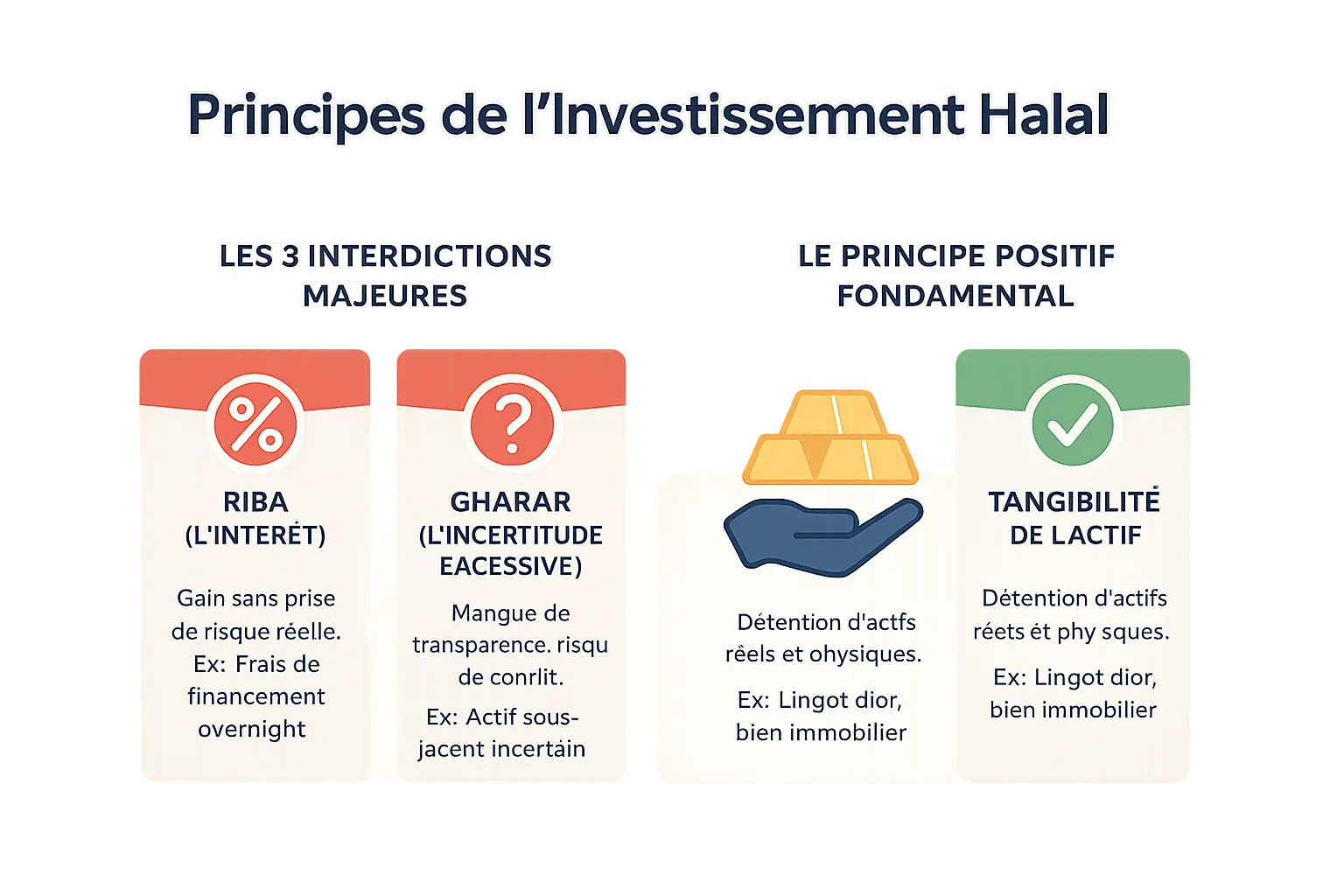
Investir dans les métaux précieux selon les principes islamiques repose sur trois règles clés. Elles protègent votre capital en alignant profit et responsabilité, avec transparence et éthique.
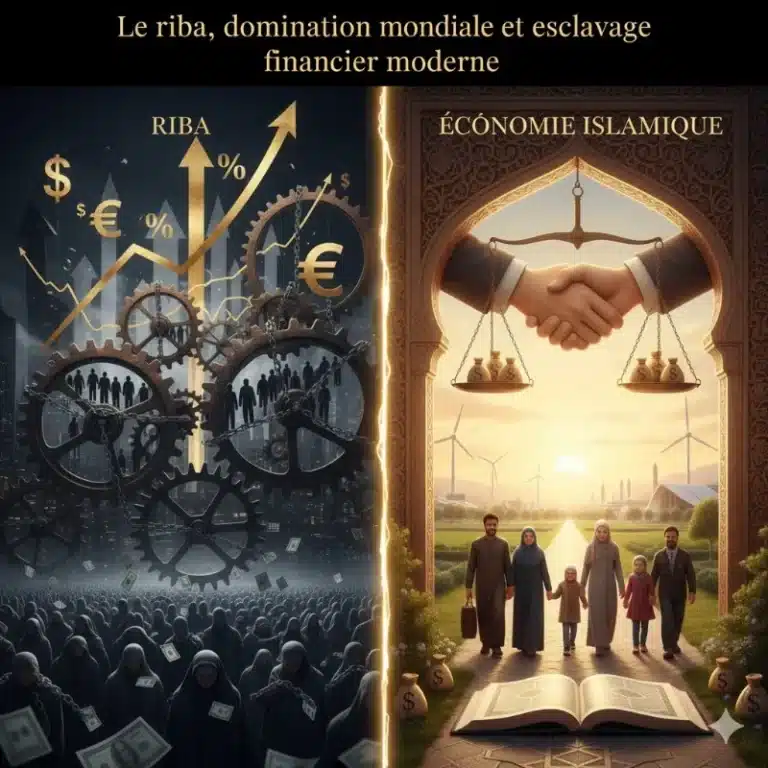
Interdiction du riba (l’intérêt caché)
Le riba désigne un gain sans partage de risque. Par exemple, des frais de garde ou des « swaps » dans un compte bancaire peuvent cacher de l’intérêt déguisé. Ces pratiques rendent l’argent passif, contraire aux principes islamiques. Privilégiez les produits physiques (lingots) ou certifiés Sharia, comme les ETC physiques de palladium approuvés par Source. Ces structures, comme les ventes à tempérament (Murabaha), lient le rendement à un actif tangible, éliminant tout risque de riba.
Rejet du gharar (l’incertitude extrême)
Acheter un lingot de palladium sans vérifier son stockage, c’est du gharar. Cette incertitude expose à des abus, comme des certificats fictifs ou des fonds sans métal réel. Les contrats à terme ou fonds sans actif sous-jacent en sont des exemples fréquents. Exigez des preuves de possession physique (certificats vérifiables) et un stockage dans des lieux reconnus (ex : Banque centrale suisse). La Shari’a exige que chaque transaction soit liée à un bien réel.
Refus du maysir (la spéculation)
Parier sur le palladium sans le posséder, c’est du maysir, interdit par la Shari’a. Cette pratique assimile l’investissement à un jeu de hasard. Privilégiez les ETC physiques certifiés ou les lingots détenus directement. Comme Aghaz, spécialiste des placements halal, qui limite l’exposition au palladium à 2 % des portefeuilles associés à d’autres actifs tangibles (ex : Sukuk, actions éthiques).
Ces piliers encadrent votre épargne avec transparence, alignant vos choix aux enseignements de la Chari’a. Voyons maintenant comment les appliquer concrètement au palladium.
Investir dans le palladium : les conditions pour rester conforme à l’éthique musulmane
Le palladium, métal stratégique pour l’industrie automobile, attire les investisseurs. Découvrez comment l’intégrer dans un portefeuille halal.
La possession physique : contrôle total, mais vigilance requise
L’achat de lingots garantit une conformité maximale, l’actif étant tangible. Cependant, deux défis majeurs :
- Frais de stockage et d’assurance, pouvant atteindre 8,30% à 33% du prix du métal
- Liquidité réduite comparée aux produits financiers
Avantage : élimination des risques liés aux dérivés. Méthode idéale pour les puristes, à condition d’opter pour des coffres certifiés.
Les produits adossés physiquement (ETC/ETP) : liquidité avec certification
Les ETC comme l’ETFS Physical Palladium d’ETF Securities offrent une solution intermédiaire. Chaque unité est soutenue par du palladium physique stocké à Londres.
Deux conditions essentielles :
- Vérifier la certification Shariah par un comité reconnu
- Confirmer l’adossement physique
Jusqu’à 2% du portefeuille peut être alloué à ce type d’actif selon Aghaz Investment pour une diversification éthique équilibrée.
Les comptes métaux via le Murabaha : structure sans riba
Le Murabaha proposé par des banques islamiques permet d’acquérir du palladium sans intérêt. La banque achète le métal puis vous le revend avec une marge convenue.
- Encadrement légal, conforme aux principes de partage des bénéfices
- Facilité d’accès pour les novices
Vérifiez la marge appliquée et exigez la transparence des frais.
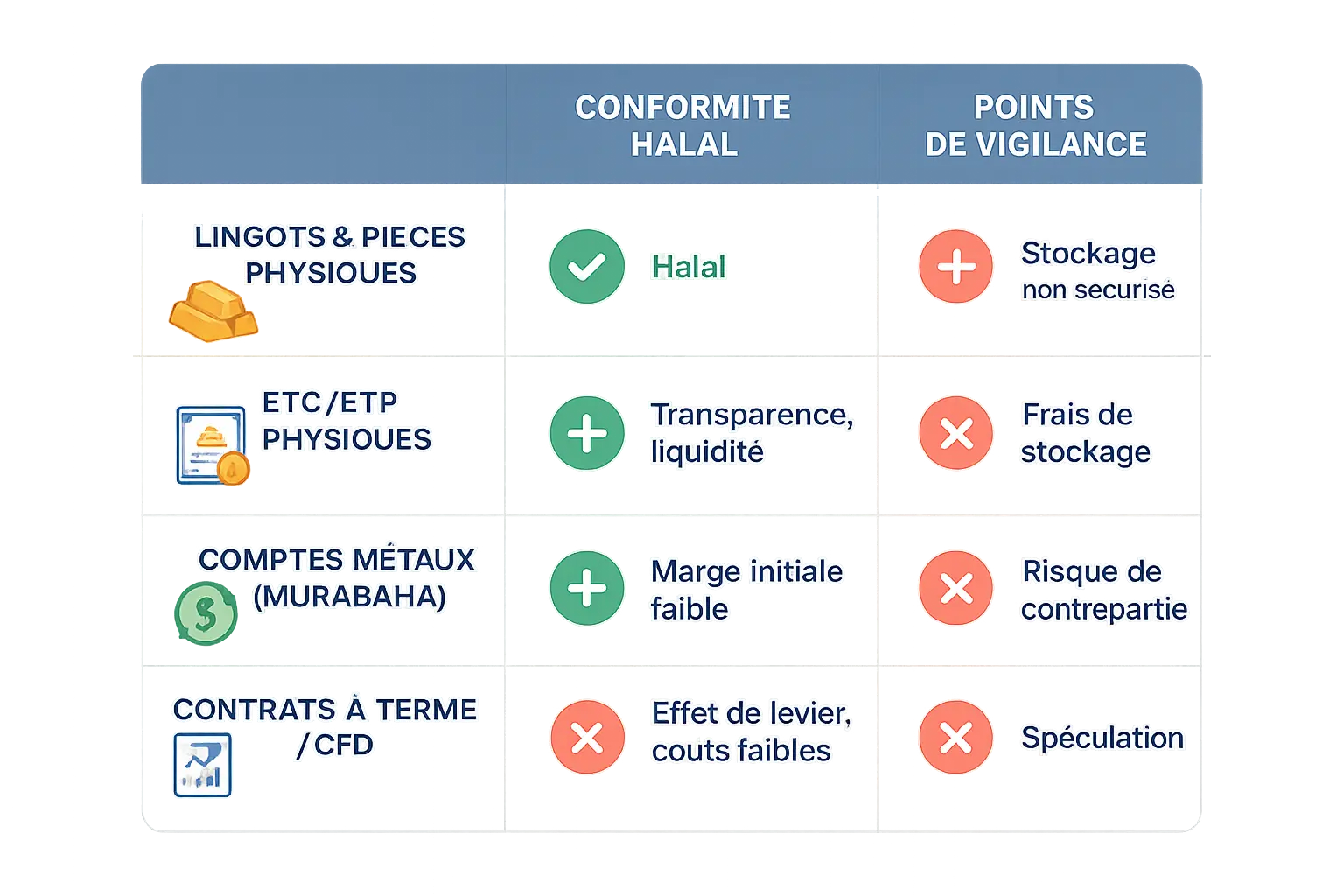
Comparatif des méthodes d’investissement dans le palladium
| Méthode d’investissement | Conformité Halal (Potentiel) | Avantages | Points de vigilance |
|---|---|---|---|
| Lingots/Pièces physiques | Très élevée | Contrôle total, actif tangible | Coûts de stockage, liquidité limitée |
| ETC/ETP Physiquement Adossés | Élevée (si certifié) | Grande liquidité, frais mutualisés | Vérifier certification Shariah |
| Comptes Métaux (Murabaha) | Élevée | Sans intérêt, cadre sécurisé | Marge bancaire, transparence du contrat |
| Contrats à terme / CFD | Non-conforme (Haram) | Aucun | Spéculation, absence de possession |
Pourquoi la consultation d’experts est incontournable
Malgré sa performance récente (+20-25% en 2025), le palladium reste volatil. Les frais de stockage (8,1% de TVA en Suisse) et les subtilités juridiques exigent une expertise pointue.
Sollicitez un conseiller en finance islamique pour identifier des solutions certifiées. En résumé : conciliez éthique et rendement via possession réelle, transparence et accompagnement expert. Une approche qui préserve votre foi et votre capital.
Les points de vigilance : comment éviter les pièges de l’investissement non-halal
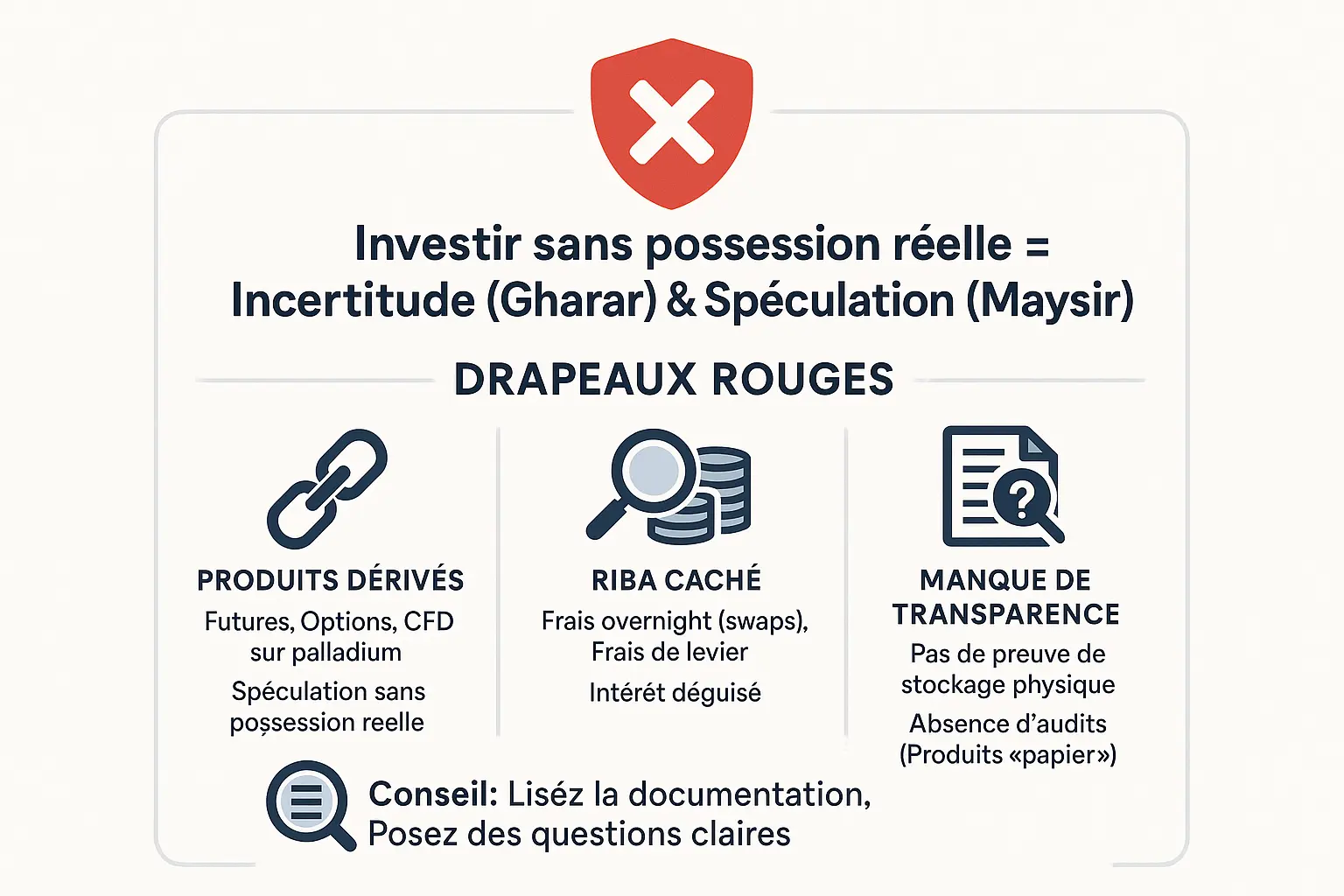
Le marché des métaux précieux regorge de produits financiers complexes. Tous ne respectent pas les principes islamiques. Investir sans possession physique expose à des pratiques non conformes. La finance islamique exige transparence et actifs tangibles pour éviter les risques spirituels et financiers.
« Investir sans possession réelle du métal, c’est s’aventurer sur le terrain de l’incertitude (Gharar) et de la spéculation (Maysir), deux pratiques à éviter en finance islamique. »
Voici les trois périls majeurs à identifier avant d’investir dans le palladium :
Les produits dérivés
Les CFD, contrats à terme et options constituent des formes de spéculation. Aucun ne donne droit au métal physique. La majorité des savants les interdisent pour cause de gharar (incertitude excessive) et de maysir (jeu de hasard). Le levier associé amplifie les risques, contraire au partage équitable des pertes et profits. Par exemple, un CFD sur palladium reste un simple pari sur sa valeur future, sans lien matériel avec le métal.
Le Riba caché
Les frais de financement nocturne (swaps) ou coûts de levier peuvent dissimuler du riba. Un produit islamique ne doit générer de revenus qu’à partir d’actifs tangibles. Certains fournisseurs appliquent des prélèvements sur positions non soldées chaque nuit, équivalents à des intérêts déguisés. Comparez cela à un prêt à intérêt, strictement prohibé. Vérifiez les politiques de financement pour éviter ces pratiques.
Le manque de transparence
Exigez des preuves de possession physique (certificats d’audit, rapports de stockage). Un simple papier sans garantie du métal viole les principes islamiques. Privilégiez les ETC physiques certifiés Shariah, comme ceux de Source, garantissant traçabilité et stockage sécurisé du palladium. Un manque de transparence peut mener à des détournements ou à des investissements dans des actifs non conformes, compromettant à la fois votre éthique et votre rendement.
Demandez des explications détaillées sur la structure du produit. En cas de doute, consultez un expert en finance islamique avant de souscrire. Une approche rigoureuse préserve votre éthique et votre capital. En vérifiant chaque détail, vous construisez un portefeuille durable, aligné sur vos valeurs et vos objectifs financiers.
Au-delà de l’investissement : le port de bijoux en palladium est-il permis en islam ?
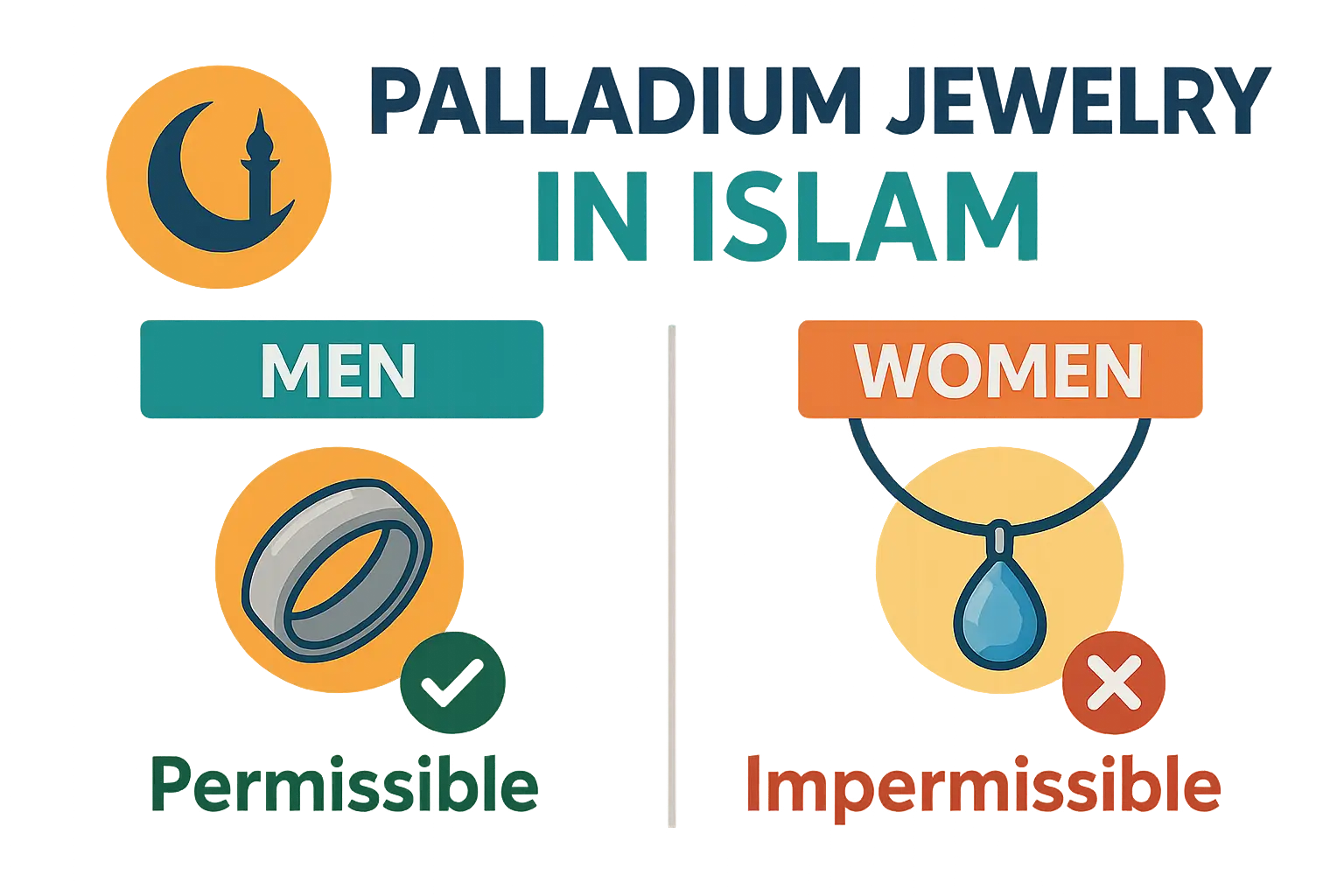
Si l’or reste interdit aux hommes musulmans pour des raisons claires issues de la sunna, qu’en est-il du palladium ?
Le hadith rapporté par Al-Tirmidhi indique explicitement : « Porter de la soie et de l’or est interdit aux hommes de ma nation ». Cette interdiction vise spécifiquement l’or, métal symbolisant l’ostentation. Le palladium, métal précieux mais distinct chimiquement, n’est jamais mentionné dans les textes sacrés.
Le platine, parfois confondu avec l’or blanc, illustre bien cette nuance. Absent de l’époque prophétique, son statut halal reste discuté. Certains l’assimilent à l’or par précaution, d’autres l’autorisent. Le palladium, bien que précieux, suit cette même logique : aucune interdiction explicite ne pèse sur lui.
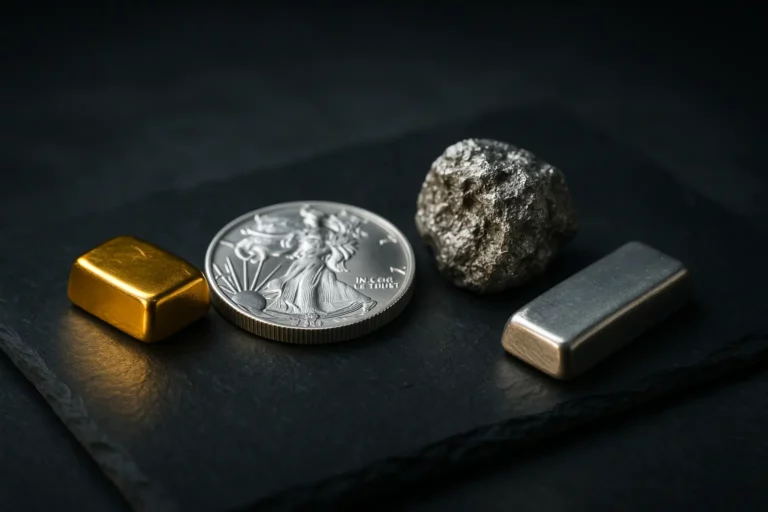
Pour les hommes, les alternatives existent : l’argent reste la référence, comme le montre l’usage des bagues prophétiques. L’acier inoxydable et le tungstène offrent des options modernes, durables et conformes. Le palladium s’ajoute à ces possibilités, avec l’avantage d’une esthétique proche de l’or blanc sans en partager les restrictions.
Au-delà des questions esthétiques, ce métal illustre parfaitement l’équilibre islamique : valoriser les ressources matériellles tout en respectant les limites divines. Tout comme pour les questions immobilières, il est toujours bon de se référer aux avis des savants.
Palladium et finance islamique : une opportunité à saisir avec prudence
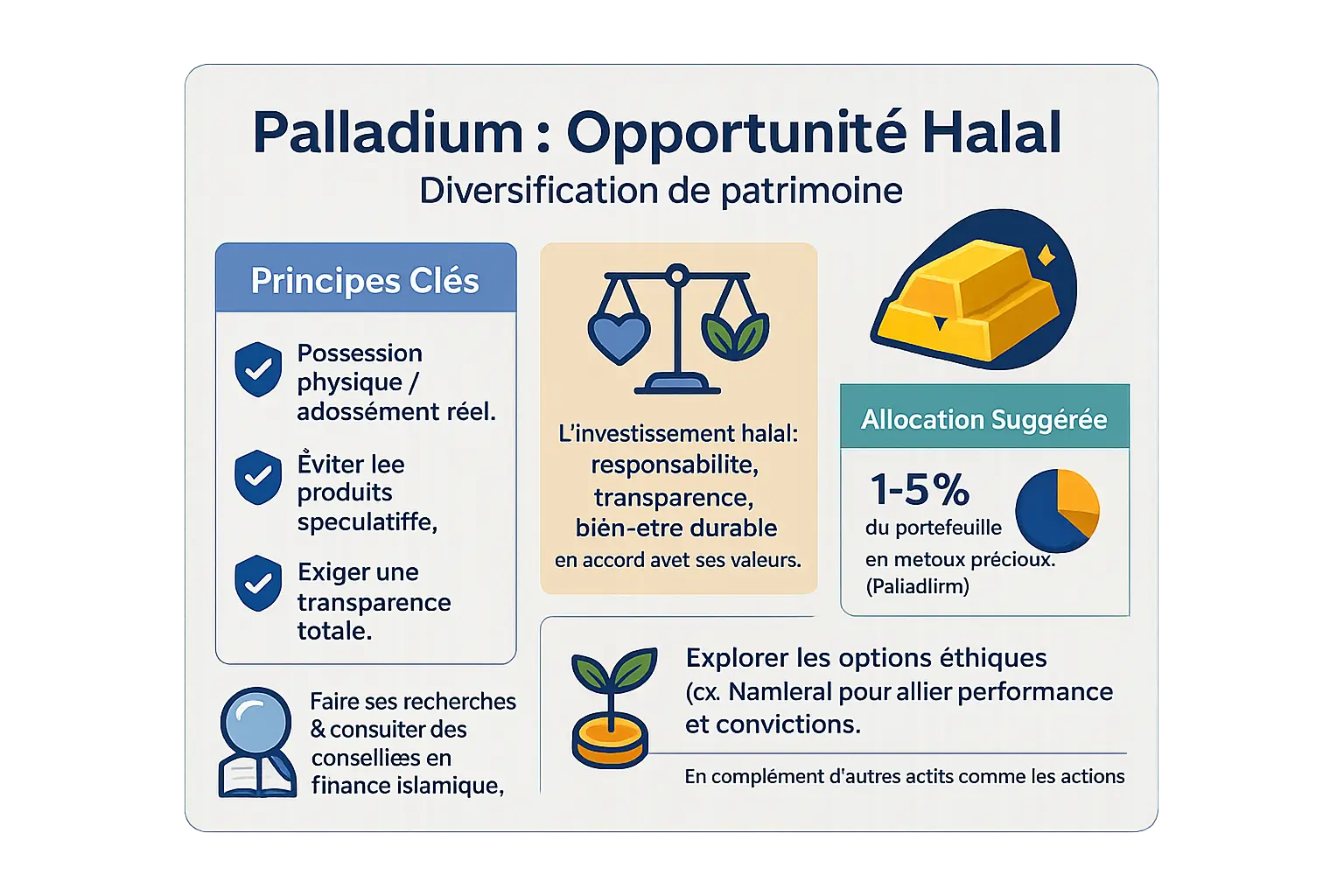
Investir dans le palladium peut s’aligner avec les principes de la finance islamique, à condition de respecter des critères stricts. Ce métal précieux, utilisé dans l’industrie et l’électronique, représente une alternative tangible pour diversifier son patrimoine tout en restant conforme à la Chari’a.
Assurez-vous de la possession physique du métal ou d’un adossement réel. Fuyez les produits spéculatifs comme les contrats dérivés, souvent assimilés à du gharar. Exigez une transparence totale sur l’origine du métal et les frais associés. Ces étapes clés garantissent la légitimité de votre investissement.
Les experts recommandent d’allouer 1 à 5 % de son portefeuille aux métaux précieux. Cette proportion permet de se prémunir contre l’inflation sans surcharger votre stratégie. Comme l’explique l’organisme Aghaz, cette approche s’intègre dans une diversification équilibrée avec des actifs comme les actions halal ou les Sukuk.
« L’investissement halal ne se résume pas à une liste de règles, mais incarne une démarche de responsabilité, de transparence et de recherche d’un bien-être durable, en accord avec ses valeurs. »
Avant toute décision, consultez des spécialistes en finance islamique. Leur expertise vérifie la conformité des fonds comme le Sprott Physical Platinum and Palladium Trust (SPPP), dont la structure physique est audité par des comités Sharia. Cela évite les pièges du riba caché ou des frais non conformes.
Pour approfondir vos connaissances, explorez les options d’investissement éthique sur Namlora. Cette plateforme rassemble des opportunités alignées avec vos convictions, en complément d’autres actifs comme les actions halal.
En conclusion, le palladium s’impose comme un métal stratégique pour l’investissement halal, alliant rareté et utilité industrielle. En respectant les principes islamiques — possession physique, évitement du Riba et Gharar — via des lingots ou ETC certifiés, il permet une diversification éthique. Une opportunité pour concilier performance et valeurs, comme le propose Namlora.
FAQ
Les musulmans peuvent-ils porter des bijoux en palladium ?
Oui, les musulmans peuvent porter des bijoux en palladium. Contrairement à l’or, strictement interdit pour les hommes en Islam, le palladium est un métal précieux distinct qui ne tombe pas sous cette restriction. Il est apprécié pour sa résistance, sa légèreté et sa couleur argentée, idéale pour les alliances ou bagues masculines. En tant qu’actif physique, il incarne à la fois un symbole de valeur et un choix éthique, sans conflit avec les principes islamiques.
Est-il permis à un homme de porter du platine en Islam ?
Le platine, comme le palladium, est autorisé pour les hommes. Bien que des débats existent, la majorité des savants s’accordent sur le fait qu’il ne subit pas les mêmes restrictions que l’or. Son usage en joaillerie ou en investissement reste conforme, à condition qu’il soit détenu physiquement ou via des produits certifiés Shariah, évitant spéculation et riba caché. C’est une alternative discrète mais précieuse.
Comment vérifier qu’un produit d’investissement en palladium est halal ?
Pour qu’un produit soit halal, trois critères clés : possession physique (lingots, pièces) ou adossement réel (ETC certifiés), absence de spéculation (éviter les CFD, futures), et transparence totale (pas de frais liés à des taux d’intérêt). Privilégiez les structures comme le Murabaha ou les ETC physiques approuvés Shariah, comme ceux de Source ou ETF Securities, pour une conformité garantie.
Qu’est-ce que le laiton plaqué palladium ?
Le laiton plaqué palladium est un matériau de base (laiton) recouvert d’une fine couche de palladium. Bien qu’il soit esthétique, son intérêt en investissement est limité, car la valeur réelle repose sur le palladium présent en faible quantité. Pour un investissement halal, préférez des actifs tangibles en palladium pur, comme des lingots certifiés, qui respectent les principes de la Shariʿah tout en offrant une valeur durable.
Qui peut porter des chaussures de la marque Palladium ?
Le terme « Palladium » dans les chaussures désigne une marque commerciale, pas le métal. Ainsi, ces chaussures sont autorisées pour tous, hommes et femmes, sans réserve religieuse. C’est un rappel que le palladium, en tant que métal, est un actif à part entière, tandis que son usage dans le nom d’un produit est une question de dénomination, non de conformité religieuse.
Pourquoi le palladium est-il si coûteux ?
Le palladium est cher en raison de sa double rareté : il est 30 fois plus rare que l’or et extrait principalement en Russie et en Afrique du Sud, régions sujettes à des tensions géopolitiques. Son prix est aussi tiré par une demande industrielle massive (90% pour les pots catalytiques) et sa volatilité liée à l’offre. En 2025, sa performance de +20-25 % souligne son attractivité en temps de crise, à condition d’opter pour des investissements tangibles et conformes.
Quelles pierres sont recommandées en Islam ?
L’islam n’interdit pas spécifiquement les pierres, mais encourage la sobriété. Des pierres comme l’agate (aqeeq) sont valorisées dans les hadiths pour leurs vertus spirituelles. Cependant, l’essentiel est d’éviter les pratiques superstitieuses ou associées à d’autres croyances. En investissement, privilégiez des actifs tangibles comme les métaux précieux, qui allient valeur matérielle et conformité éthique.
Quel métal est mentionné comme « descendu » dans le Coran ?
Le Coran évoque le fer comme un métal « envoyé » par Allah : « Et Nous avons fait descendre le fer, en lui des dommages et des avantages » (Sourate Al-Hadid, 25). Aucun verset ne mentionne spécifiquement l’or, l’argent ou le palladium. Ce rappel souligne l’importance de l’utilité du fer, mais aussi la nécessité de choisir des investissements utiles et tangibles, comme le palladium, dont la demande industrielle renforce la valeur.
L’or blanc est-il haram pour les hommes ?
Oui, l’or blanc est haram pour les hommes. Bien qu’il ait une teinte argentée, il contient de l’or mélangé à d’autres métaux (comme le palladium). L’interdiction de l’or s’étend donc à ses alliages. En revanche, le palladium pur est autorisé. Pour investir sans compromis, préférez des produits clairs : lingots physiques, ETC certifiés ou structures Murabaha, pour une diversification alignée à la fois sur la finance islamique et les réalités du marché.