<meta name="google-site-verification" content="0S72xkYcSqqt100ZuIzn_Zif1zL8vIvcXUmc5Tjo10o" />

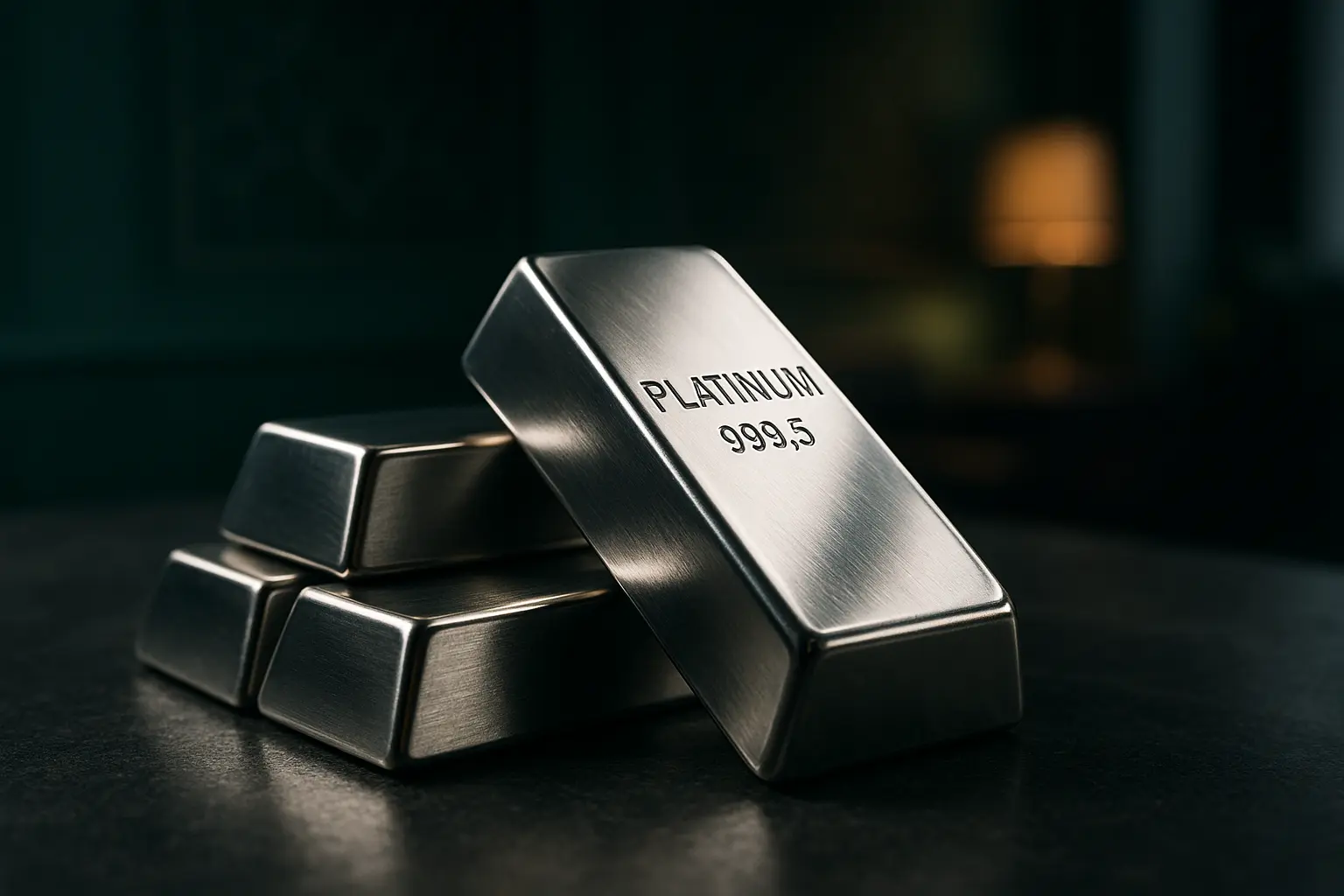
L’essentiel à retenir : Le platine, métal rare et indispensable à l’industrie, est une opportunité d’investissement halal. Contrairement à l’or, non classé « ribawi », il offre plus de flexibilité. Avec 70 % de sa production en Afrique du Sud, son marché garantit stabilité et utilité, en phase avec les valeurs de la finance islamique.
Perdu(e) face aux choix d’investissements halal en 2025 ? Le platine halal, métal précieux souvent éclipsé par l’or, se révèle pourtant un actif stratégique pour qui souhaite allier éthique islamique et diversification intelligente. Rare, tangible et indispensable à l’industrie (catalyseurs automobiles, technologie médicale), il incarne une valeur durable, sans les pièges du Riba ou du Maysir. Découvrez comment ce métal, libre de toute spéculation excessive, peut devenir une pierre angulaire de votre portefeuille halal, en phase avec les principes Sharia et les enjeux d’un monde en mutation. Platine halal : une opportunité à saisir avec sagesse.
Sommaire
Platine : un métal précieux au-delà des bijoux
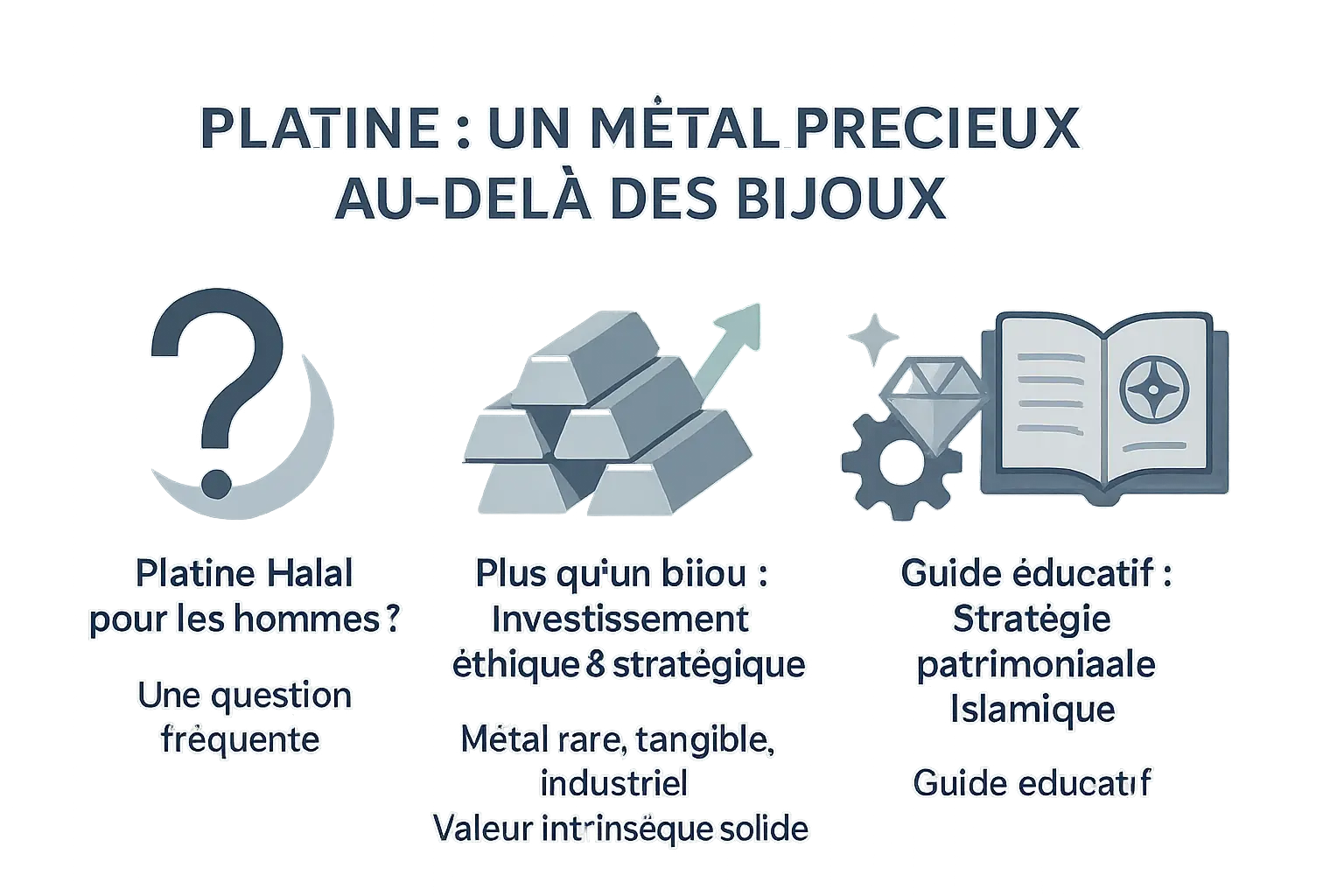
Le platine est-il halal pour les hommes ? Cette question revient souvent, alors que l’or est strictement interdit aux hommes musulmans selon les hadiths. Le platine, moins évoqué dans les textes anciens, reste un sujet de débat prudentiel.
Pourtant, au-delà de cette question légitime, le platine recèle une opportunité souvent sous-estimée : un investissement tangible, rare et stratégique. Rare à l’extrême, il faut traiter 10 tonnes de minerai 6 mois pour obtenir une once. Sa densité exceptionnelle et sa résistance à la corrosion en font un actif solide.
Sa valeur dépasse le luxe : 70 % de la demande mondiale provient de l’industrie automobile (catalyseurs), la médecine (implants médicaux), et l’électronique. Un métal indispensable à la transition énergétique, notamment pour l’hydrogène vert.
Cet article a un objectif éducatif : vous aider à comprendre comment intégrer le platine dans un portefeuille éthique, en respectant les principes islamiques. Nous explorerons les alternatives platine halal comme les lingots physiques, les ETC adossés ou le Murabaha, tout en soulignant les vigilances nécessaires.
Le port du platine en islam : ce que vous devez savoir
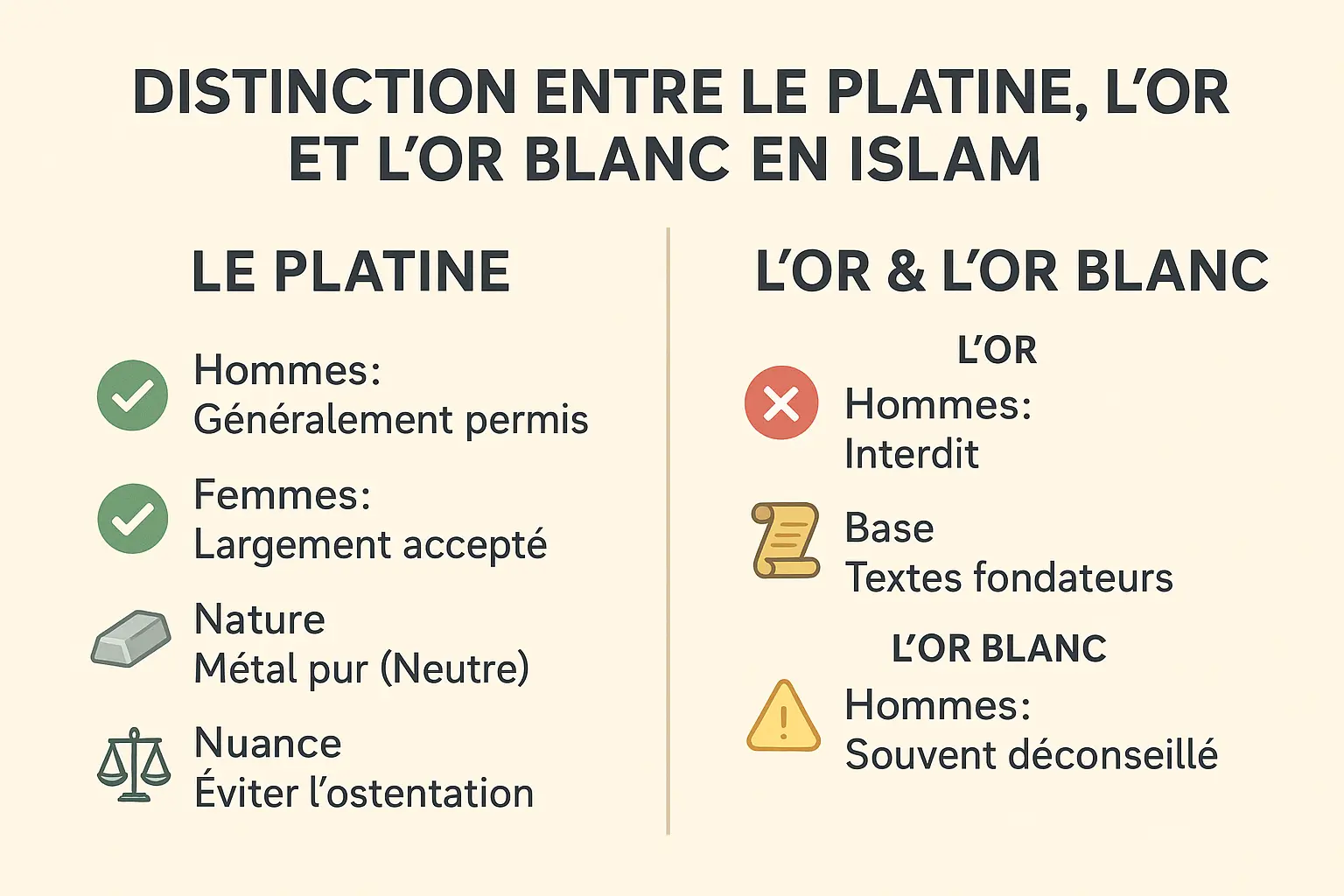
Le port du platine en islam interroge souvent en raison de sa ressemblance avec l’or, interdit aux hommes selon des hadiths d’At-Tirmidhi et Muslim. Inconnu des sociétés arabes au VIIe siècle, le platine, métal précieux mais neutre, n’est jamais mentionné dans les textes fondateurs. Cette absence ouvre le débat sur sa licéité.
La distinction essentielle avec l’or
Le Prophète a interdit le port d’or aux hommes, le comparant à tenir une braise de feu, tout en l’autorisant pour les femmes. Cette interdiction vise à éviter l’excès et la vanité. Le platine, absent des textes anciens, est considéré par la majorité des savants comme un métal autorisé pour les hommes, d’autant plus qu’il diffère chimiquement de l’or. Si l investissement sur l or de façon halal vous intéresse découvrez notre article a ce sujet.
Platine ou or blanc : ne pas confondre
L’or blanc, souvent assimilé au platine, est un alliage majoritairement composé d’or. Son statut halal suit les règles de l’or pur, interdit aux hommes. Le Cheikh Salih Al-Fawzan insiste : si sa base est de l’or, l’interdiction s’applique malgré une modification visuelle. Vérifier la composition via une certification officielle est donc essentiel.
Pour les hommes, les alternatives sûres incluent l’argent (comme la bague en argent du Prophète), l’acier inoxydable ou le tungstène, métaux neutres, abordables et sans controverse religieuse. Ces matériaux, conformes aux principes islamiques, offrent des options esthétiques et responsables pour éviter toute ambiguïté.
Le platine : un actif tangible et stratégique pour l’investisseur musulman
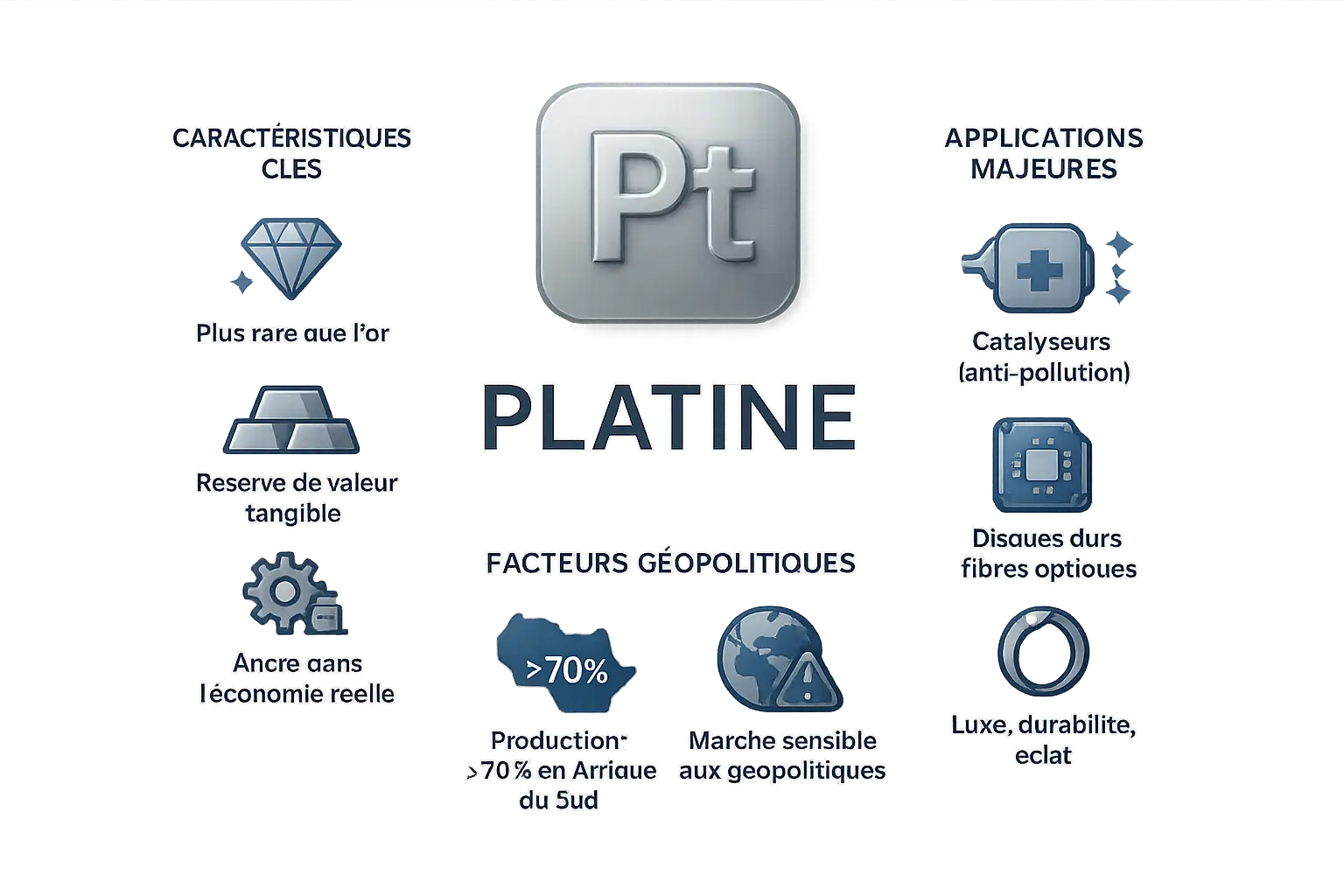
Le platine ne se limite pas à son éclat argenté ou sa place en joaillerie. C’est un pilier de l’industrie moderne, avec des propriétés uniques qui en font un actif tangible et stratégique. Sa rareté, sa densité exceptionnelle et ses multiples usages ancrent sa valeur dans l’économie réelle, alignant son potentiel avec les principes d’un investissement éthique et durable.
Plus rare que l’or, le platine est extrait à environ 160 tonnes annuelles, contre 2500 pour l’or. Cette pénurie relative renforce son attractivité. Sa densité élevée (40 à 60 % supérieure à celle de l’or) lui confère une résistance extrême aux agents chimiques et à l’usure, garantissant une préservation de sa valeur sur le long terme.
- Automobile : Indispensable aux catalyseurs réduisant les émissions des véhicules.
- Médecine : Utilisé dans des traitements anticancéreux (cisplatine) et des instruments chirurgicaux.
- Technologie : Clé dans les disques durs, fibres optiques et composants électroniques.
- Bijouterie : Halal pour les hommes, apprécié pour sa durabilité et son éclat intemporel.
La concentration de sa production en Afrique du Sud (70 %) expose l’actif à des risques géopolitiques et sociaux. Les grèves minières, les pannes d’électricité récurrentes et l’impact de la pandémie sur la chaîne d’extraction illustrent l’importance d’une analyse rigoureuse avant d’investir.
Les 3 piliers de la finance islamique appliqués à l’investissement en platine
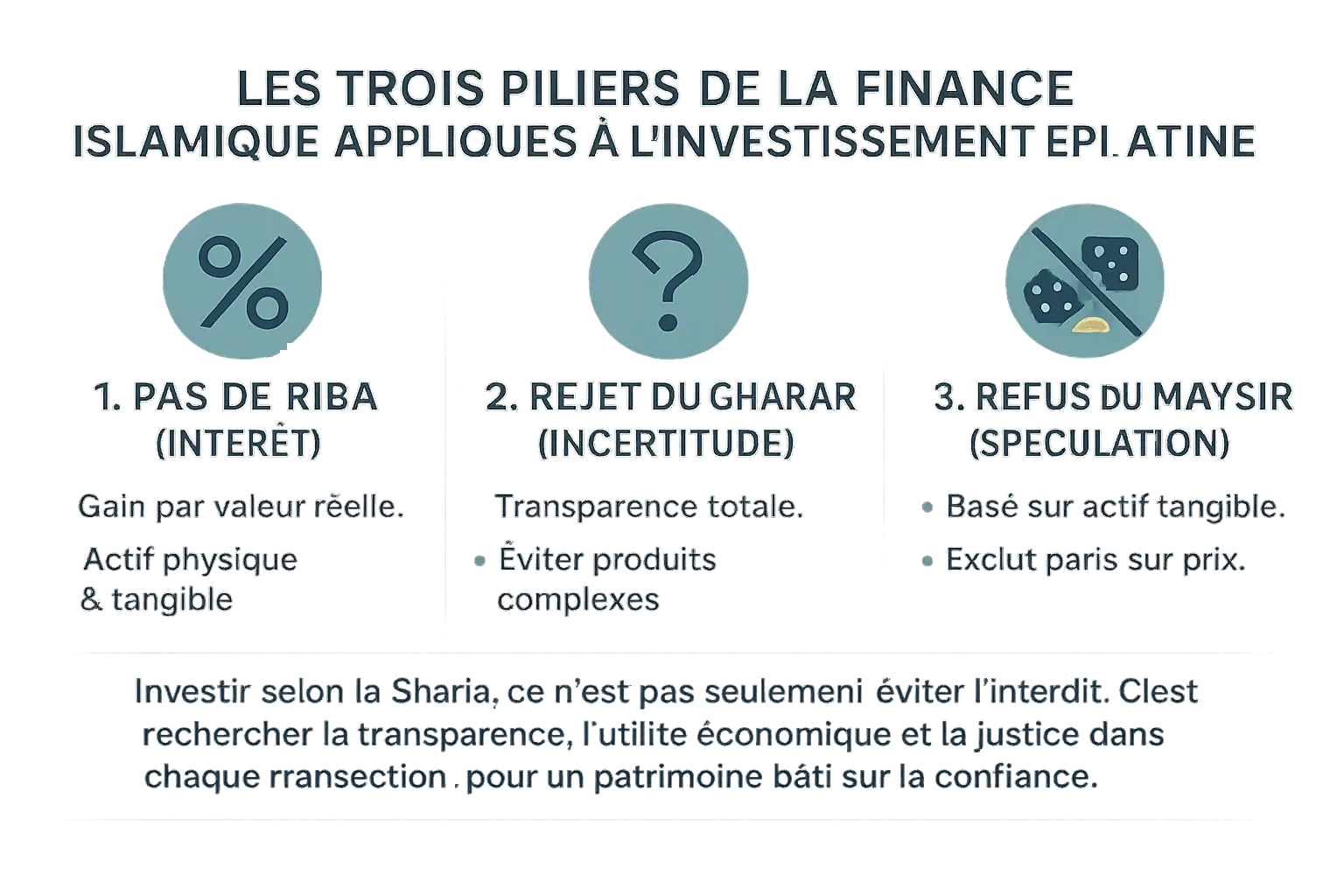
Investir dans le platine selon les principes islamiques repose sur trois fondations incontournables. Chacune d’elles garantit la conformité Shariah tout en protégeant l’investisseur contre les risques éthiques et financiers. Ces règles transforment un simple achat de métal en une démarche responsable, alignée avec les valeurs spirituelles et économiques.
L’interdiction du Riba (l’intérêt)
Le Riba, ou intérêt, est strictement prohibé. Pour le platine, cela signifie qu’un investisseur ne peut prêter son métal contre un gain supplémentaire. La valeur doit résulter uniquement de l’actif physique détenu, sans mécanisme de rendement automatique. Seuls les produits adossés à un stock réel, comme les lingots ou les ETC certifiés Shariah, respectent cette règle.
Le rejet du Gharar (l’incertitude excessive)
Le Gharar désigne toute transaction opaque ou spéculative. Pour le platine, cela implique de privilégier les solutions transparentes : lingots stockés dans des coffres certifiés, ETC avec traçabilité physique, ou contrats Murabaha détaillant le prix et les modalités. Les produits dérivés ou les certificats sans adossement réel sont à éviter.
Le refus du Maysir (la spéculation)
Le Maysir interdit les paris sur les fluctuations de prix sans possession réelle. Les CFD, contrats à terme classiques et autres outils spéculatifs sont donc incompatibles avec la Sharia. L’investissement doit reposer sur une logique de croissance tangible, comme l’achat de lingots ou la participation à des structures halal.
Investir selon la Sharia, ce n’est pas seulement éviter l’interdit. C’est rechercher la transparence, l’utilité économique et la justice dans chaque transaction, pour un patrimoine bâti sur la confiance.
La règle d’or (et d’argent) qui ne s’applique pas au platine : une nuance clé
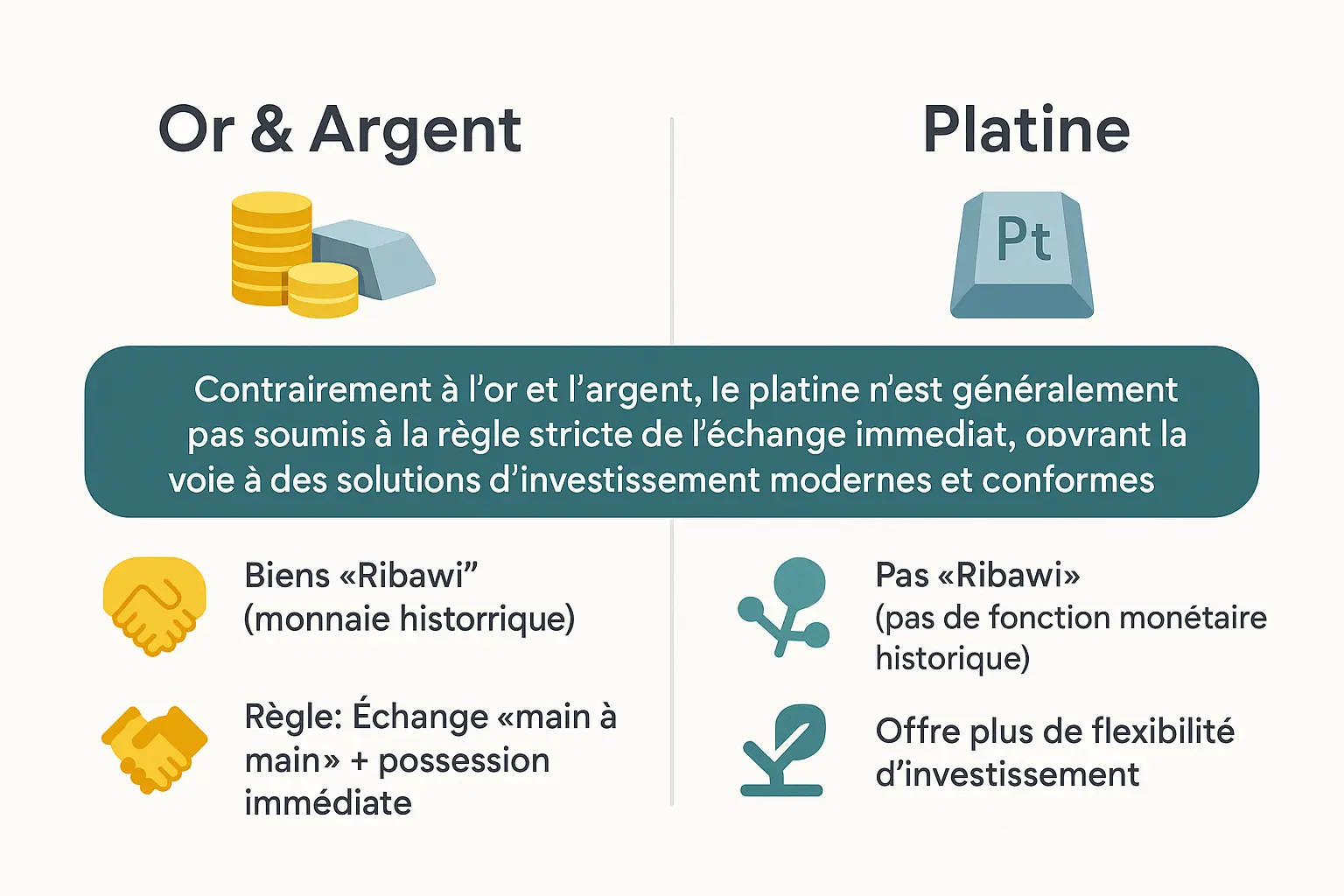
En finance islamique, l’or et l’argent sont qualifiés de « ribawi » car ils ont servi de monnaie. Un hadith oblige à des échanges égaux et immédiats pour éviter le Riba.
Pour l’or contre or, quantité et livraison instantanée sont exigées. Pour l’or contre argent, valeur égale et remise immédiate suffisent. Ces règles éliminent toute spéculation. Il est possible d investir sur l or via la plateforme Inaia découvrez notre avis sur Inaia
Le platine échappe à ce cadre : il n’a jamais eu de rôle monétaire dans l’histoire islamique. Selon les savants contemporains, il n’est donc pas classé comme bien ribawi.
Contrairement à l’or et l’argent, le platine n’est généralement pas soumis à la règle stricte de l’échange immédiat, ouvrant la voie à des solutions d’investissement modernes et conformes.
Cette distinction théologique permet plus de flexibilité. Un ETC en platine pourrait ainsi être structuré différemment d’un ETF en or, tout en respectant la possession physique et la transparence exigées par la Sharia.
En saisissant cette spécificité, les investisseurs musulmans peuvent explorer des options innovantes. Le platine, métal tangible et rare, incarne des valeurs de durabilité et d’éthique, alignées avec la finance islamique moderne.
Comment investir dans le platine halal en 2025 : les options passées au crible
Le platine, métal précieux stratégique, offre des opportunités d’investissement conformes à la finance islamique. Trois méthodes principales s’offrent aux épargnants souhaitant allier rendement et éthique. Chaque approche présente des caractéristiques distinctes en matière de conformité Sharia, liquidité et gestion des risques.
Pour faciliter votre choix, voici une comparaison claire des options disponibles :
| Méthode d’investissement | Conformité Sharia | Avantages | Inconvénients & Points de vigilance |
|---|---|---|---|
| Lingots et pièces physiques | Maximale (possession réelle) | Contrôle total, actif tangible, pas de risque de contrepartie | Frais de stockage et d’assurance élevés, liquidité limitée, nécessite un vendeur certifié Halal |
| ETC/ETP adossés physiquement | Élevée (si certifié) | Liquidité optimale (négociation boursière), frais de gestion réduits | Vérifier la certification Shariah, exiger preuve d’adossement physique, audits réguliers |
| Contrat Murabaha | Élevée (structure islamique) | Pas d’intérêts, marge connue à l’avance, transaction transparente | Pratique rare pour le platine, vérifier les marges appliquées, nécessite banque islamique accréditée |
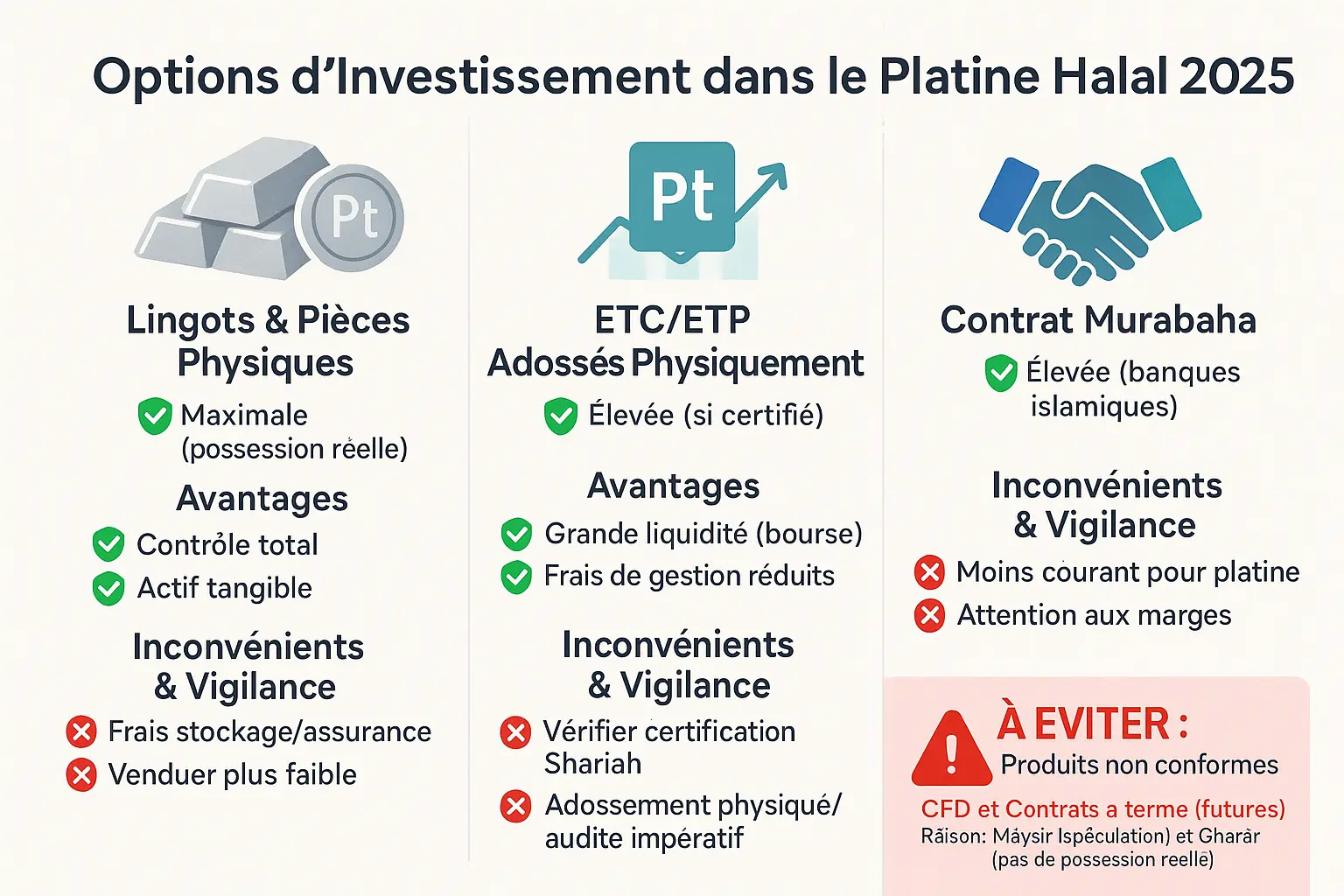
Les investisseurs doivent impérativement éviter les CFD et contrats à terme pour plusieurs raisons :
- Principe de Maysir : spéculation sans possession réelle
- Risque de Gharar : incertitude excessive sur les résultats
- Présence potentielle de Riba : frais de financement nocturnes
Les ETC (Exchange Traded Commodities) restent une solution pragmatique pour les investisseurs souhaitant bénéficier de la performance du platine sans gestion physique. Cependant, la vérification de la certification Shariah est indispensable, notamment concernant le stockage dans des coffres agréés et la traçabilité du métal. Les frais de gestion (TER) varient de 0,19% à 0,49% annuels selon les structures.
Pour les puristes, la possession physique de lingots offre une sécurité maximale. Bien que les coûts de stockage soient plus élevés, cette méthode correspond parfaitement aux principes de transparence et de matérialité exigés par la Charia. Les banques islamiques proposent également des solutions Murabaha sur métaux précieux, avec des marges préétablies et une possession réelle par l’institution financière avant revente.
Construire un avenir serein : Le platine comme diversification éthique
En 2025, le platine s’impose comme un actif rare et industriellement stratégique, alliant stabilité et conformité Sharia. Avec 70 % de sa production en Afrique du Sud, sa rareté et ses usages dans l’hydrogène ou la médecine en font une alternative solide pour un portefeuille halal.
Investir dans le platine, c’est conjuguer éthique et rendement. Contrairement à l’or interdit aux hommes, ce métal neutre permet de faire fructifier son capital en cohérence avec ses valeurs. Une démarche exigeant vigilance.
- Vérifiez la certification Shariah via des organismes comme l’AAOIFI.
- Privilégiez la possession physique ou des ETC adossés à du platine réel.
- Exigez transparence sur frais de stockage et gestion.
- Diversifiez raisonnablement : 1 à 5 % du portefeuille.
Dans l’écosystème Namlora, cet investissement incarne une finance alignée sur justice et responsabilité. Il contribue à un modèle économique durable, ancré dans les valeurs de la finance islamique.
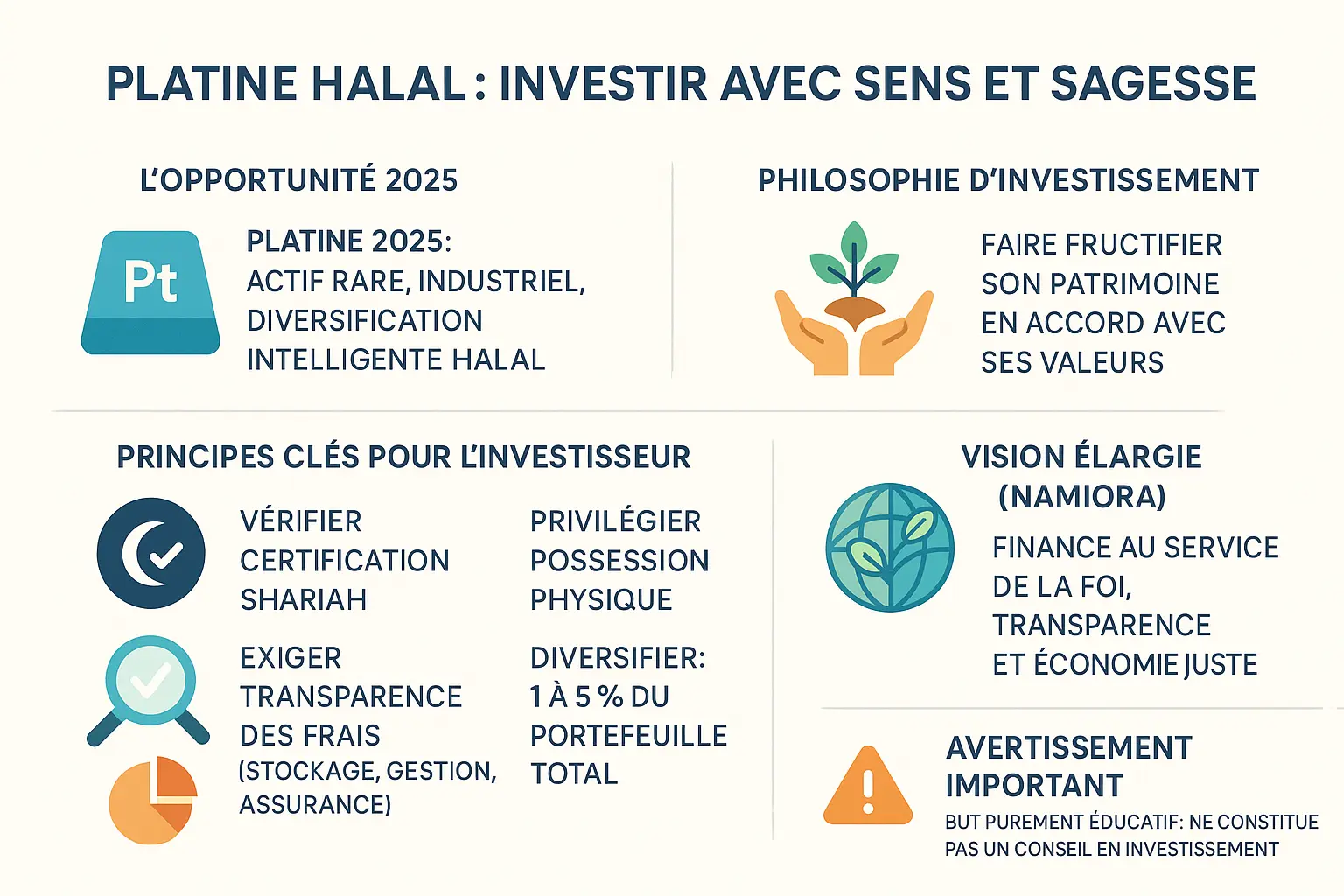
Cet article a un but purement éducatif et ne constitue en aucun cas un conseil en investissement. Prenez toujours vos décisions après avoir mené vos propres recherches.
Le platine halal se positionne comme un investissement rare, utile et éthique, alliant résistance industrielle et conformité islamique. Ressource stratégique, il incarne une diversification responsable, à explorer avec discernement, en privilégiant la possession physique et les certifications Shariah. Une opportunité pour bâtir un patrimoine aligné avec ses valeurs, dans la sagesse et la transparence.
FAQ
Comment savoir si un investissement est halal ?
Pour évaluer la conformité Sharia d’un investissement, trois critères sont essentiels : l’absence de riba (intérêts), la limite du gharar (incertitude excessive) et l’exclusion du maysir (spéculation). Dans le cas du platine, privilégiez les actifs physiques (lingots) ou les ETC certifiés Shariah, avec adossement réel et transparence sur le stockage. Une certification délivrée par un organisme reconnu (comme Amanie ou Al-Qalam) garantit la conformité.
Quel est l’instrument halal pour investir dans le platine ?
Les instruments les plus sûrs sont : les lingots physiques (possession réelle), les ETC/ETP adossés physiquement (comme les fonds WisdomTree certifiés Shariah), et le Murabaha (achat via une banque islamique avec marge définie). Les CFD, contrats à terme et autres produits dérivés sont à proscrire, car ils relèvent de la spéculation (maysir) et n’impliquent aucune possession tangible du métal.
Est-il halal d’investir dans l’or ?
L’or est un actif historique en finance islamique, mais son statut diffère du platine. En tant que bien « ribawi », il impose des règles strictes : échange « main à main » et possession immédiate pour éviter le riba. Le platine, non classé comme ribawi, offre plus de flexibilité, notamment via des ETC certifiés. Cependant, l’or reste une option conforme si les principes islamiques sont respectés.
C’est quoi un bijou en platine ?
Le platine est un métal précieux, neutre en droit islamique. Contrairement à l’or (interdit aux hommes), son port est généralement permis pour les hommes, avec une recommandation de modération pour éviter l’ostentation. Pour les femmes, aucune restriction n’existe. En bijouterie, sa durabilité et sa résistance en font un choix prisé, tout en restant conforme aux principes de la Sharia.
Comment vérifier si un produit financier est halal ?
Exigez une certification Shariah délivrée par un organisme indépendant (exemple : Amanie, Al-Qalam). Vérifiez aussi la transparence du produit : un ETC en platine doit prouver l’existence physique du métal stocké, avec audits réguliers. Enfin, évitez les produits opaques ou spéculatifs (ex : CFD) qui ne respectent pas les piliers de la finance islamique.